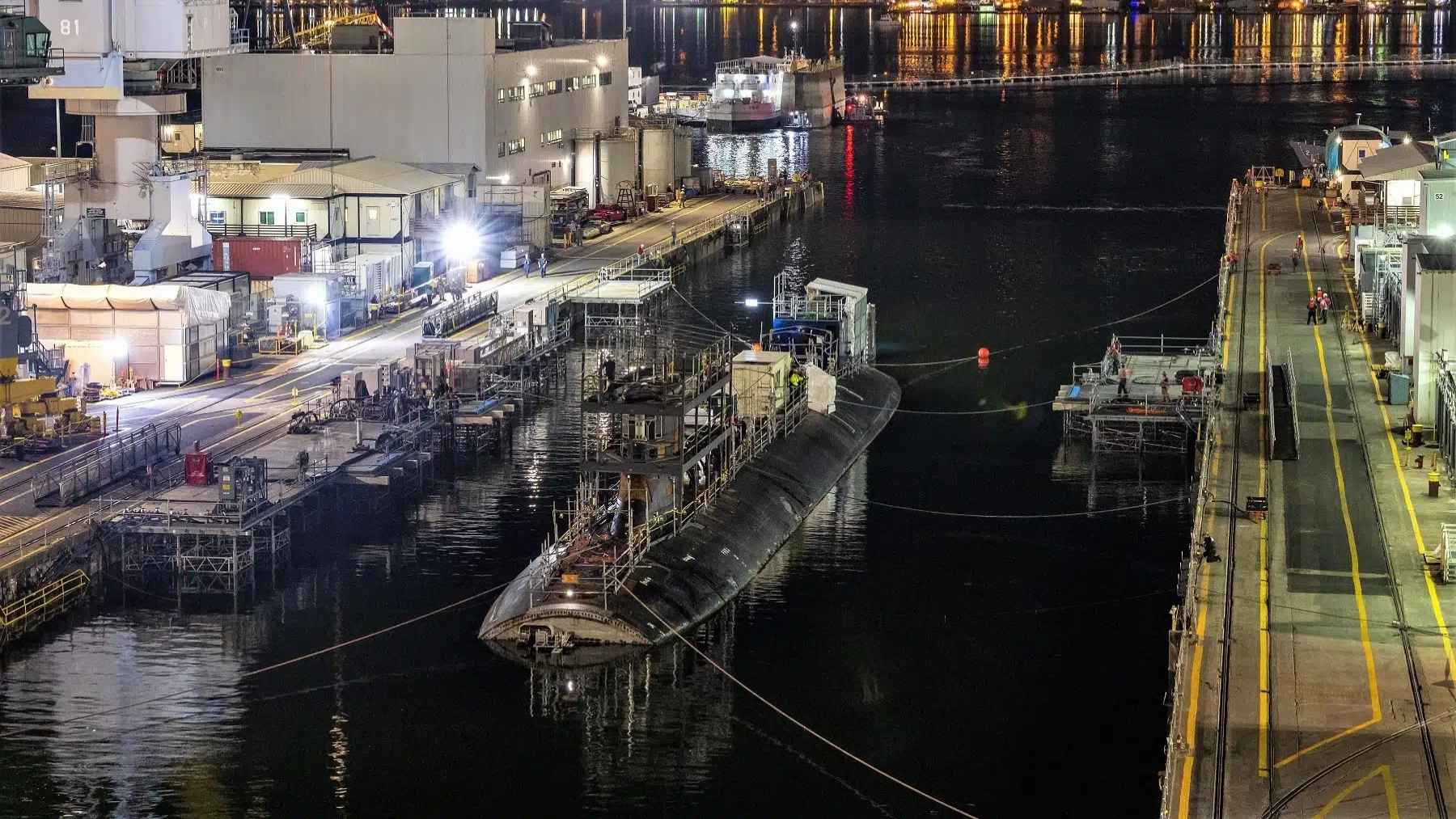

Submarines are built to be hard to find. That’s more or less the whole job description. USS Connecticut, one of the Navy’s three Seawolf-class attack boats, has been pretty easy to find for a while now, though. She’s been sitting in Dry Dock 5 at Puget Sound Naval Shipyard in Bremerton, Washington, since July 12, 2023.
And it turns out she’ll be there a while longer. On September 28, a Navy official told TWZ that the shipyard is now aiming to finish her repairs and overhaul in the summer of 2027. When that work formally kicked off in February 2023, the finish line sat at September 2025.
Figures: TWZ, Naval News, U.S. Navy.
If you haven’t been following this one, here’s how a submarine ends up out of action for the better part of six years.
The mountain wasn’t on the chart
On the afternoon of October 2, 2021, Connecticut was in the South China Sea, submerged, when she hit a seamount. A seamount is basically a mountain that rises off the seafloor and stops short of the surface, and most of them are old volcanoes. Subs on patrol don’t go around pinging with active sonar, because that would tell everybody exactly where they are. So they navigate off charts and survey data instead. According to the Navy’s investigation, this mountain wasn’t on the chart.
Eleven sailors were hurt. Connecticut came up and spent about a week on the surface getting to Guam, then made it home to Bremerton under her own power by December. Submarine Force Pacific later said the crash damaged her forward main ballast tanks and her sonar sphere, and that her sonar dome would have to be replaced. Her pressure hull and reactor weren’t damaged, according to the same officials.
If you’re not up on submarine anatomy, the sonar sphere is the big listening array in the nose, and the dome is the composite shell wrapped around it. The forward ballast tanks are what the boat floods to dive and blows out with air to surface. So, basically, she smashed up her ears and part of the plumbing she uses to go up and down.
The Navy moved fast on accountability. About a month after the crash, the commander of the 7th Fleet relieved Connecticut’s commanding officer, executive officer and chief of the boat over a loss of confidence. In the fleet’s view, better judgment and sticking to the rules on navigation planning, watch-standing and managing risk would have kept the boat off that mountain.
So why is this taking so long?
The Navy hasn’t really said. TWZ, which has tracked every finish date the service has put out, says it’s still not clear exactly why the dates keep sliding. But some of what’s slowing things down is on the record.
The dry dock needed work first. A dry dock is basically a giant concrete bathtub: you float the boat in, shut the gate and pump the water out, and the hull ends up resting on blocks where workers can reach it. Before Connecticut could go in, Puget Sound Naval Shipyard spent the spring of 2023 shoring the dock up against earthquakes, drilling into its walls to set anchors, according to the shipyard’s own release. Crews tested the dock and recertified it, and Connecticut went in on July 12.
The Navy also folded the crash repairs into a job Connecticut was already scheduled for. It’s called an Extended Docking Selected Restricted Availability, which is a mouthful, but it’s basically the big out-of-the-water overhaul every submarine gets at set points in its life. A Navy spokesperson told TWZ last year that the crash damage is being fixed as part of that overhaul. That frankly seems like the sensible way to do it, since you’d have to dry-dock her for both jobs anyway.
The Navy only built three of these
Then there’s the parts problem, which I’d bet is the biggest one. The Seawolf class was supposed to run to 29 boats before the end of the Cold War cut the order to three, per TWZ. Seawolf and Connecticut are each 353 feet long and displace 9,138 tons submerged, according to the Navy’s fact sheet, while the third boat, USS Jimmy Carter, got stretched to 453 feet for special missions. None of the three has been retired.
The Navy has fixed this kind of damage before by borrowing from a retired sister. When the Los Angeles-class USS San Francisco hit a seamount southeast of Guam two decades ago, she went back to the fleet with the bow of the decommissioned USS Honolulu, Seapower reported. Connecticut doesn’t have a retired sister. An industry source told Navy Times early on that her new dome would have to be engineered and built from scratch, and the Navy’s 2025 budget request, as TWZ reported, put the lead time on a Seawolf bow dome at more than three years.
Sister subs do have a way of sharing parts. When the World War II museum sub USS Silversides went into a Wisconsin dry dock this summer, workers found a flood valve marked for her sister boat, USS Trigger.
The Navy hasn’t put a public price on the whole job, either. Congress set aside $40 million for emergency work on Connecticut within months of the crash, plus $10 million more for the replacement dome, according to TWZ, which says the full bill for the repairs and the overhaul together still isn’t clear.
She’s due to retire in 2031
So what does Connecticut get once she’s finally out of the dock?
Not a ton of time. The Navy’s latest shipbuilding plan, released in May, has her leaving service in 2031, according to Naval News and TWZ, and TWZ reports the Navy’s already planning that retirement. If the shipyard hits its summer 2027 target, you’re looking at roughly four years back in the fleet after nearly six years out of it.
I’d call that a rough trade, but the Navy doesn’t seem to see it that way. Its own fact sheet bills the Seawolf class as unusually quiet and fast, and the Navy official who spoke to TWZ talked about putting Connecticut back “at the tip of the spear.” I wouldn’t be shocked if somebody at least runs the numbers on keeping her past 2031, although as far as I can tell, nobody’s said anything like that publicly.
USS Seawolf, the first boat of the class, is scheduled to start her own maintenance period next May and stay in it until February 2030, according to Navy budget documents cited by TWZ. With Connecticut’s target set for the summer, the Navy could spend a stretch of next year with only one Seawolf-class boat available, the Jimmy Carter.
So Connecticut’s staying put in Bremerton. The Navy official who talked to TWZ on September 28 put the shipyard’s target at the summer of 2027, and the shipbuilding plan the Navy released in May still has her leaving service in 2031.