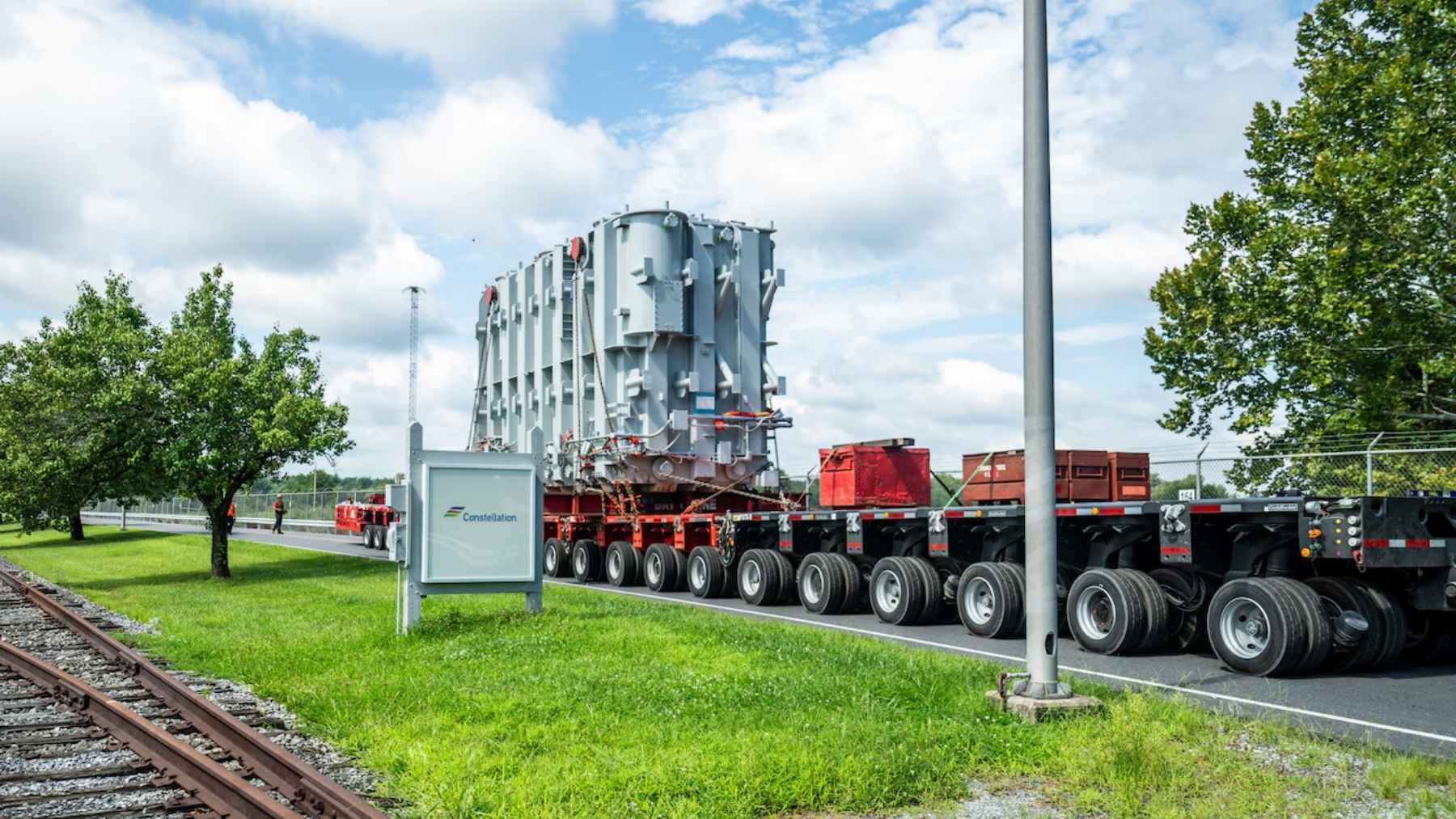

Every power plant in the country makes electricity at a voltage nobody can put on a transmission line. A generator puts out something in the tens of thousands of volts. The wires strung across the countryside carry hundreds of thousands. A transformer sits between the two and closes that gap, and on August 17 a 500,000-pound one came through the north gate at Three Mile Island a little after 11 in the morning.
Constellation had it built in South Korea. It cost $9.88 million. Two more are behind it.
Bryan Hanson, the company’s chief generation officer, called it the first big component delivered to the site, according to the Pennsylvania Capital-Star, which had a reporter at the gate. Hanson was standing on the road watching it arrive because he was the man who told the staff in 2019 that the plant was closing.
Planes, trains and automobiles, minus the planes
Hanson walked reporters through the route. A ship carried the transformer from South Korea to Baltimore. A barge took it from Baltimore to Newark. A train hauled it from Newark to Middletown, Pennsylvania. A flatbed riding on rows of small wheels covered the last stretch through Londonderry Township and onto the island. “It’s almost like planes, trains and automobiles,” Hanson told ABC27, minus the planes.
Federal rules cap a standard five-axle truck at 80,000 pounds gross on the Interstate System. This single piece of cargo weighs 500,000 pounds, which is 250 tons, or about 227 metric tons. Crews moved it again later that same week, onto a different transporter, to reach its permanent pad. That last leg ran at roughly 5 miles an hour.
The generator makes 23,000 volts and the wires want 230,000
Hanson laid out the chain in one breath for the cameras: fission makes heat, heat makes steam, steam spins the turbine, the turbine spins the generator, the generator puts out 23,000 volts. The transformer multiplies that by ten and sends 230,000 volts out to the lines.
Utilities do this for one reason. Push a fixed amount of power down a wire at a higher voltage and the current falls, and the heat a conductor wastes climbs with the square of the current. Raising the voltage tenfold cuts the current to a tenth and the resistive losses to a hundredth of what they were.
That arithmetic is why the countryside is covered in steel towers carrying quarter-million-volt lines instead of tree-trunk copper running at generator voltage. It is also why a reactor with a healthy core and a rebuilt turbine still delivers nothing if this box is missing.
Nothing else on the island does that job.
The machine on the other end of it is a Babcock & Wilcox pressurized water reactor that first got an operating license on April 19, 1974. The NRC rates it at 2,568 megawatts thermal, which Constellation converts into 835 megawatts of electricity. Everything between the core and the switchyard has been inspected or rebuilt over the past two years, and swapping a single enormous component into a plant built in the 1970s is its own discipline, the same one at work when the Army Corps replaces a 22-foot turbine runner that has been spinning since 1957.
Constellation ordered three transformers. Two will share the load and the third will sit as a spare, because a main power transformer that fails is not a part anybody pulls off a shelf. The company said in February 2025 that it had awarded the contract for all three and committed about $35 million to getting them delivered during 2026.
Constellation is quoting two restart dates and both are real
Hanson gave reporters both numbers on August 17 without blurring them. Constellation’s formal commitment is the summer of 2028. Its working expectation is 2027, and Hanson said on the site that day that the team is running ahead of the commitment and believes it can put electricity on the grid in 2027.
Joe Dominguez, Constellation’s president and chief executive, sharpened that on August 6, when the company reported second-quarter results and pointed at a restart in the second half of 2027. The earlier date exists because PJM, the grid operator covering Pennsylvania, gave the plant’s interconnection request accelerated treatment and pulled a year out of the original schedule. FERC then cleared a second piece of that puzzle in the same quarter, letting Constellation move the capacity interconnection rights of a dead Philadelphia plant across the state to Crane.
The Department of Energy’s money is a loan and it carries interest. Its Office of Energy Dominance Financing closed $1 billion for the Crane restart in November 2025, backed by Constellation’s own balance sheet. Microsoft signed a 20-year power purchase agreement in 2024 and takes the output for its data centers. Constellation says the restart supports at least 650 permanent jobs and returns 835 megawatts to the grid.
The hardware is running ahead of the paperwork
The Nuclear Regulatory Commission has not authorized this reactor to make power. Unit 1 stopped generating in September 2019, and Exelon, the licensee at the time, filed two certifications with the agency: one on June 20, 2017 saying it would permanently cease operations, and one on September 26, 2019 saying fuel had been pulled from the vessel.
Those two pieces of paper stripped the license of its authority to run a reactor. Winning it back takes an exemption plus three separate license amendments covering the operating license and technical specifications, the physical security plan and the emergency plan. On the NRC’s docket page for the plant, reviewed August 27, all four still sit without final documentation.
One piece has cleared. The NRC issued Amendment No. 307 on July 1, 2026, letting Constellation receive and hold new fuel and sealed neutron sources on site. Staff also published a draft environmental assessment and a draft finding of no significant impact on June 3, took public comment through July 8, and projects the final versions for September 2026.
The fuel comes next. Hanson told ABC27 it should reach the island later this year, arriving as solid pellets roughly the size of gummy bears.
Even a full approval buys Constellation eight years. The renewed license the NRC issued in 2009 expires on April 19, 2034, and the company notified the agency in October 2024 that it plans to file for a second renewal in the first quarter of 2029. Reactors have sat finished and idle over smaller gaps than a missing signature, which is what happened to a 500-megawatt sodium reactor on the Indian coast that spent four months critical without reaching a wire.
The opposition has not gone anywhere
Three Mile Island Alert formed after the 1979 accident and has fought this restart since Constellation announced it. Eric Epstein, the group’s chairman, told The National in August that it is litigating parts of the restart in federal court and challenging the Pennsylvania Department of Environmental Protection’s approval of a license for the reactor. Epstein also went after the plant’s draw on the Susquehanna River, saying that of roughly 440 public comments filed with the Susquehanna River Basin Commission on increased water use at the site, nearly all opposed it.
The politics around the customer have shifted too. Governor Josh Shapiro, who has backed the restart from the start, signed an executive order on data centers in August after months of complaints in Pennsylvania about noise, water and power bills, and critics said it fell short. His office told The National he still supports the arrangement between Constellation and Microsoft.
Unit 2 has nothing to do with any of this. A different company owns it, and it has been in decommissioning since the partial meltdown on March 28, 1979. Unit 1 sat next door through all of it and kept running for another 40 years, until the economics of cheap natural gas closed it in September 2019.
Crane would be the second American commercial reactor to come back from a permanent shutdown. Palisades, on the Lake Michigan shore in Covert Township, Michigan, reached NRC operations status on August 25, 2025 and took its first new fuel that October, and Holtec still had not named a startup date when it updated reporters in early July 2026. Constellation now has one transformer sitting on a pad in Dauphin County and two more to come. The NRC page for the plant, last reviewed on August 27, 2026, still lists its status as SAFSTOR.
Image credit: Megan Lavey-Heaton | mheaton@pennlive.com