
- 3 MONTHS AGO · ENERGYWhile America has 20 megawatts of cable buried seven miles off Oregon and berths that are still mostly empty, a 100-ton Swedish buoy off Portugal has been feeding a grid since 2023 and just got the certificate nobody in this industry had ever held
- 3 MONTHS AGO · ENERGYA crane set a 2.2-million-pound module five storeys tall into a Georgia reactor in a single lift, and America is now planning as many as 91 more of those reactors, held up not by cranes or concrete but by the few people qualified to sign the paperwork
- 3 MONTHS AGO · ENERGYITER just lowered a 1,100-ton sector of its fusion reactor — two and a half jumbo airliners hanging from four hooks — into a 30-meter pit in southern France almost six months early, the sixth of nine wedges and two-thirds of the machine now standing in the ground
- 1 MONTH AGO · ENERGYA 440-ton slice of steel rolled through the gates of the world’s biggest fusion experiment before dawn in southern France, the ninth and last piece of a plasma chamber that will weigh 5,732 tons welded together, and each slice already carries 93 miles of factory welds
- TODAY · THIS ARTICLEA 1,100-ton slice of the biggest reactor ever built now stands on its own support in a concrete pit in southern France, and the 88-ton steel beam that held it against the wall for months came out on a crane in under two hours, the first of nine the welders need gone
Anyone who’s spent time under a car on jack stands knows the lift isn’t the nervous part. The nervous part is pulling the stands out afterward and watching whether the car sits where you put it.
Now scale that up to something that weighs more than 1,100 tons and sits at the bottom of a concrete pit in southern France. On Wednesday, October 7, the team assembling the ITER fusion reactor pulled out its first “jack stand,” an 88-ton steel beam that had been holding one section of the machine in place for months. More than 20 people were involved, and the whole lift took a bit under two hours, according to ITER’s own account.
It’s the first time ITER’s ever taken one of these beams back out of the pit. That’s the news. And I’d argue it’s a bigger deal than it looks on paper, because every big lift at this site for the past year and a half has been about putting things in. This is the first time something came out on purpose.
So what is a radial beam, exactly?
ITER calls them radial beams, and they’re basically giant temporary props. Each section of the reactor’s plasma chamber gets wrapped in thermal shielding and bolted to two D-shaped magnets in an assembly hall next door, which turns a 485-ton steel wedge into a package of more than 1,100 tons. We watched one of those packages go down into the pit over the summer. A radial beam rides on top of it the whole way.
Once the module’s in the pit, that beam gets wedged between a steel central column in the middle of the hole and the concrete bioshield wall around the outside. The beam then holds the module steady for months while engineers align it, bolt on stability clamps, and shift its weight onto a permanent gravity support underneath. ITER says the beams run about 46 feet long and weigh 80 metric tons each, which works out to 88 US tons, or roughly 176,000 pounds.
That’s a lot of steel for a tool you’re eventually going to throw away. Then again, what it’s holding is a slice of a 5,732-ton chamber that has to line up to within a fraction of an inch, so I get it.
There are nine of these beams, one per section. The beam that came out on October 7 belonged to sector module #5, which landed on its gravity support back in August, per ITER. So the beam had already handed off its load weeks earlier. What happened last week was the last confirmation that the sector didn’t need it anymore.
Why pull it out at all?
You might wonder why ITER didn’t leave the beam where it was until everything else was finished. If it’s holding the module steady, surely more support is better?
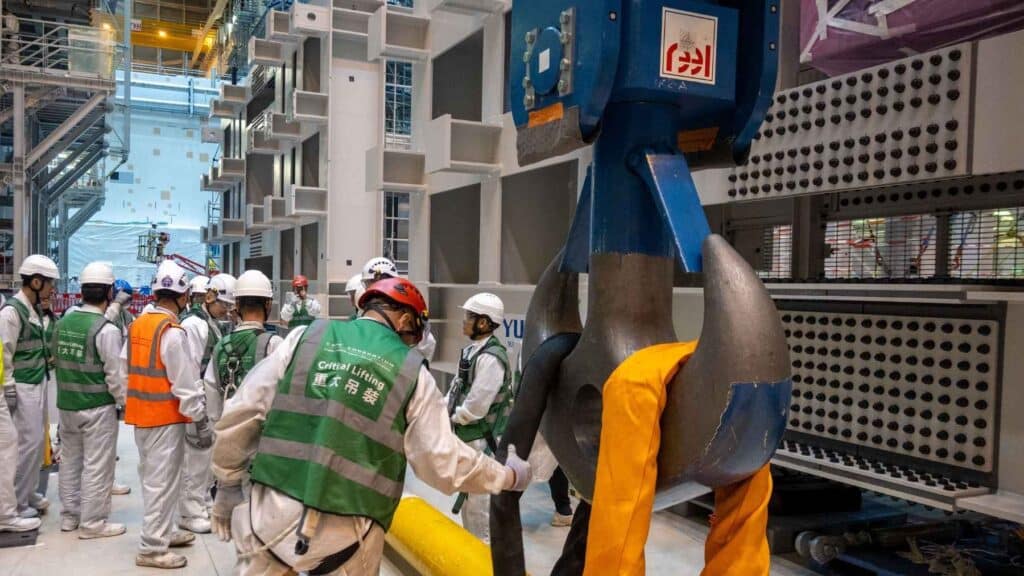
Apparently not. The beams sit right where the welders need to work. Joining nine steel wedges into one leak-tight ring means running weld seams along the edges where sectors meet, plus a pile of other assembly work on the outside of the vessel, and ITER says none of that can start while the beams are in the way. Sébastien Koczorowski, ITER’s deputy program manager for machine assembly, called the removal “the last step to demonstrate that the structure is now sufficiently stable.”
So the beam coming out isn’t the end of a job. It’s the gate to the next one.
Colin Smith, the assembly engineer who ran the extraction, said three more beams are coming out next, one right after another. ITER hasn’t said which three sectors those belong to, and it hasn’t put a start date on the welding itself, which is what I’d most like to know. From the looks of things, “soon” is the honest answer on both counts.
The welding plan changed partway through
One detail explains why this beam came out when it did. ITER’s original plan was to weld the sectors together in groups of three, then lower each welded triplet onto its permanent supports. Sometime before this spring, that plan was scrapped in favor of landing all nine sectors on their gravity supports first and then welding the whole ring at once.
Why change a plan two-thirds of the way through? Shrinkage, basically. Welding steel pulls it together as the seam cools, and on a ring this size the distortion adds up. ITER says welding all nine at once, with each sector already sitting on its own support, keeps that distortion to a minimum. It’s a pretty sensible fix, and arguably the kind of thing you’d want figured out before the sixth module went in rather than after. Still, they figured it out.
The new approach meant each sector had to come off its beam earlier than planned. The first to do it was sector #6 on May 5, when a 485-ton vacuum vessel sector was lowered onto its gravity support with about an eighth of an inch of clearance, according to ITER’s report on that transfer. Sector #5 followed in August. By the end of summer, three sectors were resting on their own supports, and ITER said that was enough to start preparing for welding.
Which brings us to the beam. Once a sector is on its gravity support and clamped, the radial beam above it is doing nothing except taking up space. October 7 was ITER proving that, on one sector, with a crane.
Eight to go
There’s a sequence here that’s easy to lose track of, so let me lay it out. Six of the nine sector modules are already in the pit. The ninth and final steel section rolled onto the site on October 2, still unwrapped and nowhere near ready to go in. ITER says the seventh module should go in before the end of this year and the last one in spring 2027.
Each one goes in with its own beam. Each one then has to be aligned, clamped, landed on its support, and checked by metrology before its beam can come out. ITER expects the last of the nine beams to be extracted in September 2027.
Then the central column goes. That steel tower in the middle of the pit is what every beam’s leaned on since the first sector arrived, and ITER has penciled in about six weeks late in 2027 to tear it down and lift it out. At that point the chamber’s standing entirely on its own supports, which is when the jack stands are finally out from under the car.
I’ll admit I didn’t expect a story about a prop being removed to be what made this project click for me. But that’s the thing about temporary tooling. You don’t notice it until it’s gone, and when it’s gone it means the real structure is holding.
ITER says the first radial beam came out of sector module #5 on October 7, 2026, with three more to follow, the final module due in the pit in spring 2027, and the last beam scheduled for removal in September 2027.
 A 1.8-megawatt wind turbine on a 257-foot tower, with 132-foot blades reaching nearly 400 feet, is one of four to be lowered by crane this fall at Ohio’s first commercial wind farm after more than 20 years, and crews will then excavate foundations about 33 feet deep, due by mid-DecemberEnergy · 1 day ago
 A 1,050-ton slab at the bottom of a 115-foot Ontario shaft is the foundation of the Western world’s first grid-scale small reactor, and the 300-megawatt machine meant to stand on it will now be late, because its engineering is still being finished as the concrete goes inEnergy · 1 day ago
 A 529-ton reactor pulled out of a German nuclear cargo ship has sat empty of fuel in a concrete shaft near Hamburg for 45 years, and regulators just cleared the hall where it will be cut into pieces and packed for disposal, part of a 17-year teardown of the research site around itEnergy · 2 days ago