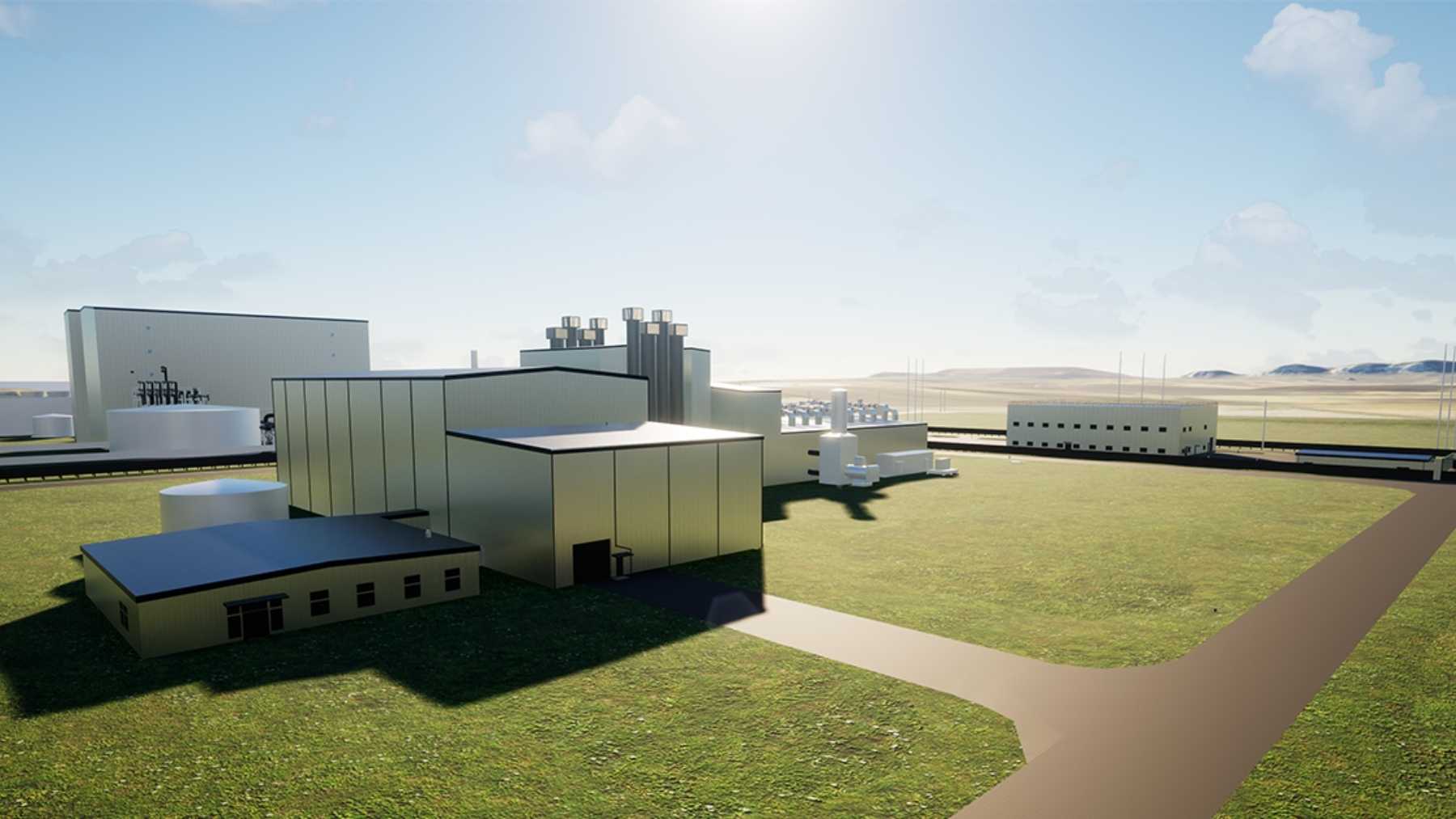

American nuclear has spent this whole year talking about sodium. TerraPower’s Natrium plant in Wyoming is a 345-megawatt reactor with a molten salt tank that lets output spike to about 500 when the grid needs it, and construction has started. Oklo’s Aurora at Idaho National Laboratory is rated by regulators at a 75-megawatt maximum, is meant to be trucked to a site, and cleared a federal safety review this summer.
Both are real. Both have paperwork. Neither has fissioned an atom, and neither is close to putting electricity on a wire.
The largest machine of that type outside Russia is already lit. It sits on the Tamil Nadu coast in southern India, it is rated at 500 megawatts of electricity, which is more than Natrium’s 345 and Aurora’s 75 added together, and it started a self-sustaining chain reaction at 8:25 on the evening of April 6. It has not delivered a watt to anyone since, and the reason has nothing to do with sodium.
The reactor is India’s Prototype Fast Breeder Reactor, PFBR if you want to sound like you work there. India’s Department of Atomic Energy confirmed first criticality the next morning. It was designed by the Indira Gandhi Centre for Atomic Research and built and commissioned by BHAVINI, the state company that exists specifically to run this machine and the ones meant to follow it.
The entire reactor sits in a tank of liquid metal
PFBR is a pool-type design, which means the core, the primary pumps and the heat exchangers are all submerged in the same tank of molten sodium, and that sodium never leaves the tank.
The World Nuclear Association records 1,750 metric tons of sodium coolant delivered to the site back in 2014, and rates the reactor at 1,250 megawatts of heat for its 500 megawatts of electricity. Fast reactors of this kind run at roughly 930 to 1,020 degrees Fahrenheit (500 to 550 Celsius) at close to atmospheric pressure.
That last part is the actual selling point, and it is the same one being made in Wyoming. A water reactor has to be built like a bank vault because the coolant wants to flash to steam. Sodium stays liquid without the pressure, hauls heat better than water, and barely slows neutrons down.
Keeping neutrons fast is the whole job. Water would moderate them and the breeding stops working. The tradeoff is that you are storing several hundred tons of a metal that burns in air and reacts violently with water, at temperature, for a 40-year design life.
Mixed oxide in the middle, uranium-238 wrapped around the outside
The core runs on uranium-plutonium mixed oxide, the plutonium coming out of spent fuel from India’s existing heavy water reactors. Around that core is a blanket of uranium-238.
Uranium-238 is 99.3 percent of natural uranium and it cannot sustain a chain reaction by itself. Hit it with fast neutrons and some of it turns into plutonium-239, which can. That is the trick that makes the machine a breeder: it manufactures fuel while it burns fuel, and it is built to end up ahead.
The World Nuclear Association puts the core breeding ratio at 1.11, so about 11 percent more fissile material comes out than went in, and lists a design fuel utilization of roughly 75 percent against about 0.3 percent for the heavy water reactors that make up most of India’s fleet. DAE says the blanket is designed to eventually hold thorium instead of uranium. There is no thorium in there now.
Right now the holdup is two power lines and a bill
Here is the part almost nobody covered, and it is the part worth reading if you care about Wyoming. India’s Southern Regional Power Committee held its 238th operation coordination meeting on May 11, and the minutes went up on May 25. DT Next reported what is in them.
BHAVINI told the committee the reactor was already critical and in stage-wise commissioning, and that phased injection into the grid is planned from December onwards. Not September, which is the date the department had given a parliamentary panel earlier. December.
The company also asked for something more basic than that. It wants two 230 kV lines running from the plant to Kancheepuram energized from the substation end. Both are charged from the reactor side. Neither is in service from the other end.
That is not about selling electricity. Redundant offsite power is a technical requirement for operating a nuclear plant at all, and BHAVINI told the forum the missing redundancy is a compliance problem during commissioning.
The Tamil Nadu load despatch centre said charging the lines was held up by commercial issues, with a clarification still awaited from the state distribution company’s regulatory wing, and noted that BHAVINI has not declared a commercial operation date. BHAVINI countered that its dues to the national grid company have been paid, and that bay charges were split with the state transmission utility from 2014 to 2019 before it started carrying the full cost itself in 2019.
The regional committee’s secretary made the obvious point, which is that a commercial dispute should not be tied to an operational requirement on a project of this size. The committee treated the line charging as a priority item, suggested the state could issue conditional approval, and told BHAVINI to come back by November with detailed injection schedules.
Two decades of sodium metallurgy, and the last mile is a substation and an invoice.
First concrete went down in October 2004
Construction started in 2004 on a schedule that had the reactor starting up around the end of 2010 and generating power in 2011. It went critical in April 2026. That is twenty-one and a half years between the concrete and the chain reaction.
The last stretch moved faster than the rest of it. India’s atomic energy regulator issued permission for initial fuel loading, first approach to criticality and low power physics experiments on October 16, 2025, according to a parliamentary answer filed that December. Criticality followed just under six months later.
DAE named the people standing there when it happened: Ajit Kumar Mohanty, secretary of the department and chairman of the Atomic Energy Commission; Sreekumar G. Pillai, director of IGCAR; Allu Ananth, chairman and managing director in charge at BHAVINI; and K.V. Suresh Kumar, a former BHAVINI chief. That is a lot of signatures for one press release, and it reads like a program that wanted every one of them on the record.
Russia is still the only country doing this for a living
Russia has run the BN-600 at Beloyarsk on the grid since 1980 and added the 864-megawatt BN-800 in 2014. Nobody else has managed a sustained commercial fast reactor, and the graveyard is well populated. France closed Superphenix. Japan gave up on Monju after a sodium fire. Germany finished a breeder at Kalkar and turned the site into a theme park instead of switching it on. Russia is now assembling a lead-cooled successor in Siberia.
Indian officials have said that once PFBR holds commercial operation, India becomes the second country after Russia with a commercial fast breeder. That claim carries an asterisk, because China has two 600-megawatt CFR-600 units on an island off Fujian. The first has been running at low power since late 2023, and no grid connection has ever been announced for either one.
One more difference worth stating plainly: the World Nuclear Association notes PFBR is not under International Atomic Energy Agency safeguards. India published the criticality date, the timestamp and the names anyway.
What is still open at Kalpakkam
No commercial operation date has been set. The breeding ratio of 1.11 is a design figure, not a number measured in this reactor at power. The blanket is uranium, not thorium, so the payoff India keeps describing is still a plan rather than a fuel load.
The loop is not closed either. The Fast Reactor Fuel Cycle Facility going up alongside the reactor, the plant that would reprocess spent fuel and pull the bred plutonium back out for the next core, is not expected to be finished until December 2027, according to Nuclear Engineering International. A breeder that cannot recycle what it breeds is an expensive way to make 500 megawatts.
The next date that means anything is November, when BHAVINI is supposed to hand the grid operators an injection schedule. If those two lines are energized by then, December survives. If they are not, the reactor keeps sitting there, hot, critical and unplugged.
Which is the useful thing to take from all of this if you are watching Wyoming. Criticality is a physics event. Commercial operation is a grid event, a regulatory event and an accounting event, and those three run on a clock that does not care how good your liquid metal engineering is.
TerraPower has the harder half of the job still in front of it, and it is not the half with the sodium in it.