
An armed patrol boat has a problem nobody puts in the brochure: staying still costs almost as much fuel as going somewhere. Engines idle, generators turn, and the tank drains while the boat does nothing but watch. That is the bill a Michigan company called Voltaic Marine is trying to delete, and the way it went about proving the point was to bolt a weapons turret into the nose of a boat that runs on sunlight.
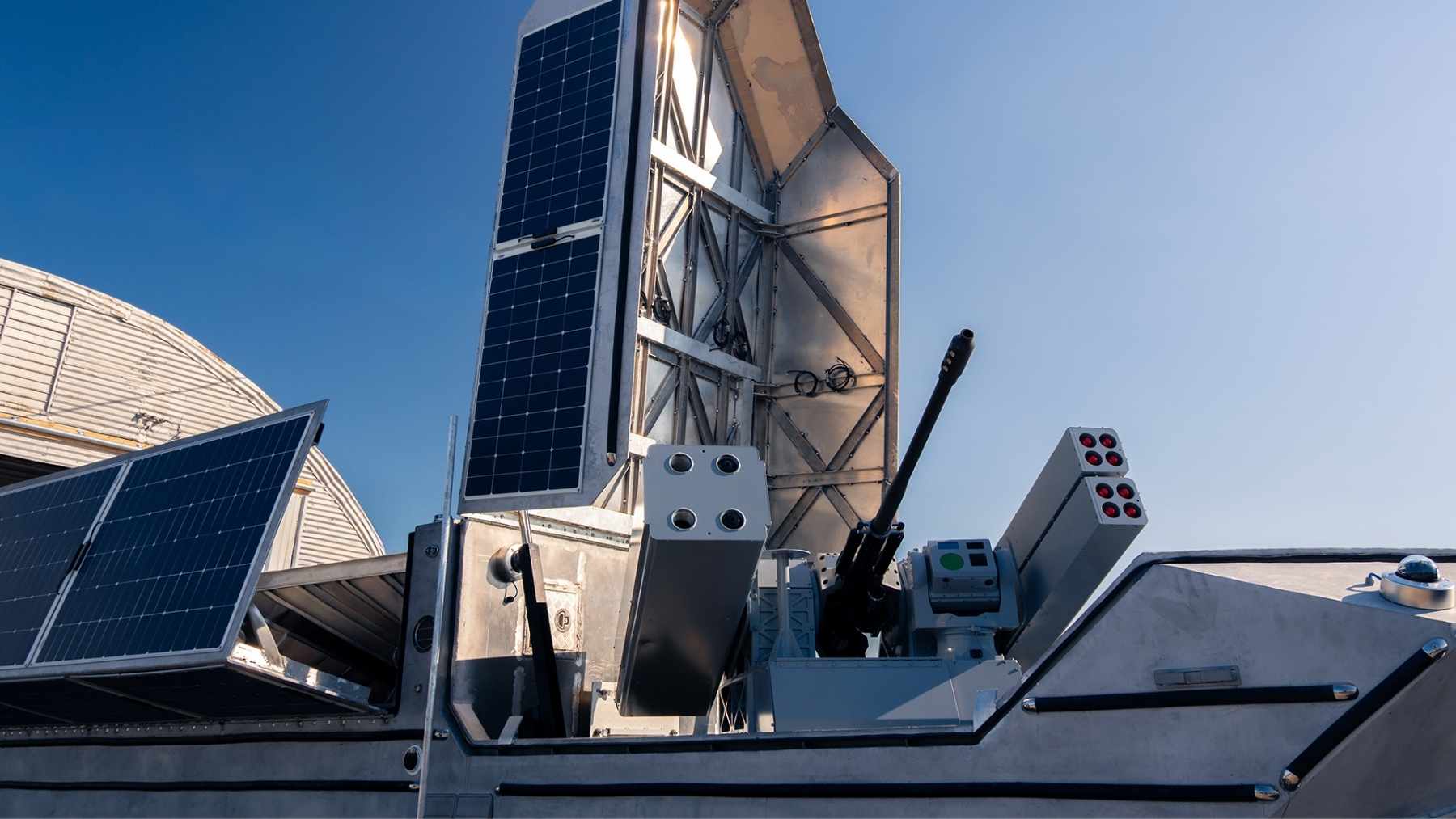
Moog announced on August 24 that it had demonstrated its Reconfigurable Integrated-weapons Platform, or RIwP, aboard Voltaic Marine’s AEU39 uncrewed surface vessel during the U.S. Navy’s Coastal Trident Demo. The turret sat inside the boat’s bow, under a hinged armored hatch that lifts when the system needs to engage and lies flush the rest of the time.
The AEU39 is 39 feet long, aluminum, and wrapped in solar panels along the full length of the hull.
Voltaic says the shell generates 5 to 6 kilowatts and feeds a 300 kilowatt-hour battery. Below roughly two knots, the company’s own specification sheet puts the daily arithmetic at 24 kilowatt-hours harvested against a 2.5 kilowatt-hour station-keeping draw. The boat gathers more than nine times what it spends sitting there. Fuel burn on station, per the same sheet: zero gallons a day.
The energy math is the whole pitch
Every other number on the AEU39 exists to serve that one. Voltaic lists a 22-knot top speed, which works out to about 25 mph, and a range of more than 5,000 nautical miles, or roughly 5,750 statute miles. Two modular bays carry a combined 4,000 pounds. A gyro-stabilized deck is rated through Sea State 4, and power for the payload runs through an 800-volt to 12-volt conversion system.
None of that is unusual for a workboat hull. What changes when you remove the fuel bill is how long the thing can loiter, and loitering is what a defensive picket does for a living. Voltaic describes the combination as capable of keeping a turret “on watch for weeks at a time,” as reported by The Defence Blog.
Solar-powered uncrewed boats are not new. Australia ordered 40 more Bluebottles that harvest sun, wind and wave and stay out for six months, and the U.S. Army has been running small solar drone boats as escorts in the Philippines. Those boats carry sensors. This one carried a gun mount.
A turret from a Stryker, shrunk to a third of the weight
RIwP is not a naval system by birth. Moog won the competition in 2018 to supply the turret as the centerpiece of the Army’s Maneuver Short-Range Air Defense program, now named SGT Stout, riding on the Stryker A1. The initial ground configuration packs a Northrop Grumman XM914 30 mm Bushmaster, four Stinger missiles in a Raytheon launcher, two Longbow Hellfires and an M240 machine gun.
The version that went to sea is far smaller. Moog says it keeps full commonality with the standard RIwP while running roughly one-third of the weight, and that the configuration can integrate a 30 mm cannon and multiple missile effectors. Moog described its Lightweight RIwP in those same terms when it unveiled that turret at AUSA in October 2025 for light tactical vehicles like the Infantry Squad Vehicle.
The commonality claim is the interesting part for anyone who has to pay for this stuff. Moog puts subcomponent commonality across the RIwP family at 85%, which means shared spares, shared software and shared training between a turret on a Stryker and a turret in a boat’s nose.
Jason Weiss, general manager of Moog’s Land and Sea business unit, framed the collaboration as taking what worked for RIwP on land and moving it to the water.
What the Navy actually saw
Moog’s statement says the demonstration proved the turret’s detection and tracking capabilities aboard the AEU39. Detection and tracking. The company did not announce a live firing, and Military Embedded Systems reported the same scope on August 26.
The Defence Blog went further and listed what stayed unsaid: Voltaic disclosed neither the date nor the location of the trials, nor the customer or program, nor whether the turret carried live weapons, nor what performance data came out of it. So the 30 mm cannon belongs in a sentence about what this turret can mount, not what this boat was carrying.
Coastal Trident itself is worth knowing. The Port of Hueneme and the Naval Postgraduate School’s Center for Asymmetric Warfare set it up in 2007, and it now runs out of Naval Surface Warfare Center Port Hueneme Division as a series of technical demonstrations and field experiments conducted between June and September 30 each year. Companies bring hardware, the Navy watches it work, and nobody signs a purchase order on the beach.
Why anyone wants a gun on a boat that cannot be heard
Electric propulsion gives the AEU39 a low acoustic and thermal signature, which Voltaic sums up as holding position without announcing it. A diesel picket announces itself constantly. That matters less against a warship with a radar horizon and more against the cheap, small, numerous things that navies now spend their days worrying about.
Richard Phamdo, CEO of Voltaic Marine, made the cost argument in Moog’s announcement, saying a reconfigurable mount lets “operators match the cost of the intercept to the cost of the threat.” Shooting down a $2,000 quadcopter with a million-dollar missile is a losing trade, and the answer the industry keeps landing on is a gun with a good sensor on the same mount.
That same logic showed up on land two weeks ago, when an American firm pitched a 660-pound remote turret with a 30 mm cannon for trucks the Army already owns. At sea, BlackSea Technologies put missiles in a bow-mounted launcher on its 43-foot Comet drone boat, and Textron’s rocket-armed Tsunami went to the Caribbean. Everybody is arriving at the same intersection from a different road.
Voltaic’s contribution is the endurance half. Moog builds the turret, the Navy is shopping, and the AEU39 supplies a hull that can hold a weapon in one place for a long time without a fuel truck behind it.
How much of this is a boat and how much is a brochure
Voltaic puts the AEU39 at Technology Readiness Level 7, patent pending. TRL 7 means a prototype demonstrated in an operational environment. It does not mean production, and it does not mean anybody has bought one.
The company says the first article went in the water in the summer of 2026 with hull, battery, solar shell, mast and autonomy suite fitted, and has been in trials on the Great Lakes since. Voltaic also says the boat travels by road trailer, launches off a boat ramp, ships inside a 45-foot high-cube container and fits aboard a C-17 or a C-130.
Every performance figure in this piece comes from Voltaic Marine or Moog. No third party has published independent measurements of the solar harvest, the range or the endurance, and the companies have not released the trial data.
Voltaic Marine builds wake boats for a living. The AEU39 rides on the same propulsion, energy and hull architecture the company uses across its consumer and commercial lines, which is the boring industrial reason a small Michigan builder can put a hull in the water at all.
The part to watch next
A turret that can see is not a turret that can shoot, and Moog has not said when the AEU39 configuration fires anything. The Coastal Trident program year closes on September 30, with an open house at Port Hueneme wrapping up three months of exercises.
Moog dated its announcement August 24, 2026. Richard Phamdo’s company has one AEU39 in the water, on the Great Lakes, at TRL 7.