
If you’ve watched enough convoy footage out of Ukraine, or the Red Sea, you already know the problem. A cheap quadcopter with a grenade zip-tied to it will punch a hole in a truck that costs several hundred thousand dollars, and the tidy answer was supposed to be a jammer. Then the drones started flying on a fiber-optic cable, or guiding themselves in the last few hundred yards without asking GPS for help, and a lot of those jammers started looking like very expensive radios.
So the current fashion in defense booths isn’t another purpose-built anti-drone vehicle. It’s a kit you bolt onto the truck you already have.
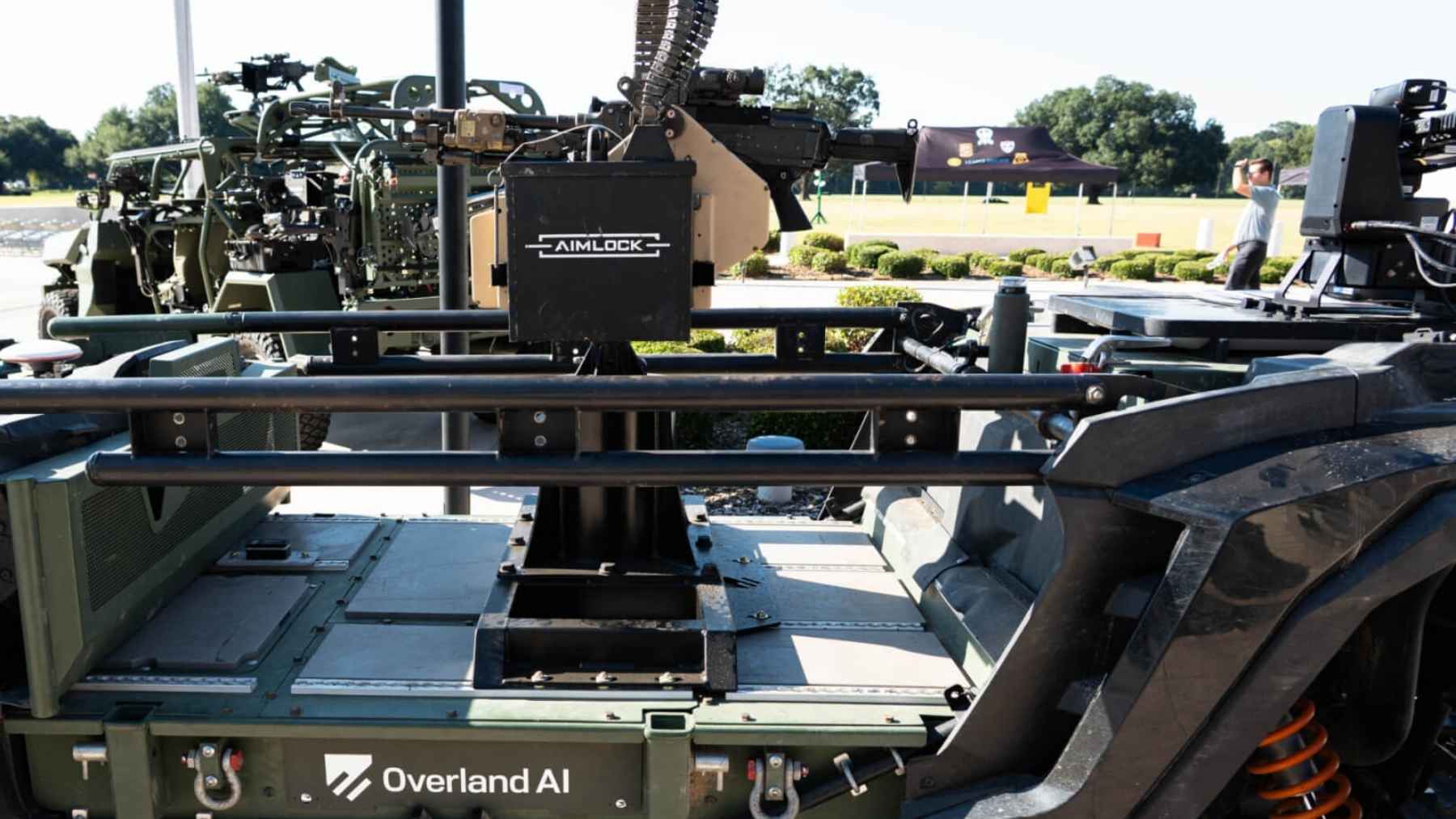
That’s what AimLock and FN America walked into SOF Week 2026 with. They call the package Dune. On May 19, the first day the Tampa Convention Center halls were open, they parked it on a six-wheel utility vehicle and said the FN DEFNDER Medium remote weapon station (FN spells it that way, with the E doing whatever FN decided an E should do) can be taught to spot a small drone, figure out what it is, and point a gun at the right piece of sky. A person still has to approve the shot.
The gun is the part they already know how to buy
Dune is two products stacked. The hardware is FN America’s DEFNDER Medium, a remote weapon station the Belgian parent, FN Herstal, has been iterating on for years. The computer is AimLock’s Keystone Core Targeting Module, the same autonomy stack the Denver company has been trying to hang on other people’s weapons since it finished its first counter-UAS boxes in 2018.
The station is the reason this isn’t locked to one caliber. AimLock’s own list for Dune is 30x113mm, 12.7x99mm (.50 cal), and 40x53mm, plus airburst, proximity-fuzed, and ordinary ammunition. That mix is not an accident. A 30mm cannon firing a proximity-fuzed shell is what you want for a one-way attacker or a fixed-wing scout at range. A .50 cal is cheaper per shot and has already been used to bring down Shaheds and Gerans in Ukraine, as Calibre Defence noted when it covered the Tampa display. A 40mm grenade launcher does a different job again. Being able to pick, or convert a station a unit already owns, means you are not buying three turrets for three fights.
The 30mm version is the one that changes the envelope. At Eurosatory 2024, FN Herstal started offering the DEFNDER Medium with a Northrop Grumman M230LF 30x113mm cannon, or as a reversible conversion kit for stations already in the field. Frag Out’s write-up of that upgrade put the 30mm station under 31.5 inches tall and about 660 pounds with the gun and 50 rounds, with an effective reach of up to 2,000 meters, or about 1.2 miles. Keep that last number in your head. A proximity-fuzed 30mm shell with a mile of reach is genuinely bad news for a Group 1 or Group 2 drone.
The 30x113mm chambering is also the one the U.S. Army already buys drone ammunition for. Northrop Grumman’s XM1211 is a high-explosive proximity round in that exact case: it only has to pass close enough for the fuze to notice. AimLock did not name that cartridge. It did say Dune will shoot proximity-fuzed 30x113mm. You can do the logistics math yourself.
AimLock’s box does the math. A person still has to say yes.
Change the gun and the fire control has to know new ballistics, new time of flight, new recoil. Handling that in software is the whole point of the “open architecture” line every defense company is repeating this year. AimLock’s pitch is that Keystone is that software: it fuses the sensors, classifies the target, writes a firing solution, and moves the turret. Calibre Defence, working off the companies’ materials, also noted that the DEFNDER needs extra computing power to run it. You are not just dropping in a thumb drive.
The human stays in the loop. AimLock’s language is “supervised” engagement. The sensors pick up the aircraft, the software works out what it is and where it will be when the round arrives, and the mount slews itself. Somebody in the vehicle still has to approve and fire. If you were hoping for a fully automatic drone-swatter, this is not that press release.
Bryan Bockmon, AimLock’s CEO, has been blunt about where a box like this sits. Talking to Business Insider at SOF Week 2025, a year before Dune existed, he put the company’s counter-drone logic next to electronic warfare: “If that doesn’t work,” he said, “this is the last line of defense.” He also told BI the company finished its first counter-UAS systems in 2018 and then watched them sit on a shelf while everyone waited to see whether jamming would carry the fight. It increasingly does not. Fiber-optic FPVs ignore a radio jammer completely. A drone that homes on what it sees does not need GPS. Which leaves kinetic (actually shooting the thing down) as the fallback that has to work.
In Tampa this May, Bockmon made the procurement version of the same argument. “It’s critical to provide them with solutions that don’t require complete system overhauls, but instead upgrade the platforms they already have,” he said in the companies’ announcement. That’s the sentence they want a program officer to underline.
The companies also list a pile of other jobs for the same box: convoy escort, base defense, even shooting at trucks. Strip the brochure and it means the station is supposed to ride along on a Thursday when nobody is flying drones at you, and still earn its keep.
They put a 30mm on the smallest truck that would hold it
The story that writes itself is that this kit hops from a Humvee to a Stryker before lunch. AimLock and FN America have not published a time-to-swap figure, and they did not show Dune on a Humvee, an MRAP, or a Stryker in Tampa. What they have said, and what FN already said about the DEFNDER Medium, is that the station is built for light, medium, and heavy vehicles. That is the class those trucks live in. It is not the same thing as a filmed install.
The demo hull was a six-wheel BC Customs UTV, the SXV-XL-6X6. AimLock puts the payload at 4,500 pounds and the deck at 46 square feet, and says it rolls on and off a CH-47 Chinook without extra shoring. Picking a Chinook-portable truck as the demonstrator is a deliberate flex. It is about the smallest, lightest thing you could reasonably bolt a 30mm cannon to. If the station works on that, getting it onto an eight-wheeled Stryker is a mechanical problem, not a software problem.
FN already sells the DEFNDER Medium for light, medium, and heavy vehicles, with a universal cradle and the usual options: laser rangefinder, two-axis gyro stabilization, ballistic protection. The modular language is not new. The new part is AimLock’s computer sitting on top of it, and the claim that you can retrofit the kit onto stations already in inventory. The Army has already been shown a version of this idea with a different turret and a commercial radar: keep the gun you have, change the software. Dune is that argument with FN’s name on the hardware.
Leonardo brought a Stryker. These guys brought a kit.
Dune is not the only counter-drone toy the Army is being walked past. The louder pitch is Leonardo DRS’s C-UAS Directed Energy Stryker, which loads up basically everything. The War Zone’s Joseph Trevithick wrote it up on October 11, 2024, when Leonardo put video out: an 8×8 armed with a laser, laser-guided 70mm rockets, a 30mm cannon, radars, and other sensors. The company then showed the vehicle at AUSA that same month.
The build is an EOS R400-series station with a Northrop Grumman XM914 30mm and a 7.62mm M240B, an Arnold Defense launcher for BAE’s APKWS II rockets, and BlueHalo’s LOCUST laser at 26 kilowatts, stored in the hull and popped up when something needs burning. Leonardo and BlueHalo say they ran a two-day live-fire for Army officials in Socorro, New Mexico, in September 2024 and knocked down every drone they shot at, including near-simultaneous laser and 30mm shots.
That’s the maximalist approach: one dedicated air-defense node with every effector you can think of. Dune is the opposite play. Instead of a bespoke drone-hunting Stryker, you take the trucks you have and give them a bolt-on upgrade. Both solve different problems. The Leonardo vehicle is a specialist. Dune is force protection you can, in theory, spread across a convoy.
One difference is worth being honest about. The Stryker has a published live-fire scorecard. Dune, as of SOF Week, was a static display on a UTV in an outdoor booth. AimLock and FN America are pitching, not delivering. I have not found a public program of record for either offering as a dedicated counter-drone fleet. Whether Dune is the thing that gets bought is a different question.
A kit is only a kit if a motor pool can move it
The interesting test isn’t a polished booth in Tampa in May. It is whether the retrofit story survives a soldier trying to do it at 2 a.m. with wet gloves on. That’s the exam every “modular” defense product eventually fails or passes, and AimLock has not published the stopwatch.
If it passes, the model gets copied fast. You’d end up with a small number of certified counter-drone kits circulating between whatever vehicles the mission needs that week, instead of dedicated air-defense variants sitting in a corner of the base being useless the 90 percent of the time nobody is shooting drones at you. That’s a better use of money than another bespoke Stryker, even if it lacks the marketing appeal of a laser and rockets on the same chassis.
Until somebody films the swap, Dune is a smart pairing of a gun the Army already understands and a computer AimLock has been sitting on since the jamming-will-save-us years. The last line of defense is just a polite way of saying: shoot it. The kit only matters if the truck you already own can do that by Thursday.