
If you’ve ever crawled along the interstate behind a flatbed with an “OVERSIZE LOAD” banner and a pilot car flashing away in front of it, you’ve seen the small end of the heavy haul business. That’s usually half a prefab house or a bundle of steel beams, and it gets where it’s going before dinner. The big end of the business looks like what just wrapped up in Australia, where one piece of electrical gear spent four days on the road, under police escort, on a route that skipped the closest port on purpose.
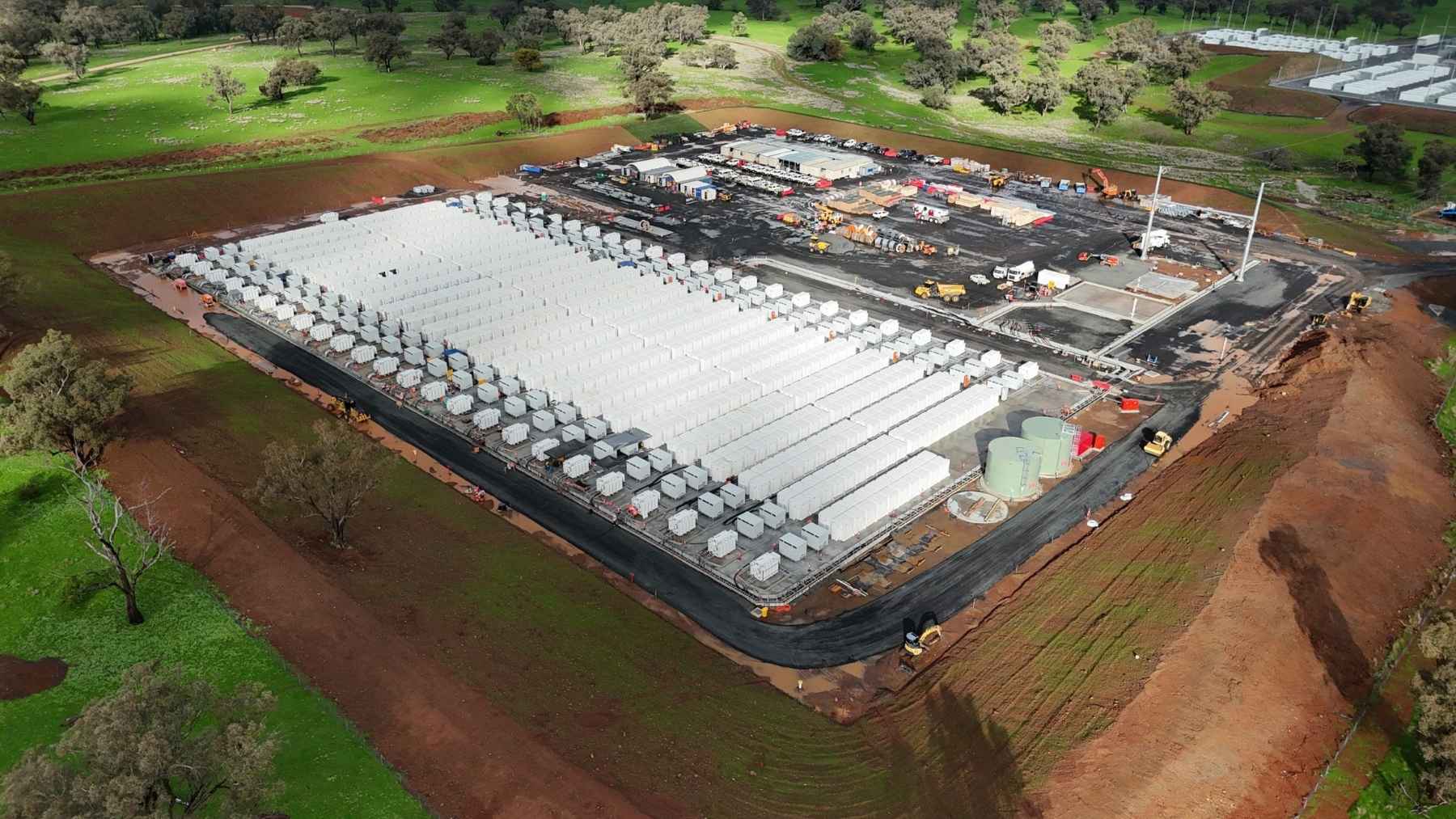
The gear in question is a transformer, built by Siemens, that weighs 215 tons. In mid-September it rolled onto the Bulabul battery site near Wellington, in the central west of New South Wales, after an 808-mile trip from a port near Adelaide, which is pretty much the drive from New York to Chicago. RenewEconomy, the Australian outlet that reported the delivery on October 4, puts the complete convoy at 380 tons and 233 feet long.
So why drive 808 miles when there’s a port a lot closer?
The closer port came with hills
The Port of Newcastle sits roughly 560 road miles closer to Wellington than Adelaide does, and it’s already handling oversize loads for the Uungula wind farm next door, where RenewEconomy says about 900 turbine parts are being trucked in over a 250-mile route. On paper, that’s the obvious place to land a transformer.
Ampyr Energy, the Singapore-backed developer building the battery, went the other way. According to RenewEconomy, the company and its logistics people judged the costs and the planning from Adelaide to be more favorable, and the road out of Adelaide has what they called a relatively flat profile. The weight of the load was a factor too, which is a polite way of saying 380 tons and hills don’t mix.
That’s the whole story, and frankly it’s the more interesting half of it. You can read it as: 560 extra miles of flat highway beat a shorter run through the Great Dividing Range. Nobody involved has published the exact route, so I can’t tell you whether the convoy clipped a corner of Victoria on the way or stayed in South Australia and New South Wales the whole time. I’d love to know how many axle lines were under it, too, and Ampyr hasn’t said.
Here’s why flat matters so much. A 380-ton convoy on a modular trailer isn’t limited by horsepower going up a grade so much as by what happens coming down the other side, where the brakes and the pavement have to deal with all of that mass wanting to keep going. Add bridges that have to be rated for the load one by one, and tight bends where a 233-foot train has to swing wide, and a hilly road starts costing money in permits and road upgrades before the first truck moves. Four days at crawling speed on a flat road is, arguably, the cheap option.
The Australian term for this kind of move is OSOM, for Oversize Overmass, which is basically their version of a superload permit. Every state the load passes through signs off on it, and the police ride along.
What a battery farm needs a transformer for
You may be wondering why a battery needs a 215-ton lump of copper and steel in the first place, since the batteries themselves come in shipping containers that any semi can carry. The answer is voltage. The containers put out power at a few hundred volts, smaller transformers around the site bump that up into the tens of thousands, and the grid next door runs at 330,000. The big transformer is the last step on that ladder, and for a plant this size it has to be enormous, with the iron core and the copper windings sitting in a tank full of oil to keep them cool.
Bulabul sits right next to Transgrid’s Wellington substation, which Ampyr describes as a key node on its 330-kilovolt network. So the transformer doesn’t have far to reach once it’s bolted down. It just had a very long way to come.
Which gets us to what the thing actually feeds. The headline number on this project is 400 megawatts and a gigawatt-hour of storage, and that’s accurate for the finished plant. But Ampyr is building it in two stages. The one under construction now, with Fluence supplying the batteries, is 300 megawatts and 600 megawatt-hours. The second stage adds 100 megawatts and 400 megawatt-hours and, as far as I can tell, hasn’t started building yet. The New South Wales government puts the full 400 megawatts at enough to power up to 52,000 homes in the state.
The name is worth a sentence, since it’s not a typo for something else. Bulabul means “two acting together” in Wiradjuri, and the local Aboriginal community holds a 5 percent stake in the project through an organization called Wambal Bila. That’s pretty unusual for a grid battery anywhere, let alone one this size.
Two weeks later, a heavier one did a longer trip
If 808 miles sounds like a lot, it didn’t hold the record for long. On October 17, RenewEconomy reported that a 269-ton transformer had left the same Port of Adelaide and covered 1,345 miles to the New England solar farm in northern New South Wales. That one measured 36 feet long and over 14 feet high, rode on an 18-axle modular trailer with several prime movers front and back, and stretched the convoy to about 230 feet. The hauler was an Australian outfit called Ares Group, which is also the company running the Uungula turbine parts up from Newcastle.
Whether Ares moved the Bulabul transformer too, I can’t confirm. Nobody’s named the carrier.
Australia is doing a lot of this right now, apparently all at once. We’ve covered the 292-foot turbine blades crawling 186 miles through the Pilbara desert in daytime-only convoys, and over in Germany a 279-foot blade came down on its own truck when a trailer’s hydraulics gave out in a mountain curve. That last one is a decent reminder of why planners get picky about grades. Closer to home, the 474-ton steam generators that went 22 miles to a US reactor show how slow even a short superload move gets once the weight climbs past 400 tons.
Put those next to each other and the Bulabul move looks like a pretty reasonable piece of logistics, from the looks of things. A heavier load than the blades, a longer road than the steam generators, and a route choice that traded distance for easier ground. It’s the kind of decision that reads as odd in a headline and obvious in a spreadsheet.
So what happens now?
The transformer getting there means the electrical side of the build can start in earnest. Ampyr said in a LinkedIn post quoted by RenewEconomy that the arrival “marks an exciting turning point for the project,” with the high-voltage installation, testing and commissioning now underway. RenewEconomy expects the plant to move into commissioning relatively soon, and I’d read that as months rather than weeks, since energizing a 300-megawatt battery isn’t something you rush after hauling the transformer 808 miles to get it there.
Ampyr has said it wants the second stage of Bulabul running in 2027, and the company lists Bulabul as the first of several grid batteries it plans to build in Australia. As of RenewEconomy’s October 4 report, stage 1’s 215-ton transformer is on site and the high-voltage work has begun.