
Most of the wave energy machines we’ve covered here are big. There’s the 160-ton MARMOK-A-5 buoy feeding the grid off Bilbao, the Swedish buoy that rode out 61-foot waves off Portugal, and an Oregon test site seven miles offshore built to host machines like them. Wave power tends to go large, partly because anything you leave in the ocean has to survive the ocean.
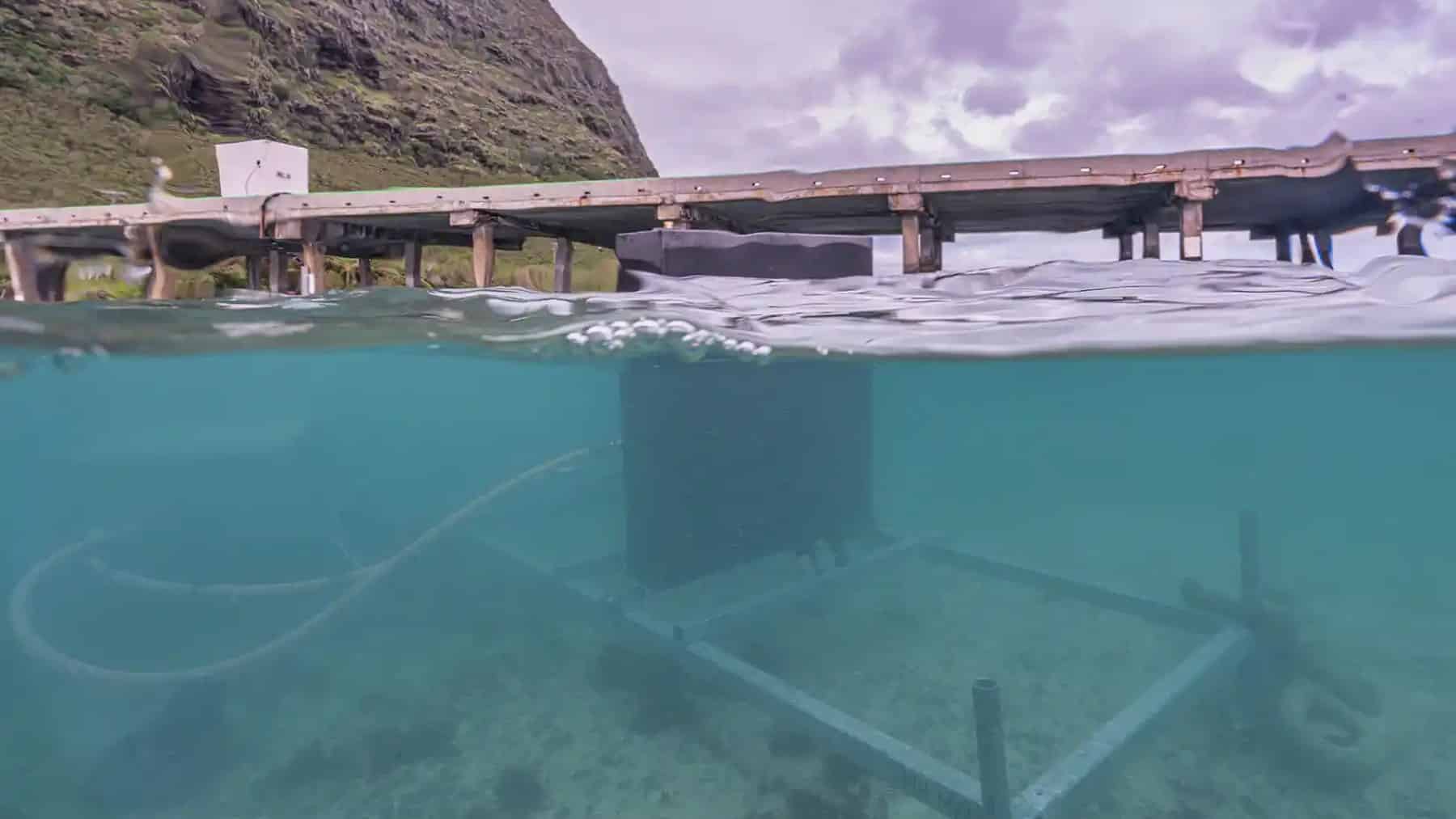
So the thing sitting in a few feet of water off Oahu is a bit of a change of pace. It’s a flap a little over 3 feet on each side, and it’s been rocking back and forth with the waves next to a research pier since March, turning that motion into electricity.
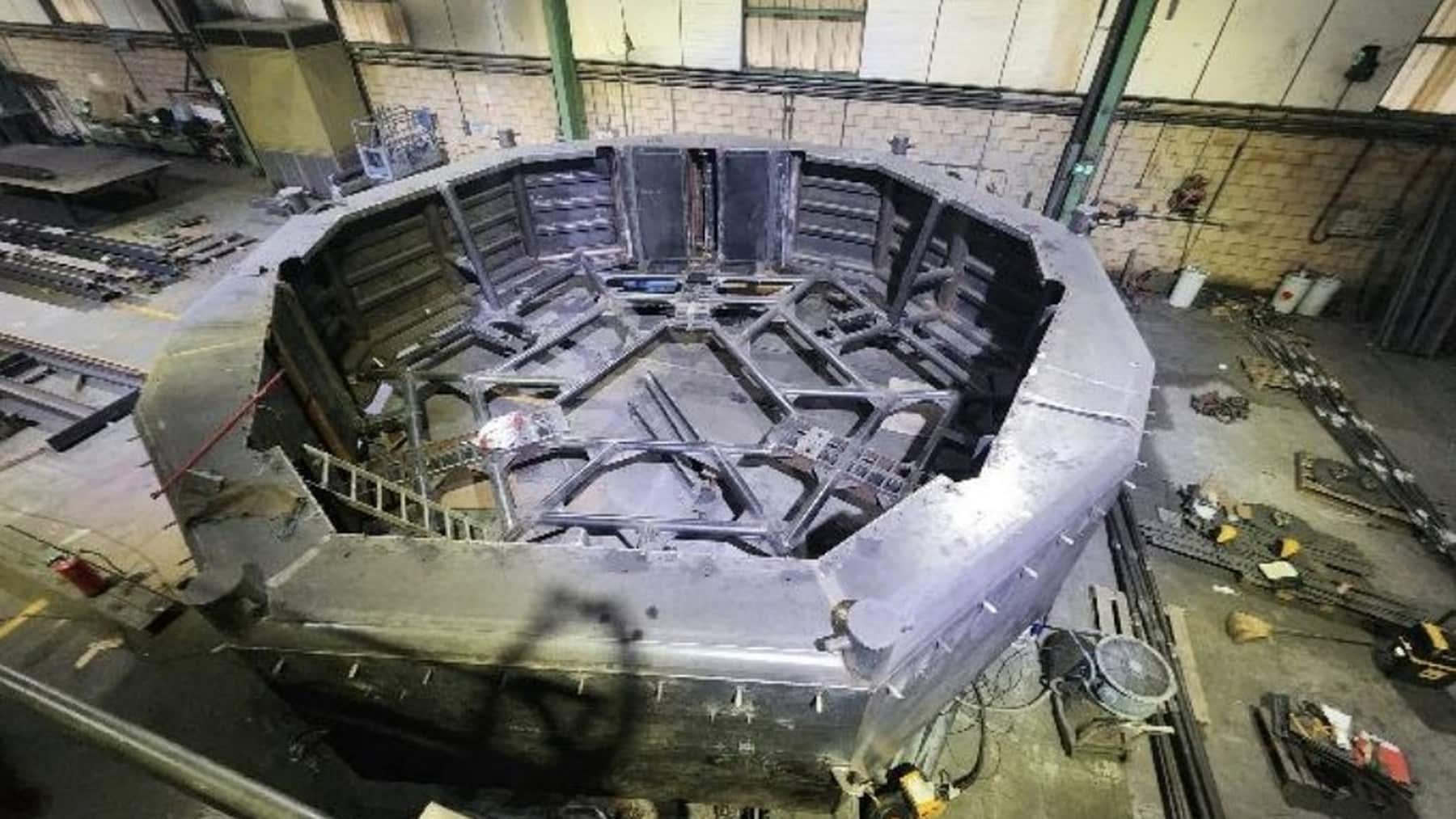
It’s called SURF-WEC, short for Small Underwater Research Flap Wave Energy Converter. That’s a lot of name for a flap the lab itself compares to a big-screen TV.
The project is a joint effort between the National Laboratory of the Rockies (the Colorado lab that was called NREL until the Department of Energy renamed it last December) and the Hawaii Natural Energy Institute, or HNEI, at the University of Hawaii at Manoa. NLR did most of the power take-off engineering, which basically means the hardware that turns all that sloshing into electricity. The Hawaii side handled the anchoring, the deployment and the testing on Oahu, and the flap itself came out of HNEI’s existing research work. DOE’s Hydropower and Hydrokinetic Office is paying for it.
The University of Hawaii’s School of Ocean and Earth Science and Technology (SOEST) put out an update on the project on October 30, and trade outlet Ocean News & Technology ran it on November 2. But this isn’t brand-new hardware. NLR first wrote it up on September 2, and by then the flap had already been in the water for more than five months.
So how does a flap make electricity?
First, a quick bit of context, because “ocean energy” covers a few very different machines. Tidal turbines are basically underwater propellers that get spun by currents as the tide floods in and drains out, a cycle that takes hours. Wave energy converters work off the waves themselves, which roll past every few seconds.
SURF-WEC is what engineers call an oscillating surge converter. In shallow water, a lot of a wave’s energy shows up as water sloshing toward the beach and then back out again. Stand a buoyant flap up in that water and it gets shoved back and forth, like a door that can’t make up its mind.
That rocking drives a hydraulic cylinder. The cylinder pumps fluid around a sealed loop, and pressure builds up in a part called an accumulator. Once the pressure hits a set level, the fluid spins a hydraulic motor, and that motor turns an electric generator.
If you’ve got a private well at home, you’ve probably seen a version of this already. The pressure tank on your well stores pressure so the pump doesn’t have to kick on every time someone opens a faucet. The accumulator does a similar job here, taking a flap that’s never moving at the same speed twice and evening it out into something a motor can actually use.
The team hasn’t published the pressure that sets it off, and NLR hasn’t given a rated output for the generator either. I went through the project’s webinar slides looking for one and came up empty. Which is fair enough, since this thing isn’t trying to sell power to anybody.
DOE’s environmental review for the project adds a couple of details, with the caveat that it was written before anything went in the water. It describes the hydraulic fluid as a biodegradable, vegetable-oil-based fluid, with less than 35 gallons in the whole system. It also puts the generator on shore, with divers hooking the device’s hydraulic and electrical lines up to cables run out from the pier.
NLR built the hydraulic system first and tested it dry at its Flatirons Campus in Colorado, using an electric actuator to fake the push and pull of the ocean. Then it all got shipped out to Hawaii, where it’s been ever since.
It went in right as a storm showed up
The site is Makai Research Pier, near Waimanalo on Oahu’s windward side. According to the team’s slides, the device had to sit less than 100 feet from the pier, in water 3 to 5 feet deep, with every bundle of gear coming in under 1,000 pounds.
That weight limit makes sense once you know how it went in. Kimball Millikan, the HNEI marine energy research engineer who led the deployment, has said it took nothing more than a handful of people and a forklift to get it all in. The slides put two divers and a couple of swimmers on that list. The flap went in at high tide, and its top barely broke the surface.
The timing wasn’t great, though. A Kona low was headed for the island. That’s a cool-season storm system that swaps Hawaii’s usual trade winds for winds out of the south and southwest, and it can dump a lot of rain. So the team put the frame in first and came back two days later, once the storm had passed, to install everything else. The slides call it a historic storm and note the state was under an emergency proclamation at the time.
So what’s the point of 1.7 watts?
The team did share how much power the flap has made, and it’s pretty modest. As of August 11, when the project was presented in a public webinar, SURF-WEC had spent 146 days in the water and produced 5.9 kilowatt-hours, which works out to an average of 1.7 watts.
In one snapshot from the slides, with a significant wave height of about 1.4 feet and waves rolling through about every four seconds, the flap averaged 6.4 watts. Significant wave height is roughly the average of the biggest third of the waves, so picture knee-high surf, give or take. Admittedly, nobody’s putting those numbers on a billboard.
So why bother? Because of the data. Bri Friedman, an NLR researcher on the project, said in the SOEST release that the marine energy community is “so data-starved,” and I think she’s got a point. As she put it, there haven’t been many deployments, and a lot of the ones that did happen didn’t leave behind data other people could get at.
SURF-WEC streams its readings to a live public feed, and NLR plans to publish a final report anyone can read. The data system behind it, which NLR calls MODAQ 2.0, was developed at the lab and then sealed up and reinforced so it could survive at sea.
The other reason it exists is an argument engineers have mostly been having on computers. In passive mode, the flap just takes whatever the waves give it. In active mode, the control system adjusts how the flap responds to each incoming wave in real time, which should capture more energy. That’s the theory, anyway. The catch is that the sensors, controls and adjustments eat some power of their own.
Friedman summed up the problem pretty neatly in NLR’s write-up: “Active systems generally outperform passive systems in models, but reality is a different story.” The team can switch SURF-WEC between the two modes remotely, in real Pacific surf, which is arguably the most useful thing about it.
Some of the lessons are pretty basic
The slides are also refreshingly honest about what went wrong. My favorite is a fitting sold as 316 stainless steel, the marine-grade stuff, that rusted within 24 hours of going in the water. It also turned out to be magnetic, which 316 stainless isn’t really supposed to be. So it wasn’t 316 at all.
There’s more where that came from. The team used a different torque sensor than planned because the original part had a 14-week lead time. And every time the setup lost power, a programmable load in the system had to be restarted by hand, which cost about three hours each time. None of that’s glamorous. But if you’re the next team trying to put a wave machine in the water, it’s probably more useful to you than the wattage.
Then there’s the paperwork. Getting permits took about two years, according to the slides, and involved NOAA, the Army Corps of Engineers, the Coast Guard and Hawaii’s Department of Land and Natural Resources. All for a flap a little over 3 feet across.
The team plans to keep SURF-WEC in the water for up to a year, which would take it into next spring if it makes it that long. Senu Sirnivas, the NLR principal investigator leading the work, has said they’ll share what they’ve learned either way, even if the flap comes out early.
NLR last updated its write-up on October 29, and the lab says the final report will be public once the testing wraps up.