
Most solar horror stories you hear involve a pushy salesman, a 25-year loan and a power bill that didn’t shrink nearly as much as promised. A fire on the roof doesn’t usually make the list. But the company that ran a huge frozen-food warehouse in Los Angeles says a fire on the roof is exactly what it got, and it’s now asking a judge to make someone pay for it.
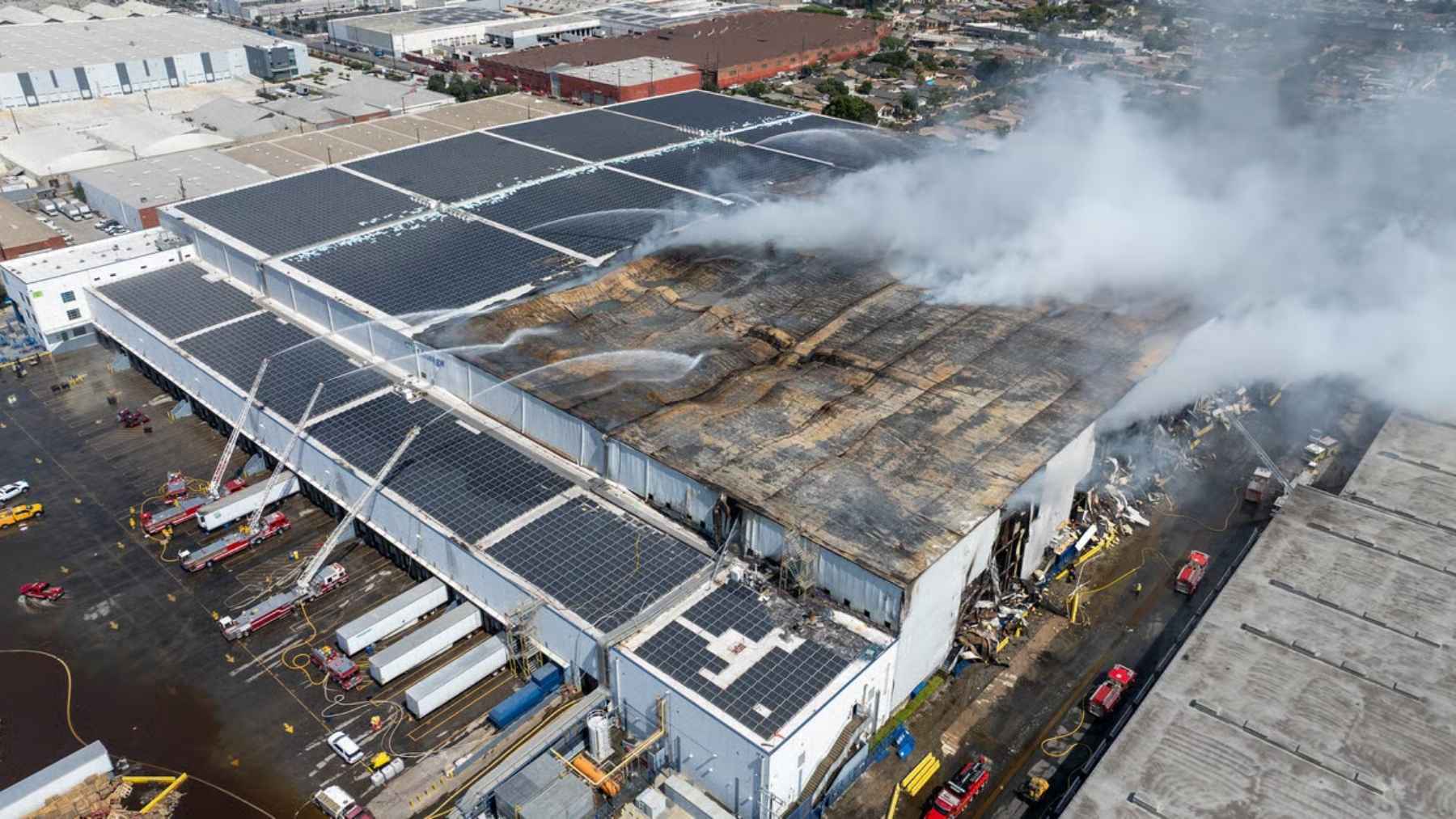
Lineage, which runs cold-storage warehouses all over the world, filed suit on September 10 in Los Angeles Superior Court. It’s going after Altus Power, which owns the solar array on the building’s roof, the Altus subsidiary Los Palos Street Operating, and Pearce Services, a CBRE-owned contractor Altus brought in to work on the panels. Lineage’s announcement blames them for the June 17 fire, which wrecked the warehouse it ran in Boyle Heights, just east of downtown, and The LA Local reports it’s seeking more than $1 billion in damages.
If you’ve never wondered where frozen chicken sits between the port and the grocery store, it’s buildings like this one. Lineage’s own explainer basically compares the place to the freezer in your kitchen, scaled up to warehouse size and cooled by an industrial ammonia system. According to the Los Angeles Fire Department, this one had about 85 million pounds of food inside when it caught fire.
So what actually burned?
The roof, to start with. The fire was reported around 2:30 p.m., and LAFD Chief Jaime Moore told NBC Los Angeles “it was a surface fire on the solar panels.”
It didn’t stay up there. About 15 minutes in, a suspected ammonia leak pushed crews off the attack, and firefighters ended up pouring water on the building from outside. LAFD even called in water-dropping helicopters, and Moore said he’d only seen that done on a building fire once before in his 31 years with the department. When a fire chief is fighting a warehouse like it’s a brush fire, you know the day has gone pretty badly.
Firefighters declared a knockdown on June 24. That’s fire department shorthand for the flames being under control and the fire no longer able to spread, which isn’t the same thing as out. Lineage says the debris kept flaring up until the Fourth of July weekend, and cleanup couldn’t really start until July 7.
Lineage says this roof had caught fire before
The lawsuit goes back further than June. According to Lineage, the same array started a smaller roof fire in August 2024, one that firefighters put out in under an hour. The company says it demanded extra safety measures before the panels could be switched back on, and Altus hired Pearce to reconfigure the system.
By May of this year, Lineage says, more than 200 connector failures had turned up across the array, some of them in the part of the roof where the June fire later started. The LA Local, which went through the complaint, puts about 10 of them near that spot. And pv magazine reports the suit describes loose bolts and mismatched jumper connections.
So why do bad plugs matter so much? A big commercial array is basically a huge number of panels wired together in long chains, and every link in those chains is a plug carrying hundreds of volts of direct current. A plug that’s loose, or that doesn’t quite fit its partner, heats up, and that’s how you end up with an electrical arc. I haven’t seen the complaint spell out what “mismatched” means. In the solar trade, though, it usually refers to one brand’s connector clicked into another brand’s, which the National Electrical Code only allows when the pair is certified to work together.
Then there’s the timeline. Lineage says it told Altus in writing on June 11 not to switch the array back on until key safety tests had been finished. The suit claims the array had been live since June 5 and stayed that way right up to June 17, when the fire started while Pearce workers were on the energized system. If that holds up in court, it’s a pretty ugly stretch of paperwork for Altus and Pearce.
I haven’t found a published count of how many panels were up there. The complaint, per pv magazine, says they covered an area equal to eight football fields, so I worked it out. An NFL field with its end zones is 57,600 square feet, which puts eight of them at about 460,000 square feet. LAFD put the whole building at nearly 491,000. So yes, the panels covered pretty much the entire roof, which makes the array about a fifth the size of the solar farm on a closed Maryland landfill we covered this week, except this one was sitting on top of a freezer full of food.
Altus and Pearce aren’t buying it
As you’d expect, the other side tells it very differently. Los Palos Street Operating called Lineage’s statement “riddled with misinformation” in a response carried by ABC7, and said Lineage, as the tenant running the building, is the one legally on the hook for the cleanup. It also argued that some of the damage came from what was released from the warehouse itself rather than from the solar panels, and said it’ll fight Lineage in court.
Pearce told The LA Local it’s cooperating with the fire department and that it’s “premature for anyone to draw conclusions.” And technically, that’s where things stand. LAFD still hasn’t released an official cause.
Lineage’s own announcement doesn’t hedge at all. “This was a solar fire, not a warehouse fire,” it reads, a line I suspect was written with a courtroom and a city council in mind at the same time.
The cleanup took most of the summer
With the refrigeration gone, the food inside was left to rot. The South Coast Air Quality Management District says it logged 4,900-plus odor complaints starting July 12, with several hundred a day at the worst of it. It also hit Lineage with 39 notices of violation for public nuisance.
The company’s own updates describe workers in protective gear climbing into racks six stories tall, with roughly 40 miles of shelving between them, to push rotten product down by hand because heavy equipment couldn’t reach it. I don’t envy a single one of them.
The company says the last of the food was out by August 29. On September 5, the South Coast AQMD confirmed crews had finished power washing and disinfecting the freezer building that’s still standing. By Lineage’s count, the whole job took more than 210,000 worker-hours and produced more than 89 million pounds of food waste.
Wait, 89 million?
LAFD put the food inside at about 85 million pounds, and Lineage’s own estimate of what was on the shelves is closer to 88 million. My guess is the difference is packaging, debris and some of the water crews poured in, which at one point ran around 12,000 gallons a minute. Lineage hasn’t broken the number down, though.
So can’t you just switch the panels off?
Not really, and it’s one of the less obvious things about solar. A panel makes electricity whenever light hits it, so killing the power to a building doesn’t make the roof safe. That’s why newer rooftop systems have to include something called rapid shutdown.
Since the 2017 edition of the National Electrical Code, rapid shutdown generally means knocking the wiring inside the array down to 80 volts or less within 30 seconds of someone hitting the switch. It’s arguably one of the more sensible rules in the code. It’s built around firefighters, though, rather than a crew working on a live array. I can’t find anything public on what shutdown equipment this array had, or when it went in. If you’ve had panels put on your house in the last few years, there’s a good chance you’ve got a switch outside with a “rapid shutdown” label on it, and now you know what it’s for.
Los Angeles isn’t waiting on the lawsuit, either. Mayor Karen Bass froze the processing of Lineage’s rebuild paperwork with an executive order at the end of July, after the company had already filed plans to put the warehouse back up.
On September 16, the Los Angeles City Council voted unanimously to hold back any permits to rebuild it until the fire department has finished investigating. Councilwoman Ysabel Jurado, who represents Boyle Heights, introduced a motion the same day asking the city to review how it oversees solar safety systems, rapid shutdown and de-energizing rules included.