
- 1 MONTH AGO · MILITARYA 15-ton drone ship with a diesel engine and a wing sail spent six months alone off the Mariana Islands mapping 16,000 square nautical miles of seafloor down to 20,925 feet, 3,000 more than it was sent to cover, and the Navy now wants the same boats in the Atlantic for a year
- 3 WEEKS AGO · MILITARYA Japanese underwater drone sent its position to an Australian acoustic node, which passed it to a US gateway and a ground station, and a command signal traveled all the way back down the same chain during a military exercise in Japan
- 2 WEEKS AGO · MILITARYA torpedo-shaped American underwater drone carrying a synthetic-aperture sonar just beat three rival bidders to hunt sea mines for the Royal Navy, which picked 24 of them in sets of three, each set with its own machine that lowers them into the water and hauls them back aboard
- 2 WEEKS AGO · MILITARYA 13-foot-wide US Navy nuclear mini-sub rolled across the seabed off Scotland on wheels, found an F-14 upside down in fishing nets nearly 1,900 feet down and brought its secret Phoenix missile up with a Soviet spy trawler watching, after a month of sonar ships had come up empty
- TODAY · THIS ARTICLEA 1,215-ton American destroyer that once sailed under the Japanese flag sits almost upright 3,500 feet down off Northern California, and three 20-foot drones found it in 24 hours after sweeping 49 square miles of seafloor together
Sinking its own retired warships on purpose is a fairly normal thing for the U.S. Navy to do. Old hulls get towed out to sea, used for target practice and left wherever they land. It’s a cheap way to see what weapons actually do to real steel, and it saves the Navy a trip to the scrapyard.
So when Navy planes went after an old four-funnel destroyer off San Francisco on May 24, 1946, it probably didn’t look like anything special from the cockpit. But USS Stewart (DD-224) showed up to its own sinking with a pretty strange résumé.
It had fought Japan, been left for dead in a drydock on Java, served in the Imperial Japanese Navy and then come home under the American flag again. And for close to eight decades, no one could’ve told you exactly where it ended up.
Now we know. Three autonomous underwater drones found Stewart sitting nearly upright about 3,500 feet down inside NOAA’s Cordell Bank National Marine Sanctuary, roughly 30 miles off the Northern California coast. And they didn’t need more than a single 24-hour sweep to do it.
Stewart had about as weird a career as a destroyer can have
Stewart was a Clemson-class destroyer, one of the narrow, flush-decked “four-stackers” the U.S. turned out in big batches around the end of World War I. William Cramp and Sons built it in Philadelphia, and the Navy commissioned it on September 15, 1920, which was too late for the war it’d been designed for.
The Navy’s official ship history lists it at 314 feet 5 inches long and 1,215 tons. It could do 35 knots, and it carried four 4-inch guns and twelve torpedo tubes. That’s tiny next to a modern Navy destroyer, but it was a fairly standard package back then.
It spent most of its life with the Asiatic Fleet, patrolling the China coast and the Philippines, and it was based in Manila when the Pacific War started. During a night fight in February 1942, Japanese destroyers shot it up, and one hit below the waterline aft flooded the steering engine room. The crew got it back to Surabaya and put it in a floating drydock. The lift went badly. As the dock came up, the destroyer toppled over onto its side, and with Japanese forces closing in, the drydock was scuttled with Stewart still in it before the port was evacuated on March 2.
That should’ve been the end of it. Instead, the Japanese navy raised the ship in February 1943, repaired it and put it back in service that September as Patrol Boat No. 102. Allied pilots started reporting an old American destroyer steaming around behind enemy lines, and that’s where the “ghost ship of the Pacific” nickname comes from.
American occupation forces found it laid up in Hiro Bay, near Kure, in August 1945. The Navy recommissioned it right there at Kure that fall, and the sailors who brought it home apparently called it “RAMP-224,” after the slang term for Recovered Allied Military Personnel. It’s frankly a great nickname.
Stewart was towed into San Francisco Bay in early March 1946 and decommissioned on May 23. The next day, according to the search team, it took more than two hours of aircraft rockets, machine-gun fire and naval gunfire to send it under. So it wasn’t exactly a flimsy ship.
So why did it take this long to find?
You’d think a ship the Navy sank on purpose, a short trip from the Golden Gate, would be easy to find. And it’s not like NOAA didn’t know it was down there. The sanctuary’s own condition report lists the ex-Stewart as the one maritime heritage resource documented inside Cordell Bank.
But “down there” covers a lot of ground when the bottom is 3,500 feet deep and the last known position comes from a crew in 1946 who’d never heard of GPS, because it didn’t exist yet. The team drew its search box from historical accounts of where Stewart was disposed of, and that box came out to 37 square nautical miles, or about 49 regular square miles. The whole sanctuary covers 1,286 square miles, so the box wasn’t even 4% of it.
Some reports say the wreck turned up within a few miles of its recorded sinking spot. I couldn’t find that figure in anything the team itself published, so I’d treat it as unconfirmed.
So how do you find one destroyer in 49 square miles of pitch-dark seafloor?
Three drones covered the whole box in a day
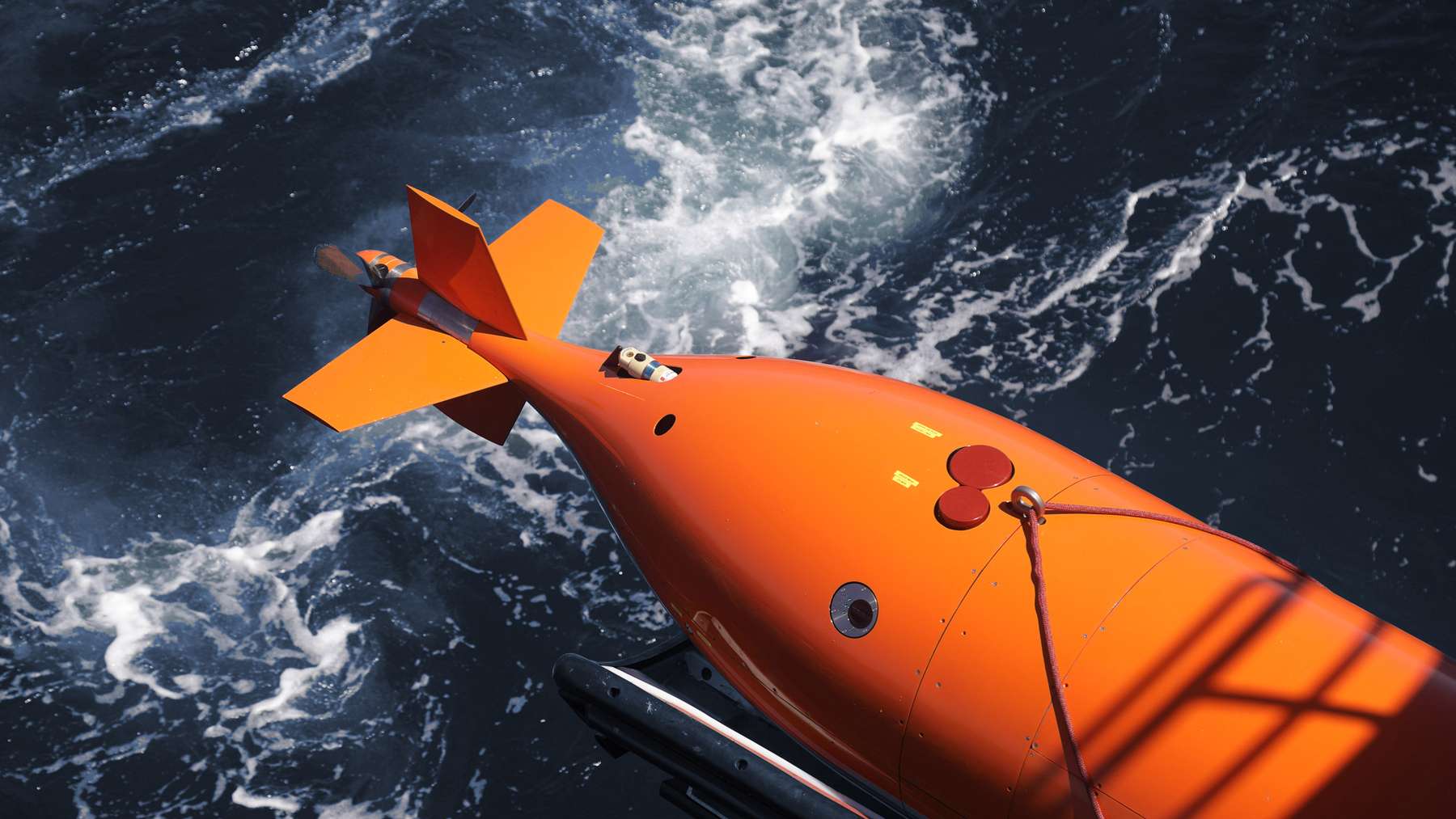
The drones were HUGIN 6000s, built by Norway’s Kongsberg and operated by Ocean Infinity, a marine robotics company that’s made a business out of searching the seafloor with fleets of these things. If you haven’t run into an AUV (autonomous underwater vehicle) before, it’s basically a torpedo-shaped robot that follows a preprogrammed route underwater with no cable back to the ship. It figures out where it is on its own, records everything, and hands over its data once it’s back on board.
Kongsberg’s HUGIN 6000 data sheet puts a typical vehicle at about 20 feet long and roughly 4,400 pounds, with a body about 34 inches across. It’s rated to nearly 19,700 feet, so on a job like this it’s working at less than a fifth of its rated depth. On a full charge, it can stay out for close to three days with all its sensors running.
Each of the three carried a multibeam echosounder, which maps the shape and depth of the bottom, and a synthetic aperture sonar that Kongsberg calls HISAS. A regular side-scan sonar image gets blurrier the farther out it looks. Synthetic aperture sonar gets around that by stitching together a long series of pings as the drone moves, so it acts like a much bigger antenna and keeps the picture sharp across the whole swath. That’s why the Stewart images look a lot closer to photos than the fuzzy blobs you’re probably used to from sonar.
Ocean Infinity programmed all three to scan the seafloor at the same time, and the run lasted 24 hours. Andy Sherrell, the company’s director of maritime operations in the U.S., has said that mapping a 37-square-nautical-mile area normally takes weeks. Even if you allow for a little company pride there, a day versus a few weeks is still a pretty big difference.
Stewart is in surprisingly good shape down there
When the team pulled the data, the sonar showed a ship sitting nearly upright on the bottom, largely intact, with its hull still holding its shape. According to the expedition’s announcement, the team followed up with a second, higher-resolution sonar pass, then sent down a camera-equipped ROV with live video streamed to shore over satellite. Unlike an AUV, an ROV (remotely operated vehicle) stays on a tether, and there’s a pilot on the surface driving it.
The footage shows a hull covered in marine growth, with sponges on it and crabs picking their way around the bow. SEARCH, the maritime archaeology outfit on the team, says that level of preservation could make Stewart one of the best-preserved four-stacker destroyers known to exist. Honestly, that’s a bit surprising for a ship that spent its last afternoon as a punching bag.
This isn’t the first time this group has gone looking for a ship the Navy sank on purpose. It’s the same pairing, Ocean Infinity and SEARCH, that found the battleship USS Nevada, a veteran of Pearl Harbor, D-Day and the Bikini atomic tests. Old target ships seem to make good test cases for multi-drone surveys, and if you like this sort of thing, we recently covered a 98-foot steam tug found in Lake Huron 152 years after its boiler blew and a WHOI robot rated for 36,000 feet.
The wreck still belongs to the Navy
Finding Stewart doesn’t make it fair game, though. Retired Rear Adm. Samuel J. Cox, who directs the Naval History and Heritage Command, said in the team’s announcement that a warship lost in battle or sunk as a target “remains sovereign property in perpetuity.” Which means you can’t go poking around it without the Navy’s say-so, not that many of us could get to 3,500 feet anyway.
In practice, that’s handled under the Sunken Military Craft Act, which gives the Navy management authority over the site, and Ocean Infinity did its survey under a national marine sanctuary permit. The survey data’s headed to the Naval History and Heritage Command for site management, and to Cordell Bank National Marine Sanctuary, which plans to use the maps and imagery to keep an eye on the wreck’s condition and learn more about the habitat and wildlife on that part of the seafloor.
Stewart’s been sitting on that slope since May 24, 1946, a day after it was decommissioned and a little over 25 years after it first went into commission.
 An 11-foot American mine-hunting drone weighing 600 pounds went on Iranian state TV as the second underwater drone the Revolutionary Guard says it pulled out of the Strait of Hormuz in three weeks, one of more than 90 the Navy has sent to seaMilitary · 18 hours ago
 A 27,100-ton aircraft carrier has sat in 25 feet of Charleston Harbor mud for 51 years and moved only twice, once lifted about 6 feet by a hurricane, while divers patched 35 holes in her hull and more than 1 million gallons of oily water came out of her tanksMilitary · 21 hours ago
 Crystals had grown over the lids of 68 drums holding more than 9,700 pounds of primer explosive, too dangerous to move or open. The Army blew them up in place at an Iowa plant behind water tanksMilitary · 2 days ago