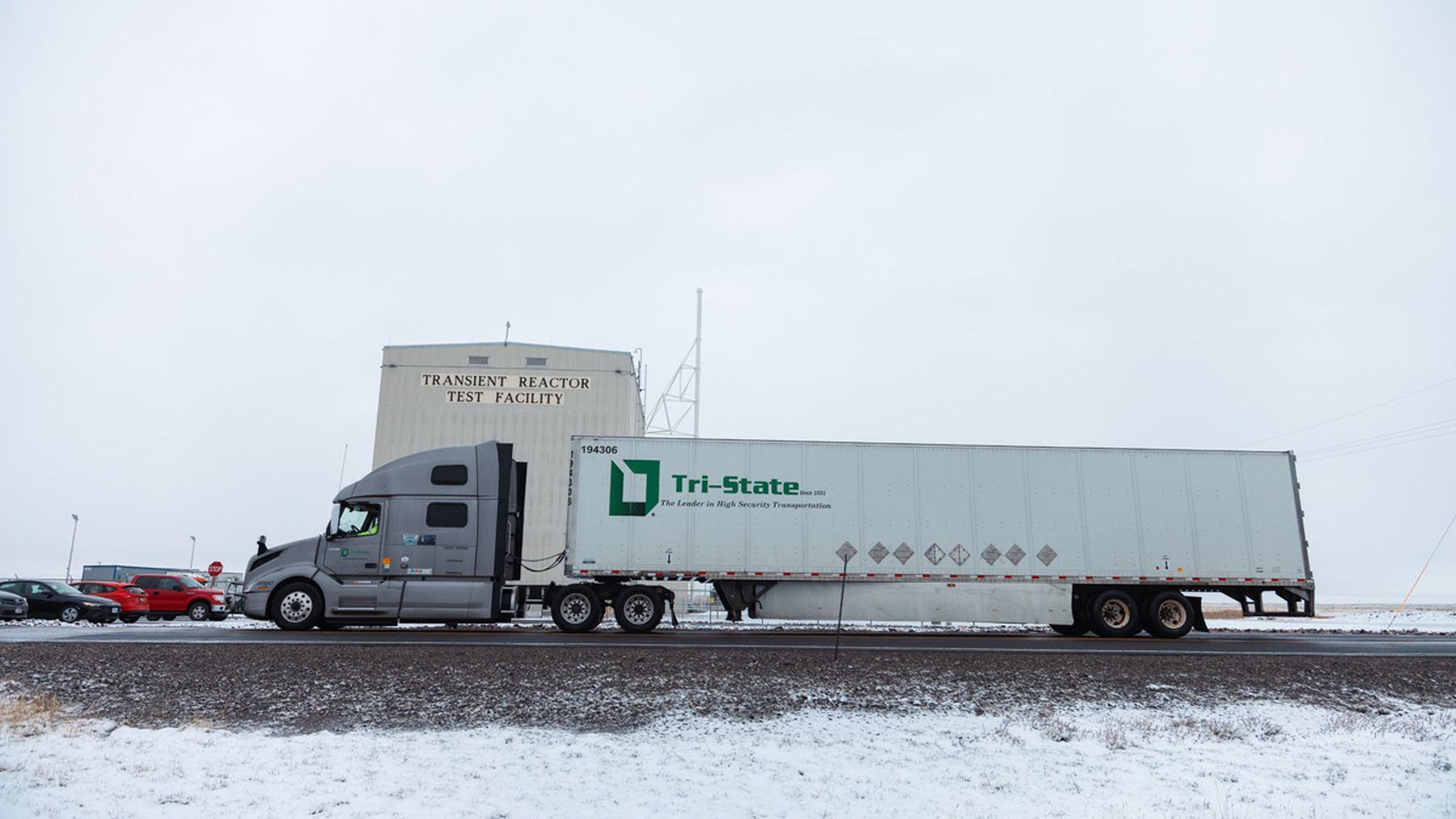

Packages that show up late don’t usually get a photo shoot. But Idaho National Laboratory had a pretty good reason to pull the camera out on November 19, when a high-security trailer parked in front of the Transient Reactor Test Facility with the fuel for MARVEL inside.
MARVEL is the Department of Energy’s test microreactor. It’s about 15 feet tall and 4 feet wide, it weighs under 10 tons according to INL’s own project slides, and it’s built to put out 85 kilowatts of heat. Those same slides list a crew of two operators. It isn’t a product, and nobody’s plugging it into the grid. INL wants it as a test bed, so the lab can work out how small reactors behave and pass what it learns on to the companies building their own.
The lab’s official account posted four photos of the unloading and said the TRIGA fuel Framatome made for the reactor had been delivered, putting MARVEL “one step closer to fueling and criticality.” INL hasn’t put out a press release on the delivery, so if you’re looking for the lab’s own account, those photos and that one line are it so far.
The fuel came from France, a few weeks late
The fuel was made by TRIGA International, a joint venture between Framatome and General Atomics that the DOE says is the world’s only supplier of TRIGA fuel. The DOE gave it a contract worth about $8.4 million in November 2023 to build 37 fuel elements, and the work was done at Framatome’s CERCA plant in Romans, France.
Abdalla Abou-Jaoude, who leads MARVEL at INL, laid out the last few weeks in a LinkedIn post on November 13. The final element was finished on October 30. The INL team was in France the following week to inspect it all. On November 6, they signed the End of Manufacturing Report, which is the formal sign-off that manufacturing’s done. The fuel left the plant on November 13, and by November 19 it was in Idaho.
Ralf Gathmann, from Framatome’s CERCA business, added in his own post that INL accepted all 37 elements during that visit. So the full order made it through inspection.
So what’s TRIGA fuel, and why use it here?
TRIGA fuel is uranium mixed with zirconium hydride, and for MARVEL it comes as pins clad in stainless steel, according to an INL fuel performance report. It’s the same family of fuel university research reactors in the US have used for decades. INL’s project page describes MARVEL’s fuel as high-assay low-enriched uranium, or HALEU. In plain terms, that means it’s richer in the kind of uranium that splits than the fuel in a regular power plant, but still nowhere near weapons grade.
The real selling point is a safety quirk. The hydrogen in that zirconium hydride sits right inside the fuel and slows neutrons down, which is what keeps the chain reaction going. When the fuel heats up, it gets worse at that job almost instantly, so the reaction backs off on its own without anyone touching a control. General Atomics, which developed TRIGA in the late 1950s, says its prototype was deliberately pulsed past 1,000 megawatts and settled back down within milliseconds.
That’s a fairly convincing party trick. And it’s apparently why the DOE went with it: the department says it’s safe and already certified for use in the US. If you’re building a reactor that’s never run before, using a fuel with a long track record makes a lot of sense, frankly. You’ve got enough new problems without inventing a new fuel too.
So did the fuel actually show up late?
A bit. At the American Nuclear Society’s annual conference on June 1, the MARVEL team said it expected the fuel in October and planned to spend October and November on readiness work before going critical in December. That plan got squeezed by a few weeks.
Then again, if you’ve followed MARVEL for a while, you’ll know the delivery date has moved before. When fabrication started in early 2024, the DOE was expecting the first fuel in spring 2025. In March of this year, Nuclear Engineering International reported a July or August delivery. Against that history, a few weeks in the fall is pretty mild. The criticality target has actually moved the other way. That same March report put dry criticality in 2027, and INL’s project page still says 2027, but the lab’s October release and Abou-Jaoude’s post both point to December.
So what happens in December?
INL said in October that MARVEL’s first criticality is anticipated in December. Abou-Jaoude’s November 13 post says the shipment keeps MARVEL on schedule to go critical, dry, by the end of the year. That’s a target. INL hasn’t named a day, and it hasn’t said when the fuel goes into the core, which has to happen first.
If “dry criticality” sounds like a contradiction to you, here’s the short version. Going critical just means the uranium is keeping a chain reaction going on its own. Doing it dry means running at such low power that there’s basically no heat to carry away, so the sodium-potassium coolant can stay out of the vessel until later. We went through the longer version, and why INL does it this way, when the reactor’s vessel showed up in Idaho.
From November 19 to New Year’s Eve is six weeks. Honestly, that’s a tight window for loading fuel and running through readiness checks the team originally gave itself two months for. I wouldn’t bet against it, though. The coolant system and the fuel are finally in the same building.
Critical isn’t the finish line
Even if December goes to plan, don’t expect MARVEL to make anything useful right away. INL’s utilization plan says the first phase only wraps up once the reactor has gone critical, finished its physics and acceptance testing, and been cleared for regular operation inside TREAT. After the dry test, the coolant goes in, and the heat gets routed out to Stirling engines and a separate loop for industrial heat. INL’s project page puts full-power operation in 2028.
The lab already has a line of would-be users. In December 2025, INL picked five teams as the first potential end users. Amazon Web Services wants to pair it with a modular data center. GE Vernova wants to test remote and autonomous reactor operation, and Radiation Detection Technologies wants to try out new sensors. DCX USA and Arizona State University want to see how it handles an AI data center, and a group made up of Shepherd Power, NOV and ConocoPhillips wants to use its heat for a small desalination pilot.
That’s a pretty eclectic guest list for a reactor about the size of a sedan. INL said final agreements were expected to be announced in 2026, and I couldn’t find an announcement that any of them have been signed yet.
The next thing to watch for is the fuel actually going into the core. As of the lab’s November 19 post, the fuel is at the Transient Reactor Test Facility, and INL’s goal is still a dry criticality in December.