
Wind has been pushing boats around the Baltic for a few thousand years, so there’s something a little funny about it turning up as the latest thing in naval surveillance. But that’s pretty much where the Swedish Navy has ended up this fall.
The Swedish Armed Forces and FMV, the country’s defense procurement agency, have signed a deal for four uncrewed sailboats that watch shipping in the Baltic. They’ve been on the job since October, and the Navy says it’s already getting useful information out of them.
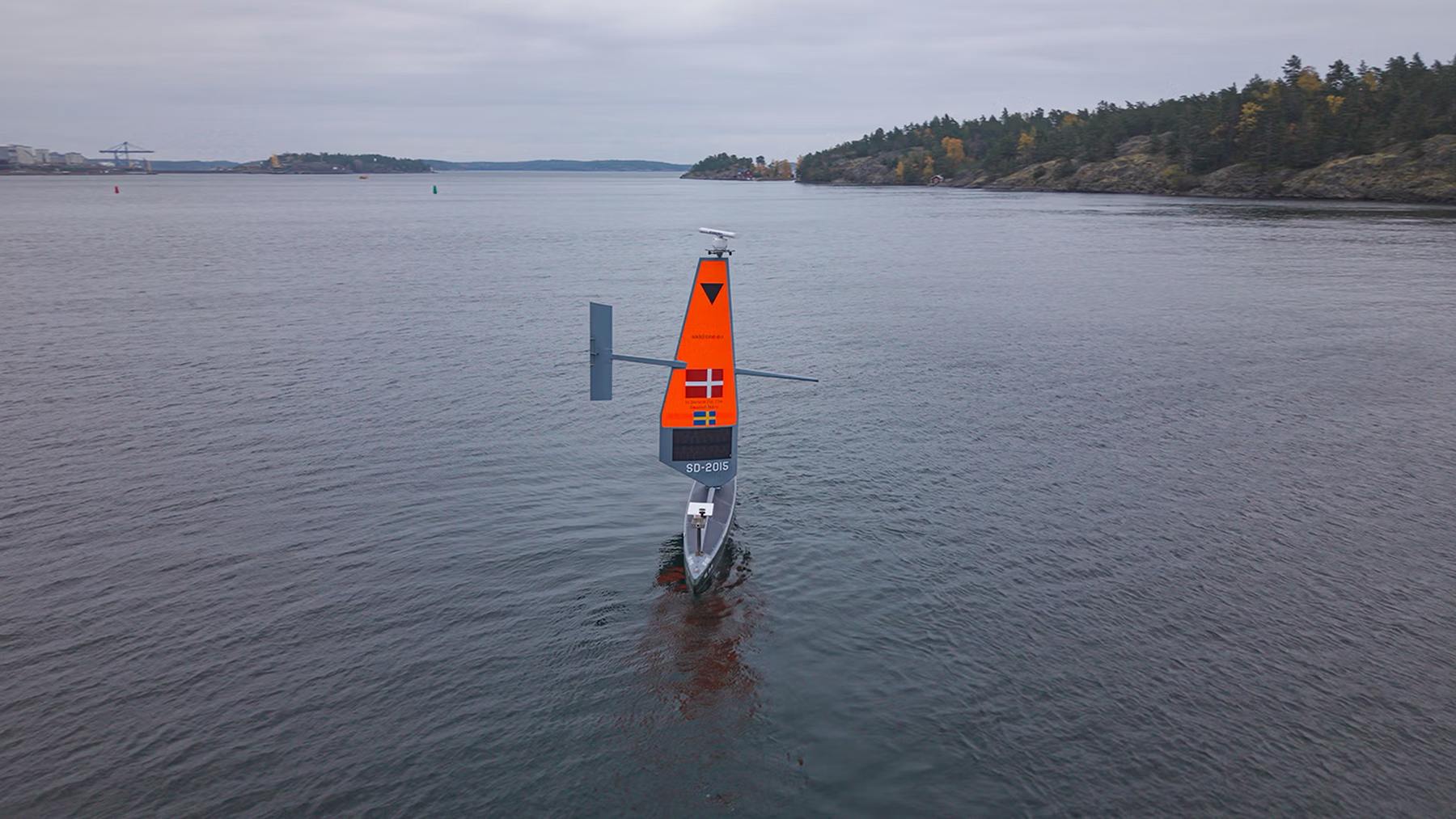
The boats are Voyagers, built by the California company Saildrone. Each one is 33 feet long, with a rigid wing about 20 feet tall where you’d expect a sail and a keel that reaches around 6.6 feet below the waterline. There’s nobody aboard. The spec sheet doesn’t list a weight, so I can’t tell you how heavy one is.
Under the deal, the four boats are booked for 360 days each. That adds up to 1,440 “vehicle-days” of surveillance across Sweden’s territorial waters and its exclusive economic zone, according to the company.
So what is Sweden actually buying?
Basically, a subscription. Saildrone owns the Voyagers, maintains them and has its own people steering and watching them around the clock. The Swedish Navy decides what it wants watched and gets the data back in real time. It’s a bit like paying a security company to keep an eye on your building instead of buying the cameras and hiring the guards yourself.
Johan Wahren, the FMV project manager on the deal, said as much in the agency’s press release, describing it as “purchasing a persistent maritime surveillance service.” Frankly, that’s a pretty sensible way for a navy to try something like this. If the boats don’t work out, Sweden isn’t left with four of them sitting at a pier.
The deal was set up through NORDEFCO, the defense cooperation framework the Nordic countries share. In practice, that means Norway, Finland or Denmark could sign up quickly for the same service and point the boats at their own waters, with each country running its own mission.
Captain Paula Wallenburg, the Swedish Navy’s chief of operations, said the boats carry cameras and radar, and that what they collect goes straight into the Navy’s command center. In a statement published by the Swedish Armed Forces, she also said “the vessels have already contributed valuable information to us” (that’s my translation from the Swedish).
She was careful not to oversell it, though. Her point was endurance. The Navy could already see this traffic, and the drones let it keep watching for longer without burning through crews. That frees up the crewed ships for the jobs where a person has to make a legal or ethical call, which I’d argue is the right split.
Why does the Baltic need this many eyes?
Because it’s busy. The Swedish Armed Forces say around 4,500 ships move through the Baltic every day, and keeping track of them is one of the Navy’s main jobs.
Most of that tracking leans on AIS, the Automatic Identification System. It’s basically a transponder that broadcasts a ship’s name, position, course and speed to anyone listening. As you’d expect, the ships a navy gets nervous about are often the ones that switch it off. Radar doesn’t care whether a transponder is on or not, and a camera can put a face to a blip. That’s why the radar and the cameras on a boat like this arguably matter more than its AIS receiver does.
Then there’s the seabed. A string of damaged undersea cables over the last couple of years pushed NATO to launch Baltic Sentry, and Task Force X Baltic grew out of it to get uncrewed systems into allied navies faster. Sweden’s Armed Forces say the four Voyagers feed into that effort too.
Drones have already shown what they can catch out there. In June, a different Danish drone boat sitting at anchor off Bornholm filmed a Russian corvette passing about 650 feet away with its transponder off. That boat belonged to a startup testing its own sensors, and it wasn’t working for any navy at the time. Still, it’s a pretty good example of what Sweden is now paying to catch.
Denmark already ran the test
Sweden isn’t the first Baltic navy to try these exact boats. DALO, Denmark’s defense procurement agency, had Saildrone run four Voyagers for the Royal Danish Navy for six months, and the company published the results in February.
Across those six months, the four boats sailed more than 20,000 nautical miles, picked up more than 170,000 unique vessels and kept the fleet available 92% of the time, according to the company. Saildrone compared that with crewed warships, which it says often average closer to 30% operational availability over their service lives.
Those are the company’s own numbers, so take them with the usual grain of salt. But 92% is a pretty strong figure for anything that spends six months out on the Baltic. It also means the fleet was out of action about 8% of the time, which nobody should be surprised by.
You might assume a drone sailboat runs on wind alone. It doesn’t, quite. The wing harvests wind to supplement an electric drive, and the company’s Danish write-up describes that drive as diesel-electric, so there’s still a fuel tank in the mix. The wind is there to stretch that fuel out over months at sea.
How does a 33-foot boat stay out for 360 days?
Honestly, I can’t fully answer this one.
The Voyager’s own spec sheet says it goes about 100 days between service stops, and the Swedish deal is for 360 days per boat. I couldn’t find anything from the company or the Swedish government that explains how those two numbers fit together. My guess is that each boat comes in for service two or three times over the year while a spare fills in. But that’s my guess, not something either side has said.
I also couldn’t find a price in anything FMV or the company has released. And the Navy has only said “cameras and radar” when it comes to sensors. The Voyager’s spec sheet lists an infrared camera, radar, AIS and a Starlink link, but the Swedish Armed Forces haven’t said exactly what’s fitted to their four.
Four 33-foot boats aren’t going to watch the whole Baltic by themselves, and to be fair, nobody in Sweden is pretending they will.
If you’re keeping an eye on how small drone boats hold up at sea, our story on a 16-foot solar drone boat that went silent off Maine for 11 days is a decent reminder that these things don’t always behave.
Swedish Defense Minister Pål Jonson was at the media day FMV held for the boats in Nynäshamn, south of Stockholm, on October 22, and Saildrone says more national deployments under NORDEFCO will follow.