
America has never worked out where to put the fuel that comes out of its nuclear reactors. That part most people know. What tends to get left out is that the country did build the first stage of an answer, cut it five miles into a ridge in southern Nevada, and then stopped.
On July 28 the Energy Department named five states as its initial contenders to host what it calls Nuclear Lifecycle Innovation Campuses: Utah, Tennessee, Oklahoma, Louisiana and Idaho. All five volunteered. Energy Secretary Chris Wright had signed memorandums of understanding with each of them days earlier, and the department estimates the campuses could attract up to $50 billion in capital investment and create close to 25,000 jobs.
Nevada is not on that list. Nevada is also, under federal law, still the only place in the United States where high-level nuclear waste is allowed to be buried.
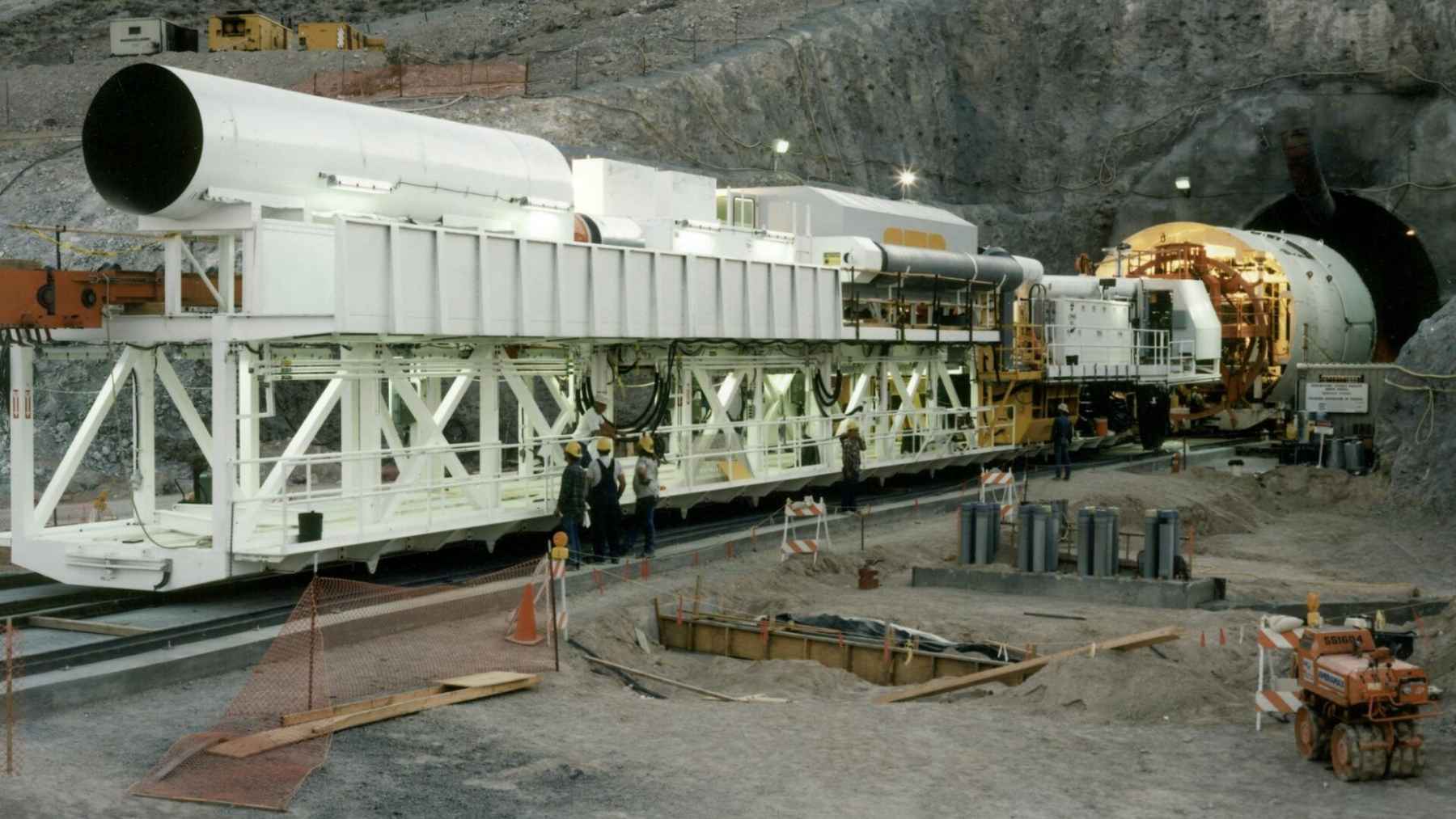
About 100 miles northwest of Las Vegas there is a horseshoe-shaped tunnel through Yucca Mountain, and the machine that cut it has been sitting outside the south end of it since the Clinton administration. It weighs 860 tons. The government tried to sell it and could not find anyone willing to pay a price it would accept.
The cutting head arrived from Kent, Washington, on fifty trucks
The tunnel is officially the Exploratory Studies Facility, and it was never meant to hold waste. It was dug so scientists could get inside the rock and find out whether the mountain could be trusted with the stuff for the next 10,000 years.
Boring started in September 1994 with a machine 25 feet across, according to the Nuclear Regulatory Commission. It was fabricated for the Energy Department by Construction & Tunneling Services of Kent, Washington, and designed by TRW Environmental Safety Systems, with Kiewit and Parsons Brinckerhoff running the excavation.
It came to Nevada in pieces on fifty trucks and was reassembled at the foot of the mountain. Twelve motors, 3,800 horsepower, and 48 cutter wheels 17 inches across, per a March 2006 account in the Las Vegas Sun that was distributed nationally by Scripps Howard News Service. The machine itself cost about $13 million and the boring job ran through a budget of roughly $130 million.
It worked three shifts a day, five days a week, for two and a half years. On a good day it hit 18 feet an hour. That sounds slow until you remember it was grinding through welded volcanic tuff with a cutting head as wide as a two-lane road.
The tunnel is a horseshoe with seven alcoves cut into the sides
From the north portal the bore runs about 2,000 meters northwest, then swings roughly 60 degrees south into the main tunnel, which sits 300 meters down, or 984 feet below the surface. That section runs about 3,000 meters south before a 90-degree turn sends it 1,300 meters east and back out at the south portal.
Seven testing alcoves and four test niches were carved into it along the way, and the machine bored straight through the Bow Ridge Fault to get there. The whole loop comes to roughly five miles.
Nuclear Engineering International, which published a detailed account of the excavation in 2003, put the count at more than 20,000 expanding steel rockbolts holding up about 70 percent of the tunnel, with steel sets doing the rest. The repository horizon was chosen partly because it sits more than 100 meters above the water table.
The machine broke daylight at the south portal in April 1997. The project crews named the moment the Daylighting. In December of that year a smaller Robbins hard rock machine started a second, straight tunnel across the first one, averaging 25 meters a day over 106 mining days.
Nobody bought it, and the scrap was worth more than the offer
With the job done, the Energy Department gave the machine a coat of fresh white paint. Then it left it near the south portal and started looking for a buyer.
Most of the attachments, the trailers and gantries that made the full rig longer than a football field, were sold off as scrap. The department offered the machine itself to other federal agencies and then tried the commercial market. One potential buyer came in at a few hundred thousand dollars and was turned down.
“The scrap alone is probably worth that,” department spokesman Allen Benson told the Las Vegas Sun in 2006, when the machine had already been sitting unused for nine years.
By then it had found the only job it had left, which was being the thing visitors wanted to photograph on the Yucca Mountain tour.
The law still says Nevada, and that is the whole problem
The Nuclear Waste Policy Act of 1982 made the Energy Department responsible for burying this material. A 1987 amendment narrowed the search to Yucca Mountain and nowhere else, which is why Nevadans have been calling it the Screw Nevada Bill ever since. In 2002 Congress and President George W. Bush overrode the state’s veto.
The department filed an 8,600-page construction license application in June 2008. In March 2010 it moved to withdraw that application. The NRC suspended the hearings on September 30, 2011, with close to 300 contested issues admitted and no money appropriated to hear any of them.
A federal appeals court ordered the commission in 2013 to spend what was left in the account and finish its technical review, which produced a five-volume safety evaluation report in January 2015. Nobody has ever ruled on whether the repository should be built.
The Government Accountability Office put the bill at nearly $15 billion spent since 1983 on site evaluation and the license application, about 65 percent of it from the Nuclear Waste Fund, which was filled by charging nuclear ratepayers a tenth of a cent per kilowatt-hour. Collection of that fee stopped in May 2014 after the courts found it could no longer be justified.
The same GAO review found that the decision to shut the program down was made for policy reasons, not technical or safety ones.
The waste kept arriving whether anyone agreed or not
There are now roughly 95,000 metric tons of spent fuel sitting at reactor sites around the country, and the pile grows by about 2,000 metric tons a year. The legal ceiling at Yucca Mountain is 70,000 metric tons, a number Congress has never touched.
Because the government missed its 1998 deadline to start taking the fuel, it has been losing breach-of-contract cases to utilities ever since. Representative Mike Levin of California put the taxpayer bill at $56.5 billion as of 2025. The Energy Department’s own accounting is about $12.2 billion already paid out and another $38.6 billion to $44.3 billion still owed.
Other countries have moved on this. Finland is weeks from opening the world’s first permanent repository, 430 meters down in bedrock 1.9 billion years old. In Washington State a pair of 300-ton melters have started turning Cold War tank waste into solid glass. America has been busier at the front end of the cycle than the back, and the government recently licensed a startup to pull uranium out of seawater.
“Yucca Mountain is still the codified repository,” Marla Morales, the Energy Department’s acting deputy assistant secretary for spent fuel and high-level waste, told Utility Dive in May, before adding that Wright has made clear it is not the solution.
Five states raised their hands and Nevada was not one of them
The department reviewed 28 applications from 26 states before landing on its five contenders. Oklahoma’s commerce department says three of the five will be picked as hosts by the end of this year.
The campuses are meant to cover the whole fuel cycle, including enrichment, fuel fabrication, reprocessing and final disposition of used fuel. That last item is the one that matters here, and it is the one current law does not allow anywhere except Nevada.
On July 27, POLITICO’s E&E News reported on a leaked White House document laying out legislative principles that would strip Yucca Mountain of its sole-site status, let the department work with willing states, and restart the waste fee the courts halted. None of that is law yet. Congress has to write it.
Nevada’s position has not moved in four decades. “We’ve had to be junkyard dogs about this for a long time,” Fred Dilger, who runs the Nevada Agency for Nuclear Projects, said at a state budget hearing last year. He has also pointed out what lives in the tunnel now, which is barn owls.
So the score after 40 years and about $15 billion is one five-mile tunnel, two tunnel boring machines, a licensing case nobody has ruled on, and 95,000 metric tons of fuel still parked next to the reactors that produced it. Congress may well change the law and hand the job to a state that actually wants it. Until it does, the only thing the United States has ever built for its high-level nuclear waste is a hole in a Nevada ridge with owls living in it, and the last public account of the machine that dug the thing had it parked outside the south portal, painted white, unsold.
 @joeamos ROOKIE1 month ago