
The Army Corps of Engineers doesn’t really do hype. A lot of what its districts post online is water release updates, lake levels and reminders to wear a life jacket. So when the Omaha District put out a 64-second clip in October and called a delivery “a major milestone,” I went and watched it.
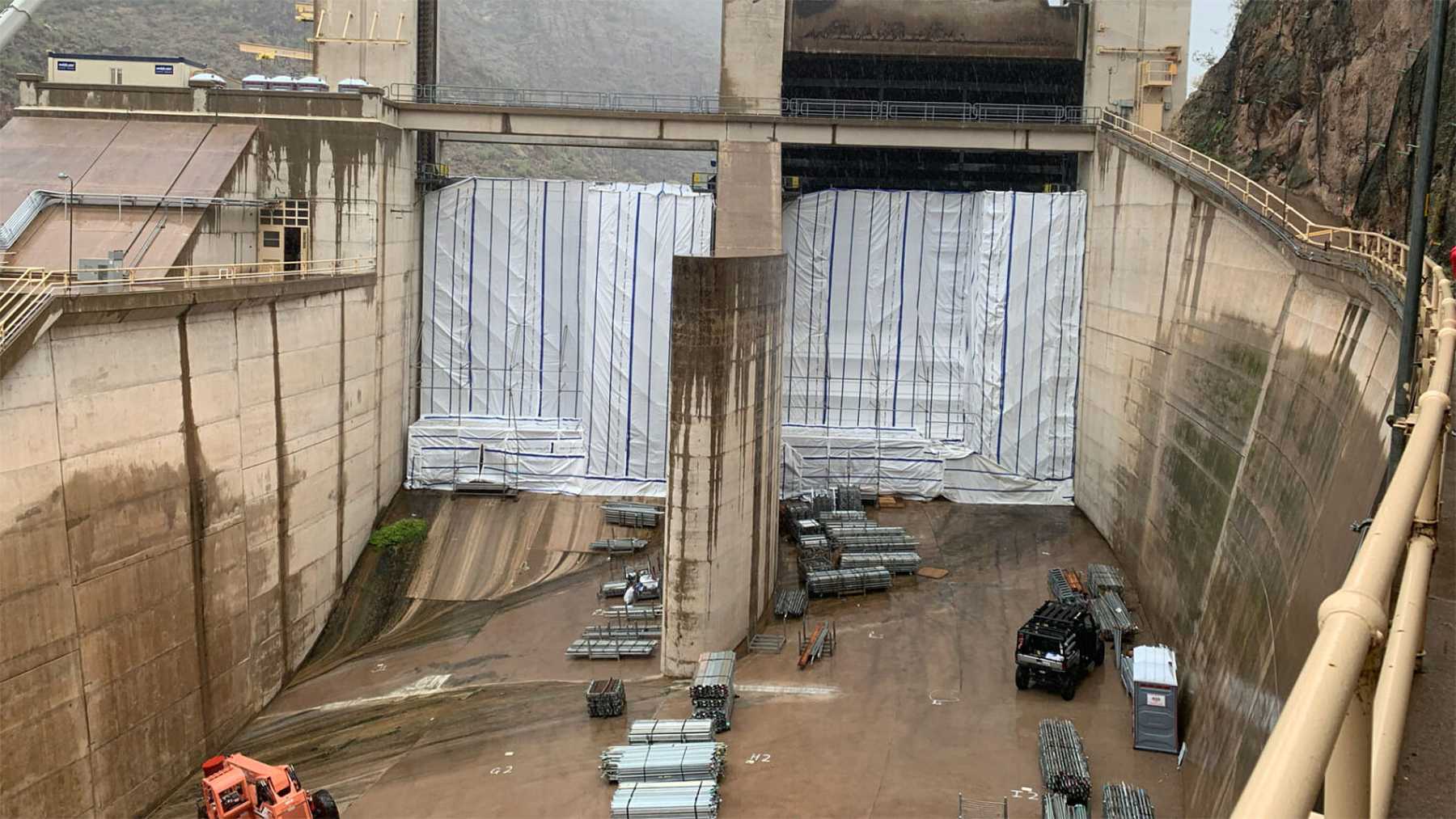
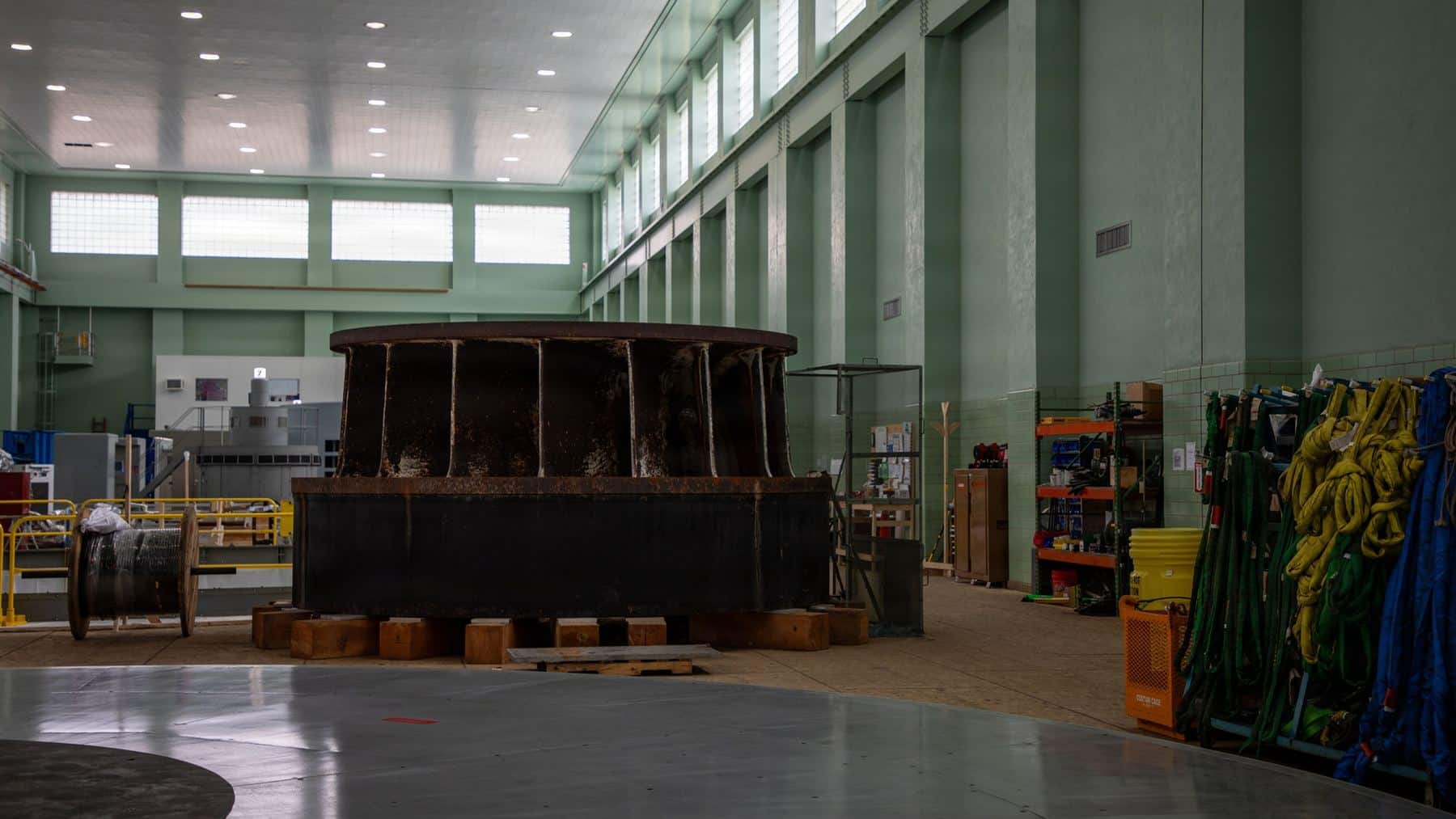
The delivery was a turbine runner. On September 23, it rolled out of temporary storage and into the powerhouse at Fort Randall Dam, on the Missouri River near Pickstown, South Dakota. It’s the first of eight new runners going into a plant whose generators started coming online in the mid-1950s, and every runner it’s replacing is an original.
That same day, a crane hauled one of those originals out of the building. The Corps photographed it on the way out, which is about as close to a retirement party as a 70-year-old piece of machinery is going to get.
What’s a turbine runner, anyway?
If you’ve never been inside a hydro plant, the runner is the wheel at the bottom of each unit that the water actually pushes on. Fort Randall uses Francis turbines, a pretty common design for big dams. Water from the reservoir swirls in around the edge of the runner, spins it and drops out the bottom.
The runner is fixed to the end of a long vertical shaft, and that shaft runs straight up into the generator. Up there it turns the rotor, which is basically a giant electromagnet, inside a ring of copper windings called the stator. Spin one inside the other and you get electricity. When KELOLAND News toured the plant last year, one of the units still in service was turning at 85.7 revolutions per minute.
Each complete unit, with the generator, shaft and turbine stacked together, stands more than 40 feet tall and weighs about 400 tons. That’s according to Mike Schenkel, who runs maintenance and operations at Fort Randall for the Corps.
The rotor is the heaviest lift in the building
Here’s where it gets interesting. You can’t reach the runner without pulling out what’s sitting on top of it, and the heaviest thing on top of it is the generator rotor, at 275 tons. The powerhouse has two overhead bridge cranes rated at 155 tons each. Neither one can pick up the rotor on its own. Hooked together, they’re good for 310 tons, which leaves 35 tons of margin. That’s less than a fully loaded semi, and it’s the kind of margin I’d want someone very calm running the controls for.
Both cranes started out as 150-ton machines. The Corps had them rebuilt and re-rated, along with a 280-ton lifting beam, which pretty much tells you somebody planned this a long way out. Schenkel told the Yankton Press & Dakotan the rehab was in the works for about a decade, and that the two cranes work in tandem on the heaviest loads.
Unit 6 was the first one opened up. By February, it had been taken apart far enough that its turbine shaft was lying on the powerhouse floor, and the Corps’ photo captions from that visit say that shaft will be refurbished and go back in alongside a new runner, a new stator casing and the refurbished rotor.
Why rip out generators that still work?
So why take apart eight generators that aren’t broken?
Because they’re old. Schenkel says a generator is typically designed to last about 40 years, and these have been running for roughly 70. “We’re doing this just because it’s due,” he told the Press & Dakotan, and he said the generators don’t have any current problems. He’s also said they’d never been taken apart in all that time. So the Corps squeezed about 30 bonus years out of machines built for 40, which is frankly a pretty good run for anything with bearings in it.
Fort Randall isn’t a plant that sits around idling, either. It runs as a peaking plant. Basically, it ramps up when demand spikes and backs off when it doesn’t, instead of running flat out around the clock. Schenkel says all eight units usually run through the evening peak, when people get home from work and turn everything on, and the plant typically shuts down from about midnight to 6 a.m.
The Western Area Power Administration sells that power to local co-ops. If you buy electricity from a rural cooperative in the region, some of what lights your kitchen at 7 p.m. could be coming out of this building.
That’s why the schedule looks the way it does. The contractor got one unit for the first rebuild. Once it proves it can finish one, it’s allowed two at a time, staggered so one comes apart while the other goes back together. The rest of the plant keeps generating through all of it.
The new units get more out of the same water
The whole rehab runs about $150 million. Voith Hydro won the contract about four years ago and builds the new runners at its plant in York, Pennsylvania, and Schenkel says designing the turbines took about a year and building them took about another one. The job also covers the wicket gates (the ring of adjustable vanes around the runner that opens and closes to control how much water hits it) and a rewind of every generator’s stator. The shafts get inspected and reused, and the bearings get refurbished.
And the payoff? Depending on which interview you read, Schenkel puts the old units at about 42 or 43 megawatts each, and the Corps rounds the whole plant off at 320. The new units are rated at 52 megawatts apiece (one TV report had 50, but two print interviews say 52), which he says takes the plant to about 400 megawatts once all eight are done. Eight times 52 is actually 416, so I’d read 400 as a tidy round number rather than a promise.
Then there’s efficiency. The turbines go from about 89% to 92%. Three points doesn’t sound like much. But it means the same water coming through the dam makes roughly 3% more electricity every hour the plant runs, for decades. That’s arguably the best deal in the whole project, since the Missouri River doesn’t charge extra.
When’s the first one back?
KELOLAND reported that work on Unit 6 started shortly after the Fourth of July last year, and Corps photos show contractors lifting the first major piece of it out of its casing on August 27. Schenkel has said each outage runs 16 to 18 months, and the Press & Dakotan reported the first one was scheduled to last until this fall. If that holds, Unit 6 should be back sometime around the end of the year.
I can’t confirm that yet. The Corps hasn’t announced Unit 6 back on the grid, and the September video doesn’t actually say which unit the new runner is going into. Unit 6 is the only one anyone has reported as opened up, so it’s a safe bet, but it’s still a bet. The Corps hasn’t published the runner’s diameter or weight either, which is a little frustrating for a video that’s entirely about moving it.
For a sense of pace, the Corps has been swapping out 1950s Kaplan runners at Old Hickory Dam on the Cumberland River in Tennessee, and the New York Power Authority needed 33 months to rebuild the first of 13 turbines at Niagara. Sixteen to 18 months a unit at Fort Randall is a pretty brisk target by comparison, though Niagara’s units are a lot bigger.
Fort Randall is also the second of six big Missouri River dams lined up for this kind of overhaul. Garrison Dam in North Dakota got its turn in the early 2000s, and planning is underway for Oahe Dam near Pierre.
As for the finish line, local TV had the whole project wrapping up in July 2031. The Corps’ own captions list a contract end date of September 2032, and since that’s the newer number and it comes from the people paying for the job, I’d go with it.
So Voith has until September 2032 to get all eight runners in, and the Corps’ cameras caught number one rolling into Fort Randall’s powerhouse on September 23.