
Every argument about nuclear power runs into the same wall eventually. The reactors are clean, the output is steady, the safety record is better than most people assume, and then someone asks where the waste goes. For roughly 70 years, the honest answer has been a swimming pool next to the reactor, indefinitely.
Finland is a few weeks away from changing that answer. The Finnish Radiation and Nuclear Safety Authority, known as STUK, is scheduled to deliver its final safety assessment of the Onkalo repository by the end of June, according to Interesting Engineering. A positive statement opens the door to an operating license, and that license would make Onkalo the world’s first permanent deep geological repository for spent nuclear fuel. Not a pilot project, not a test cavern. The actual, final resting place, designed to stay sealed for at least 100,000 years.
TVO chief executive Philippe Bordarier told AFP the plan is to start operations late this year or, more likely, early next. So the rock is real, the canisters are real, and the only thing left between Finland and a world first is paperwork. Here’s what they actually built down there.
A tomb 430 meters down, in rock older than animal life
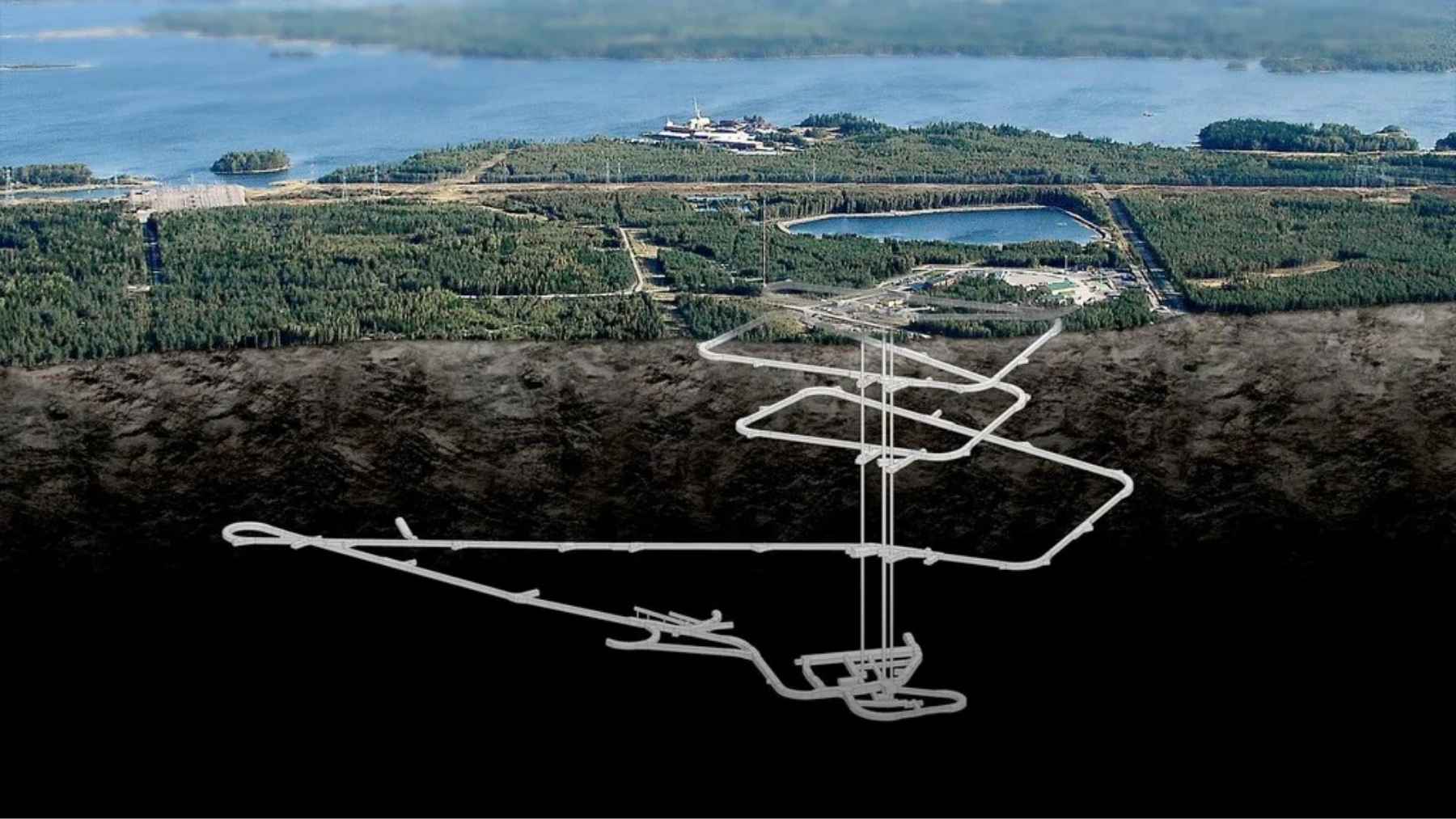
Onkalo means “cave” in Finnish, which undersells it the way “boat” undersells an aircraft carrier. The facility sits on the island of Olkiluoto in Eurajoki, on Finland’s southwest coast, next door to three of the five reactors whose fuel it will eventually swallow. Posiva, the waste management company owned by Finland’s two nuclear operators, TVO and Fortum, started digging in 2004. Two decades and roughly 1 billion euros ($1.16 billion) later, there is a network of tunnels carved into 1.9-billion-year-old bedrock about 430 meters (1,400 feet) below the surface. Reporters AFP sent down this spring noted the elevator display reads “433” at the bottom.
For scale: that bedrock formed more than a billion years before the first animals existed. Finland picked it precisely because nothing geologically interesting has happened to it in an extremely long time, and the entire safety case rests on nothing interesting continuing to happen for another 100,000 years.
The capacity figure is 6,500 tons of spent uranium fuel, enough to take everything produced by Finland’s five commercial reactors: three at Olkiluoto and two at Fortum’s Loviisa plant. The operating license on the table covers a period running through 2070, though under current plans the disposal work stretches into the 2120s before the final seal goes on. After the last canister is in, the tunnels get backfilled and plugged, and the site is designed to need exactly zero human attention from that point forward. No guards, no monitoring, no maintenance budget. A closed system, on purpose.
Copper, clay, and a Swedish recipe called KBS-3
The disposal method is not Finnish, as it happens. It is a Swedish design called KBS-3, developed by Sweden’s nuclear waste company SKB, and it works like a very expensive set of nesting dolls. According to the World Nuclear Association, twelve spent fuel assemblies go into a boron steel canister, and that canister gets sealed inside a copper one, chosen because copper resists corrosion better than almost any practical metal. The copper canister is then lowered into a hole drilled in the tunnel floor and packed in bentonite clay, which swells when wet and seals the canister off from groundwater. The tunnel itself gets backfilled and capped with concrete.
Each barrier covers for the others. If the copper fails, the clay slows everything down. If the clay fails, there are still 430 meters of granite between the canister and your drinking water. The fuel’s radioactivity falls the entire time, and after 100,000 years it lands back at roughly the level of the uranium ore it was made from. The system is deliberately passive: no pumps, no sensors, no staff. It works whether or not anyone remembers it exists, which is the only realistic standard when your timescale outlasts languages.
“Basically, it needs to be safe forever,” Posiva chemist Lauri Parviainen told AFP during a press tour this spring. That is the actual engineering requirement, said out loud, by someone whose name is on the project.
So what exactly happens at the end of June?
STUK has been reviewing Posiva’s operating license application since May 2022. The application went in on December 30, 2021, and the review was originally supposed to wrap by the end of 2023. It did not. The regulator asked for more time on three separate occasions, and Finland’s economy ministry granted the latest extension in December 2025, setting the current deadline: a final statement by the end of June 2026.
Slow, yes. But the slowness is sort of the point. Jarkko Kyllonen, a nuclear safety expert at STUK, told AFP his team has assessed risk scenarios stretching up to a million years into the future, and that the first 10,000 years are the critical window for keeping the canisters intact, as reported by ScienceAlert. When your review horizon is a million years, a couple of extra years of paperwork is a rounding error.
The sequence from here is short. STUK issues its statement, then the Finnish government makes the final call on the license. If both go Posiva’s way, the first canister of real spent fuel goes underground in late 2026 or early 2027, per Bordarier. Sweden and France are building deep repositories of their own, but AFP reports Finland is expected to cross the finish line first.
Two-thirds of the world’s spent fuel is still in temporary storage
Here is the scoreboard Onkalo is playing against. According to a 2022 report by the International Atomic Energy Agency, cited by the Associated Press, the world has produced almost 400,000 tons of spent fuel since the 1950s. About two-thirds of it sits in temporary storage, meaning cooling pools at the reactors that produced it or dry casks parked above ground, and the other third has been recycled through reprocessing. Not one ton of spent fuel, anywhere, has ever gone into permanent disposal. That includes the fuel sitting at American reactor sites right now.
And the front end of the industry is sprinting in the opposite direction. Tech giants are lining up reactor deals for AI data centers, China is testing a 10-megawatt nuclear reactor that rides on a truck bed, and governments are pouring billions into fusion machines built to hit 100 million degrees. Some researchers are even mining the waste itself for value, like the UK team that pulled radioactive carbon out of old reactor graphite and sealed it inside diamond batteries that trickle out electricity for thousands of years. All of that is front-end innovation. Onkalo is the first permanent answer anyone has actually finished building at the back end.
The copper is the honest catch
Now the caveat, and it is a real one. Edwin Lyman, director of nuclear power safety at the Union of Concerned Scientists, told the AP that geologic disposal still carries genuine uncertainties, and that since no good option exists for nuclear waste, the job is finding “the least bad option,” as he put it to the Associated Press.
The specific long-term worry is the copper. Over a long enough timeline even corrosion-resistant metal corrodes, and STUK’s own modeling flags canister corrosion and earthquakes during future ice ages as the two main long-term hazards, per Kyllonen. The counterargument is layered into the design itself: the clay, the depth and the granite all exist for exactly the scenario where the copper eventually gives out, and the radioactivity keeps dropping the whole time. STUK’s risk assessments over the years have come back positive, per the same AFP reporting. Which is regulator-speak for: the least bad option is holding up well.
Posiva communications manager Pasi Tuohimaa framed the project to the AP as the missing piece for sustainable nuclear power, and pointed out that Finland’s nuclear companies have been saving for decades to pay for it. That detail deserves more attention than it gets. The waste bill is being paid by the companies that made the waste, in advance, on purpose. Plenty of industries have promised that arrangement. This one wrote the checks.
So that is what sits on the table in Helsinki this month. A billion euros, two decades of digging, and a hole in 1.9-billion-year-old rock built to outlast every country currently on the map, all waiting on one regulator’s verdict and one government decision. If the Finns are wrong about the copper, nobody alive today will be around to say so. If they are right, every other nuclear nation just ran out of excuses.