
If you have spent any time following how Big Tech plans to feed its AI habit, you already know the fashionable answer: small modular reactors. Small, factory-built, quick to deploy, at least on the slides. Meta, Microsoft, Amazon and Google have all lined up nuclear deals for their data centers, much of it riding on reactor designs that do not commercially exist in the U.S. yet.
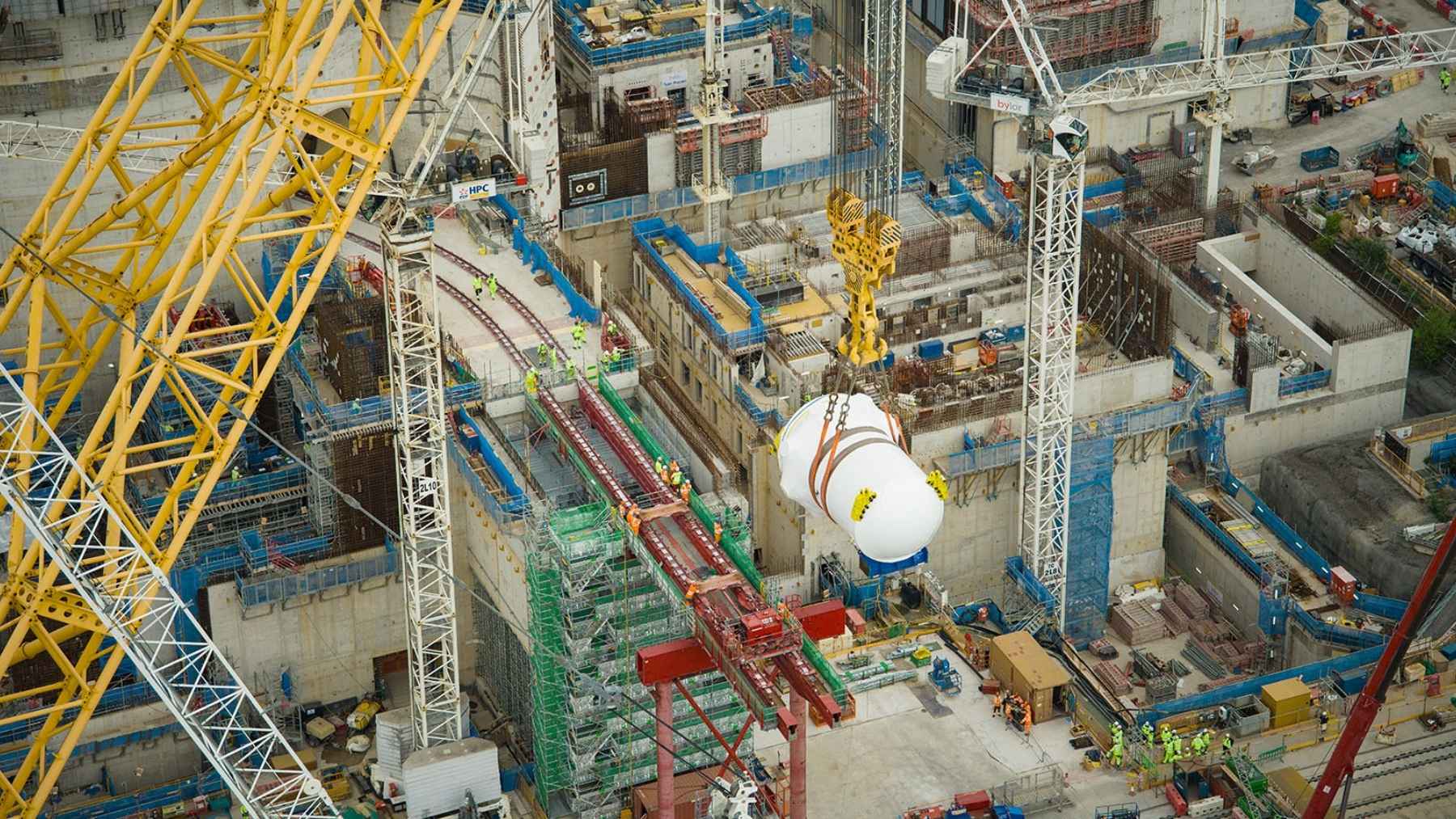
Then, late last week in southwest England, the other kind of nuclear turned up. It turned up as a single 500-metric-ton steel cylinder being lowered into a reactor building by the largest crane on the planet, with roughly an inch and a half of room on either side. Nothing modular about it. This is the version where you forge one enormous reactor in France, ship it across the Channel, and bolt it down by hand.
The plant is Hinkley Point C, in Somerset, and the cylinder is the second of its two reactor pressure vessels. The crane is called Big Carl. And the gap between the two approaches, the American bet and the British one, is most of the story here.
Big Carl, and the inch and a half that counted
Big Carl is formally the Sarens SGC-250, and Hinkley Point C bills it as the world’s largest land-based crane: over 250 meters tall in its biggest setup and rated to lift up to 5,000 metric tons, around 5,500 U.S. tons. For the second reactor it had a 500-metric-ton job, which is to say roughly a tenth of what the machine can handle, as New Civil Engineer documented in photos. The lift still took two days. Work started Thursday, May 28, and finished the following afternoon, Friday, May 29.
The choreography is the interesting part. The reactor vessel is 13 meters long, roughly 43 feet, and Big Carl lifted it off a self-propelled transporter and set it onto an elevated rail skid outside the building. From there it was slid sideways through a 19.5-meter equipment hatch in the side of the reactor building. Once it was inside, a separate crane already mounted in the structure, the internal “polar” crane, rotated the vessel upright and lowered it onto its support ring. The clearance at that point was 40 millimeters on either side. That is about the width of a hardback book, holding a 500-ton object you cannot exactly nudge back into position.
The first reactor, installed back in December 2024, went in differently. That one rode a large temporary overhead lifting system built specifically for the lift. Switching to Big Carl for the second vessel, EDF told World Nuclear News, saved space, time and money. It is a small example of a much larger idea the project keeps leaning on.
Why the second reactor went in faster than the first
That idea is what EDF calls “Build and Repeat,” and Hinkley Point C is the cleanest test of it you will find in the West. The two units are identical EPR reactors. Build the first one, learn every painful lesson, then build the same machine again and move faster the second time.
By the project’s own accounting, it is working. Unit 2 is being assembled 20 to 30 percent more quickly than Unit 1, with the same teams repeating the same work. When the 245-ton steel dome went onto the second reactor building last July, EDF noted that on the civil construction, 30 percent fewer people had done 40 percent more work than on the first unit. Large steel structures and entire rooms are now prefabricated off-site and craned in whole.
The reactor lift itself landed less than a year after that dome. Simon Parsons, Hinkley Point C’s delivery director, credited “strong innovation to achieve not just a ‘cut and paste'” from the first reactor’s installation, pointing to months of planning across the ten main contractors on the job. The second unit’s reactor building is now further along than the first one was at the equivalent stage, with more equipment fitted, more structural steel up, and the outer containment layer already in place. The whole point of building two identical reactors is to spend the lessons forward, and EDF says the planned Sizewell C plant, a near-copy of Hinkley, is meant to inherit them from day one.
What the giant cylinder is actually for
Strip away the spectacle and the reactor pressure vessel is a job-specific object: a high-strength steel shell that will house the reactor core, the control rods, and the plumbing that drives coolant through it. The vessel was forged by Framatome at its Saint-Marcel plant in eastern France, finished late last November, and shipped to the site in January. For a sense of how rare this is, the first vessel installed at Hinkley in 2024 was the first reactor fitted at a British power station since Sizewell B back in 1991.
Once the plant is running, the core’s heat boils water. Four 25-meter steam generators flanking the reactor turn that heat into steam, and the steam spins a turbine. The turbine here is worth naming: it is GE’s Arabelle, which the company calls the largest steam turbine ever built, longer than an Airbus A380 and good for around 1,770 megawatts on its own. It is another entry in the project’s long list of superlatives, and the kind of record-scale clean-energy hardware we have covered before. Two reactors feed two turbine halls, and EDF puts the combined output at enough low-carbon electricity for about six million homes, from a plant designed to run for as long as 80 years.
America bet small. Britain bet big.
None of this has been cheap or fast. The funding deal for Hinkley Point C was signed in 2016, with a roughly £18 billion price tag and a promise of power by 2025. Ten years on, the first reactor is not expected to generate until 2030, and the projected cost has climbed to about £35 billion in 2015 prices, near $47 billion, with the real-money figure higher once you fold in a decade of inflation, as New Civil Engineer reported on EDF’s latest accounts. The second unit follows the first by about a year, which lands it in the early 2030s. EDF, which owns the plant jointly with China’s state-owned CGN, absorbs the overruns itself. British consumers, for their part, are committed to a guaranteed electricity price of £92.50 per megawatt-hour for 35 years once the plant switches on.
Now set that against the American playbook. In January, Meta signed deals with three companies, the SMR developers Oklo and TerraPower plus Vistra’s existing plants, for 6.6 gigawatts of nuclear power by 2035 to feed its data centers, including its Prometheus AI supercluster, as TechCrunch detailed. It is one piece of a broader tech industry that has now committed tens of billions of dollars to nuclear power for AI. The catch is that the small modular reactors at the center of that bet have not been built at commercial scale in the U.S. yet, with online dates running anywhere from 2030 to 2035. China, meanwhile, is testing a 10-megawatt reactor small enough to ride on a truck bed, pitched as a “power bank” for data centers, which we covered when the prototype went public.
So you have two opposite philosophies of nuclear, both chasing the same prize. One spreads the risk across a fleet of small reactors you can stamp out in a factory. The other concentrates it in two machines so large you need the biggest crane ever built just to assemble them.
The version you can see from the road
Both bets are aimed at roughly the same finish line: clean power at industrial scale by the early 2030s. They just disagree completely on the physics of getting there. The American plan is faster to promise and still mostly on paper. The British one is the thing sitting in Somerset right now, a 500-ton reactor bolted to a support ring, 40 millimeters from the wall, with the world’s largest crane parked next to it. Whatever you make of the price tag, that is what big Western nuclear looks like when it actually shows up.