
Everything that rides a rocket has to earn its seat, because lifting mass off the ground is still priced by the pound and the bill is brutal. A water tank, a bag of bolts and a solar panel all ride up at the same eye-watering rate, which is why engineers burn careers shaving grams off hardware that then has to survive a launch and work in a vacuum.
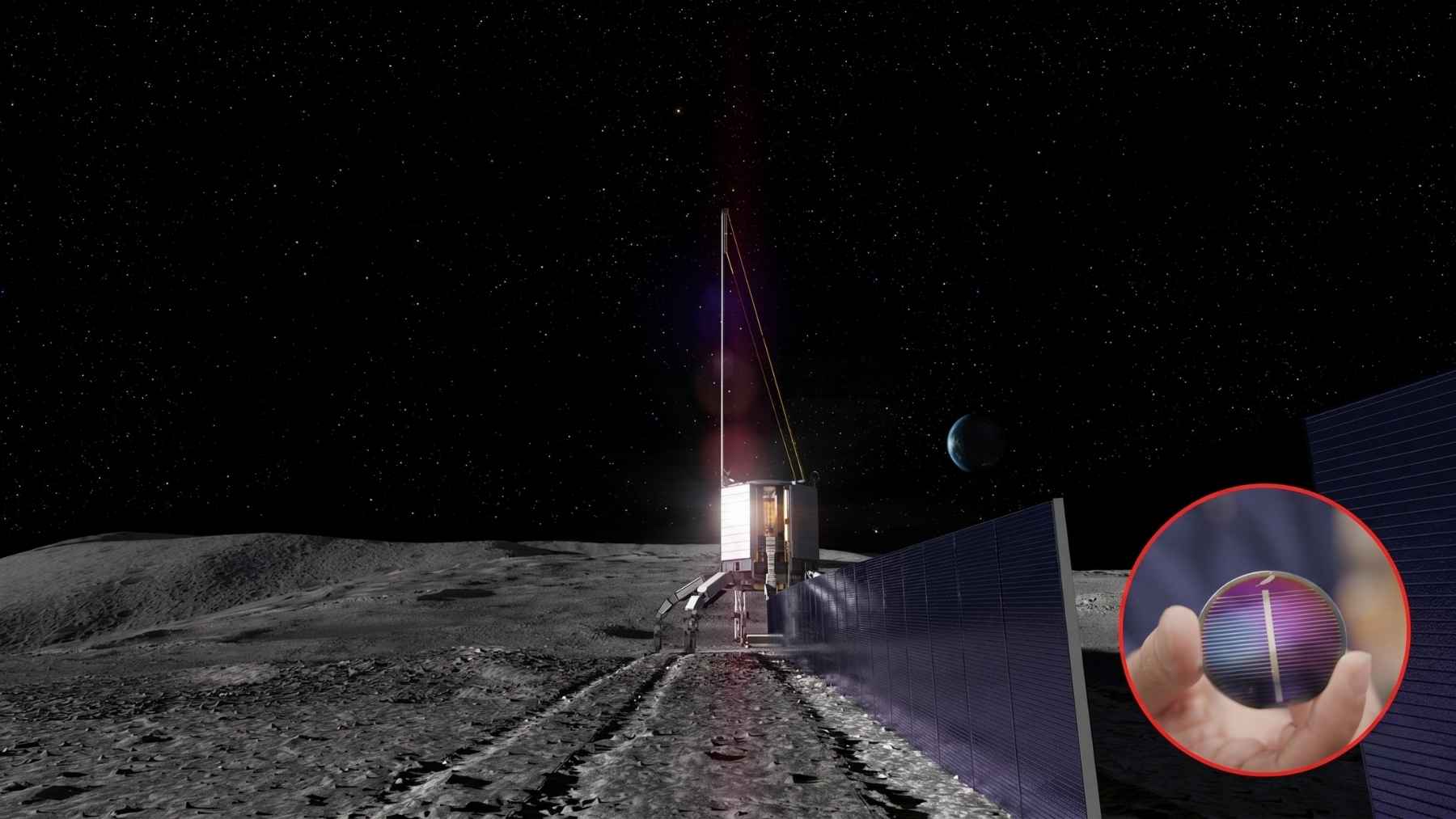
Blue Origin’s answer to that arithmetic is to stop shipping one of the heaviest things a Moon base needs and grow it on site instead. The company wants to make solar panels out of the dust already lying on the lunar surface, with nothing in the cargo hold: no panels, no glass, no wire. Dirt goes into a reactor, finished solar cells come out the far end.
That used to be a slide in a conference deck. It is a lot closer to hardware now. Blue Origin’s regolith-to-power system, called Blue Alchemist, cleared its Critical Design Review in September 2025, the engineering checkpoint that says a design is locked down enough to start building for real. The next step is a full demonstration in 2026, and there is a university team chasing the same prize from a completely different angle. Both are circling the one number that decides whether anyone ever lives up there: how much of this you have to launch from Earth.
Molten regolith electrolysis does the heavy lifting
The process under the hood is called molten regolith electrolysis, and it is about as unsubtle as it sounds. You take crushed lunar soil, heat it until it melts (Blue Origin’s reactor runs the regolith up to around 1,600 degrees Celsius, hot enough that the melt starts conducting electricity), and then pass a current through it. The current rips the chemical bonds apart and pulls oxygen away from the metals it was locked to. Iron separates out first, then silicon, then aluminum, with bubbles of oxygen rising off the opposite electrode. No water, no acid baths, no toxic solvents, none of the stuff a normal silicon plant on Earth leans on.
Silicon is the part that matters for a solar cell, and it has to be almost absurdly clean. Blue Origin says its process refines the silicon to better than 99.999% purity, which is the floor you need before the material will turn sunlight into useful current. The same reactor byproducts get spun into the cover glass that sits over the cell, and that glass does a job most people never think about.
Without it, an unshielded cell on the Moon would last a matter of days before radiation chewed it up. With regolith-made cover glass, Blue Origin says the cells should keep working for more than a decade. The connecting wire gets drawn from the aluminum, and the leftover oxygen is not waste at all. It can feed life support or get stored as rocket propellant. The company has been quietly building cells and transmission wire from simulated regolith since 2021, so this is not a thought experiment that started last week.
The 2026 demo runs on Earth, not the Moon
The headlines blur this part, so here it is straight: the 2026 demonstration is not happening on the Moon. It runs on Earth, inside vacuum chambers built to fake what the lunar surface does to hardware. Vlada Stamenkovic, the senior director who runs Blue Origin’s Space Resources Center of Excellence in Los Angeles, told Aerospace America the plan is to load different blends of regolith simulant into the chambers and have robots run the entire chain untouched, with a finished solar cell coming out the other end. No human hands in the loop. That autonomy is the entire point of the test.
The conditions it has to survive explain why this is hard. A lunar day and a lunar night each run about two weeks, and the surface swings between roughly 120 degrees Celsius in the sun and minus 133 in the dark. Gravity is one-sixth of Earth’s, which changes how molten glass forms and flows in ways you can only partly model on a computer. The instruction Stamenkovic says came down from founder Jeff Bezos was about as plain as it gets: prove “this is real, that it’s not just a dream.” Clearing the Critical Design Review green-lit the attempt. Whether the robots can run the full sequence start to finish, hands-off, is the question 2026 is meant to answer.
A second team is taking a shortcut
Blue Origin’s approach is the maximalist one, making everything, silicon included, from scratch on the surface. A separate group of researchers thinks there is a faster way in, and they published it in April 2025 in the journal Device. Their argument is that purifying silicon is the hard, energy-hungry step, so why not skip it.
Instead, they melt regolith into a rough “moonglass” and use that as both the base and the protective layer, then ship up only the active ingredient: an ultrathin film of perovskite, a cheap crystal that is very good at turning light into electricity.
The weight math is the eye-catcher. Because the heavy glass gets made on the Moon and only the thin perovskite layer flies up, the team calculated the approach trims launch mass by 99.4% and transport cost by about 99%. The cells they built in the lab hit 10% efficiency, with a route to roughly 23% once they clear up the glass, and they held onto 99.6% of their performance after being blasted with the kind of proton radiation the Moon throws at hardware.
Felix Lang, the University of Potsdam physicist who led the work, framed the trade-off bluntly: the cells do not need to be world-beaters because you can “just make more of them on the Moon.” One team wants to manufacture the whole panel locally. The other wants to ship the clever part and grow the rest. Same enemy, two philosophies.
The launch bill is the whole game
Strip away the chemistry and both projects are really attacks on the same line item. Putting a kilogram of anything onto the lunar surface costs a fortune, and a solar farm big enough to run a base is a lot of kilograms of glass, silicon and wire. Every panel you can build out of dirt that is already there is a panel you never paid to launch, which is why this keeps pulling in serious money instead of staying a curiosity.
For Blue Origin the solar cells are one slice of a much bigger regolith play. The same reactor is meant to crank out breathable oxygen, propellant, metals and construction material, and the company says it is on track to make lunar landings up to 60% cheaper and cut fuel-cell and battery mass by as much as 70% by refueling those systems with oxygen pulled from the soil.
There is an Earth angle too: the same trick can make solar cells with zero carbon emissions out of cheap feedstock like desert sand, which is a tidier pitch for anyone who does not care about the Moon. None of this is the only way to keep the lights on up there. The brutal two-week lunar night is exactly why the U.S. has committed to landing a nuclear reactor on the Moon by 2030, since a reactor does not care whether the Sun is up. Regolith solar and a fission reactor are not really rivals so much as two halves of the same problem.
Both versions still live in labs and simulant, not on the actual Moon. Nobody has melted a scoop of real lunar regolith into a working solar cell on the surface yet, and the list of things that could still go wrong is long. Perovskite’s liquid solvents do not behave in a vacuum, low gravity could warp how the glass sets, and the whole autonomous chain has to keep running through a freeze that lasts two Earth weeks.
Japan is coming at the logistics from orbit instead, testing a washing-machine-sized satellite that makes electricity from sunlight in space and beams it home, which tells you how many directions smart people are willing to attack the cost of running anything off-world. The pitch underneath all of it is the same, and it is hard to argue with: the cheapest pound of solar panel is the one you never have to launch.