
Solar panels quit the moment the sun goes down, and wind turbines slow to a crawl whenever the air goes still. That intermittency is the oldest knock against renewables, the reason most grids still keep something burning in the background to cover the quiet hours. A startup near Munich figures part of the fix has been flowing past everyone this whole time, and it just got the green light to anchor 124 small turbines in the Rhine to prove the point.
The company is Energyminer, and the project sits in the river near Sankt Goar, in the German state of Rhineland-Palatinate. The state’s environment ministry calls it the world’s first fully approved swarm power plant of its kind, built from 124 hydrokinetic turbines the company nicknames “Energyfish.” There is no dam and no reservoir. The turbines just hang in the current and spin, day and night, whether or not the sun is out or the wind is blowing. Three are already running. Twenty-one more are set to follow in the next phase before the swarm scales toward the full 124.
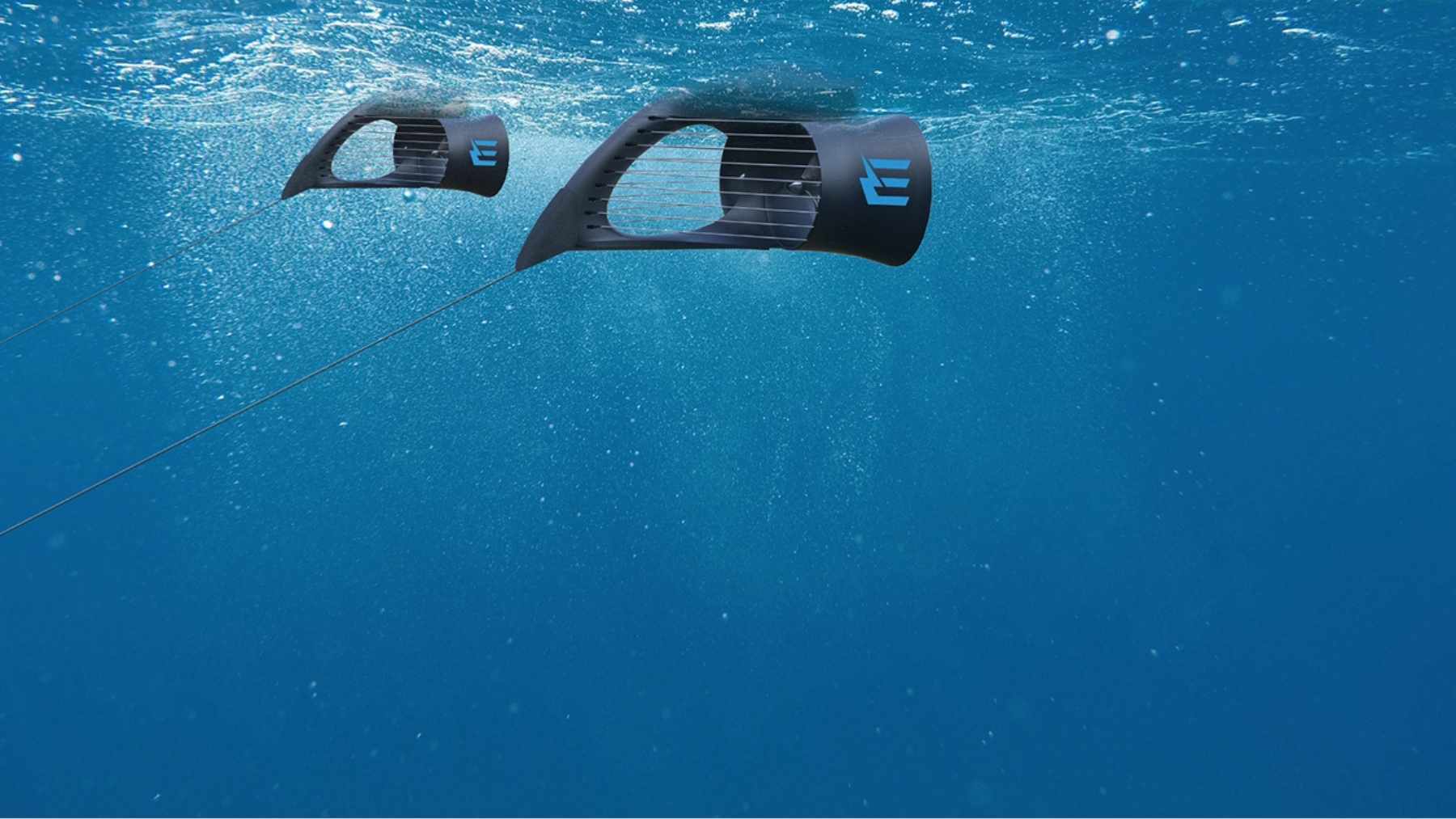
Each Energyfish is about the size of a small car
Up close, an Energyfish is not much to look at, which is partly the point. Each unit runs about 2.8 meters long, 2.4 wide and 1.4 high (roughly 9 by 8 by 5 feet), weighs around 80 kilograms (about 176 pounds), and carries two rotors and a generator. According to technical director Chantel Niebuhr, the rotors start turning in the current, the onboard generator turns that motion into electricity, and a cable runs down an anchor line to the riverbed and then over to shore, where a box on land converts the output into something the grid will accept.
Because the things sit underwater, you would struggle to spot one from the bank. The developer describes them as barely visible and almost silent once they are in, which is where the “invisible turbine” framing in the headlines comes from. They are not actually invisible. They are just submerged, and small.
Small is the operative word for the output, too. Energyminer’s own figures put each turbine at a peak of about 6 kilowatts and an average closer to 1.8, which works out to roughly 15 megawatt-hours a year per unit. That covers maybe four or five four-person households. At the scale of a power grid, one turbine is a rounding error, which is exactly why nobody is proposing to install just one.
One does almost nothing. A swarm of 124 starts to add up
Stack enough modest outputs together and the number stops being a rounding error. The state ministry says 100 Energyfish generate about 1.5 gigawatt-hours a year, enough to cover 400 to 500 four-person households, at generation costs it places in the same range as wind and solar. The Sankt Goar plant is designed for 124 units, so the full swarm would run a little above that.
Getting there is a staged process. Three turbines are in the water now, with installation having begun earlier this year, as the trade outlet Renewables Now reported. The next phase adds 21 more, and the fleet grows from there toward 124. The whole approach rests on a simple bet: that a lot of small, cheap, fish-friendly machines beat one big concrete structure, at least in the right river. It is decentralized hydropower, built without building anything across the river itself.
The whole pitch is power that does not clock off
A river has one advantage a solar panel will never have. Solar stops at sunset, and wind sags whenever the weather refuses to cooperate, but the Rhine keeps moving at night, on calm days, in July and in January. That is the entire reason Energyminer is in the water instead of on a rooftop.
Co-CEO Georg Walder leans on the word “baseload” to describe it, the same term usually reserved for coal, gas and nuclear plants that run no matter what. His point, as he told German broadcaster ZDF, is that the swarm produces around the clock, rather than only during daylight like solar or in fits and starts like wind. The site at Sankt Goar was picked for exactly this reason. The Middle Rhine narrows there and speeds the current to between 1.5 and 2 meters per second (5 to 6.5 feet per second), which the company considers close to ideal.
The Rhine is not always polite. When the water rises or ice starts forming, the company says each Energyfish reacts on its own, sinking to the riverbed to ride out the trouble while still generating, and letting debris pass overhead instead of snagging it. The whole unit can also be pulled back out of the water when it needs servicing.
No dam means no wall for the fish
The reason the turbines hang loose in the current instead of sitting behind a barrier is not just engineering elegance. Conventional hydropower dams up the river, and that wall is a genuine problem for migratory species. In the Middle Rhine those include barbel and nase, fish that need to move up and down the river and cannot do it through a slab of concrete.
Energyminer commissioned researchers at the Technical University of Munich to look at whether its turbines hurt fish. Jürgen Geist, a professor of aquatic systems biology there, has spent years studying what hydropower does to river life, and his read, as relayed by the German daily Handelsblatt, is blunt. At conventional plants, depending on turbine speed and drop height, fish mortality can be severe, with up to half dying under bad conditions. Hydrokinetic machines like the Energyfish, he says, leave fish far more room to simply swim around them, and the study found that running the plant did not change fish behavior in the stretch they monitored. For the record, Energyminer paid for the study, though Geist’s group ran it independently, and his broader work on hydropower and fish goes back years before this project.
Approved in months, not years
Speed is the other half of the sales pitch, and it is the part regulators tend to notice. Walder says a swarm plant like this can clear approval in roughly three to six months. A conventional hydropower project, by comparison, can take something like seven years to get a new build or a major upgrade signed off. Installation runs fast too. The company says a crew can drop ten units into a river in about three days.
Sankt Goar is not the company’s first time in the water. A smaller Energyfish setup already runs on the Lech river in Bavaria, which is part of why Co-CEO Richard Eckl, in remarks reported by Munich Startup, calls the Rhine project the company’s “proof of scale.” The Bavaria install showed the hardware works. Sankt Goar is the bet that you can string a lot of it together, get it permitted, and feed the result into the grid.
None of this remakes a national grid by itself. The ministry that approved the plant is careful to say so, and so is the company. A single turbine covers a few homes, the full swarm a few hundred, and rivers deep and fast enough to make the math work are not exactly everywhere. Officials have said more of these should follow only where the conditions actually fit. But the gap that solar and wind leave behind every night and every calm afternoon is real, and a machine that keeps spinning in the dark, underwater, where nobody can see it, is at least a strange and interesting way to start filling it.
 @philwoods ROOKIE5 months ago