
A nuclear reactor’s steel vessel is the one component nobody at the plant is allowed to be relaxed about. It’s the thick-walled can that holds the fuel and the superheated, pressurized water around it, and the job is to keep doing that for decades without a single crack ever getting past anyone.
Which leaves an awkward problem once the plant is up and running. How do you inspect the welds on something that’s sealed shut, intensely radioactive, and flooded with water?
Japan’s answer has been swimming around inside these things since the 1990s. It’s called the A-UT, it looks a bit like a metal giraffe, and Mitsubishi Heavy Industries put out a fresh look at it last fall, video included, that sent the clip doing the rounds.
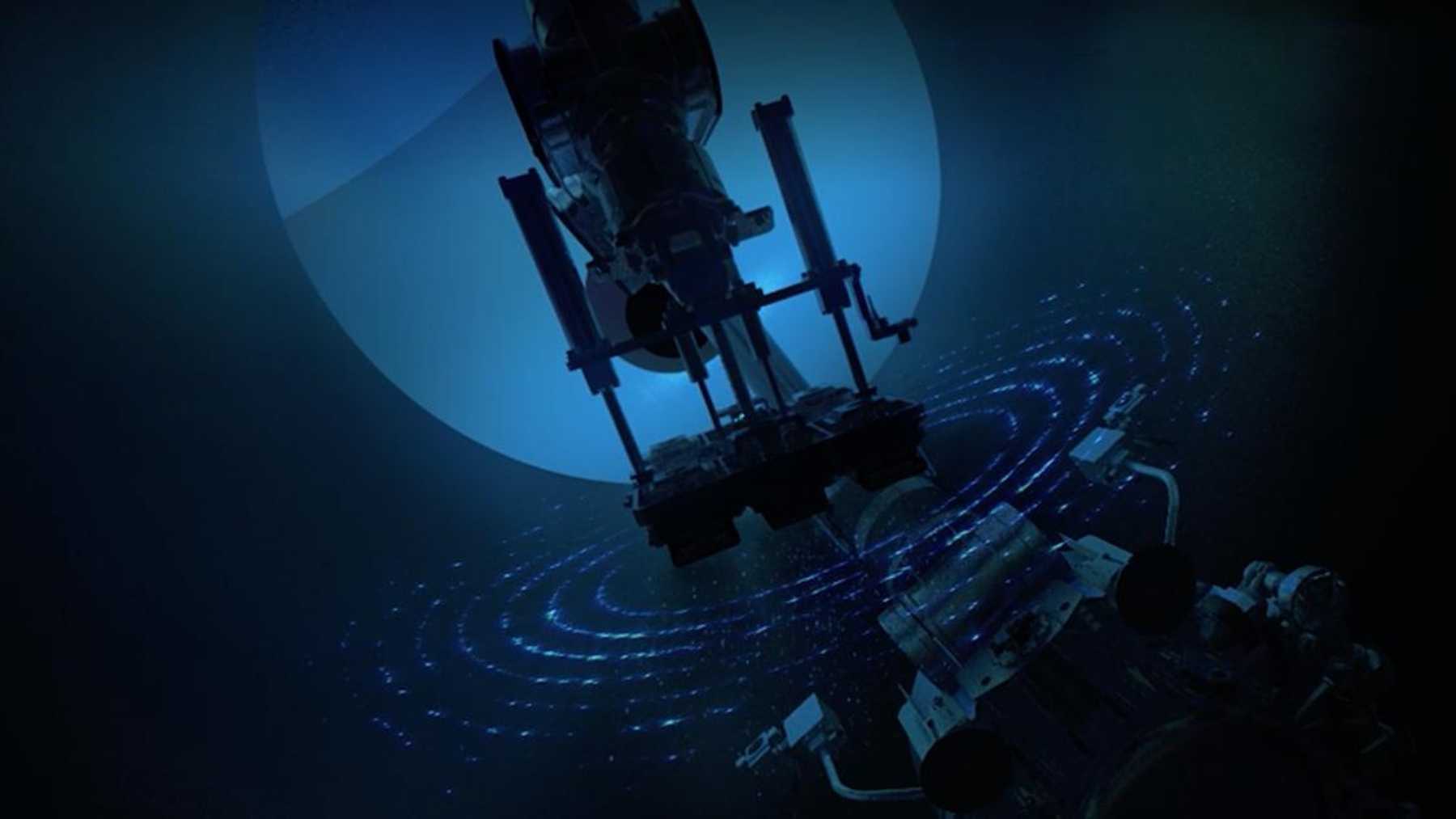
The A-UT, short for autonomous underwater inspection device, carries a seven-axis robotic arm with an ultrasonic probe on the end. Its one job is to hunt for flaws in the weld lines inside a reactor vessel, the part of a plant a person genuinely cannot go and check by hand.
A metal giraffe with an ultrasound wand
The giraffe comparison is Mitsubishi’s, not mine, and once you watch it move it’s hard to argue. In MHI’s own writeup on its Spectra site, the A-UT swims through the flooded vessel, then anchors to the steel with vacuum-pad feet so it can hold position while an ultrasonic probe reads the welds for cracks the eye would never catch.
It scans at about 200 millimeters a second, a touch under eight inches. That sounds slow until you remember it’s doing it underwater, in a radiation field, on a surface no person can share with it. Send two of them in at once and the whole inspection wraps up a lot faster.
The part of the job no person can take
Here’s a bit of shorthand worth untangling. The A-UT gets described as swimming inside a reactor, which can leave you picturing a robot paddling around a plant that’s running. It isn’t, and it couldn’t be. A PWR at power is sealed and holds water well above 150 times atmospheric pressure at north of 300 degrees Celsius. Nothing’s going in there.
The work happens during a scheduled shutdown. The plant comes offline, the vessel head comes off, and the whole thing gets flooded with water for refueling and inspection. That water is pulling double duty: it’s the environment the robot swims in, and it’s the shield that keeps the crew up top out of the dose.
Even flooded and shut down, the neighborhood right next to the vessel welds is no place for a human. The steel has spent years soaking up neutron bombardment, and the radiation field down at the wall would hand a person a dose they can’t take. So the robot takes it instead, which is roughly the entire point.
Interesting Engineering, reporting on the machine, notes it’s been doing this at pressurized-water plants across Japan since 1995 and has racked up around 50 inspections. That’s enough of a track record that the Japan Society of Maintenology has logged it as a number-one “Maintenance Heritage,” the kind of label a tool earns once it’s quietly become part of how an industry runs.
It swims in, then it drives on the walls
For a machine that mostly swims, the A-UT has a surprising amount of car in it. Per Robotics & Automation News, it moves through the water on thrusters, then switches to wheels to crawl along the inside surface of the vessel once it’s where it needs to be. The vacuum-pad feet let it park against a wall and stay put while the arm works, instead of burning energy fighting the water.
That seven-axis arm is the business end. It can carry a payload of up to about 22 pounds (roughly 10 kilograms) and swap tools through a changer, so the same robot runs different inspection heads depending on what the crew is chasing.
It’s not a big machine. Robotics & Automation News lists it at about six feet long, weighing roughly 880 pounds on land, a figure that drops to essentially nothing once it’s submerged, and rated to work down to around 65 feet of depth.
This robot isn’t new, and that’s kind of the point
None of this is a new invention, and there’s no point pretending otherwise. The A-UT has been on the job for thirty years. What changed is the spotlight: MHI released fresh footage, the clip traveled, and it landed at a moment when reactor hardware is suddenly interesting again.
That moment is real. On February 9, 2026, Japan restarted Unit 6 at Kashiwazaki-Kariwa, its biggest nuclear plant and the first TEPCO reactor back online since the 2011 Fukushima accident. Per the U.S. Energy Information Administration, the country now has 15 reactors running, and the unit reached commercial operation in the spring. Prime Minister Sanae Takaichi has been pushing for new build on top of that, small modular reactors included.
Most of the reactors Japan has brought back are pressurized-water plants, which happens to be exactly the kind the A-UT was built to inspect. More running PWRs means more scheduled outages, and more outages mean more welds that need a look from something that can take the dose.
The rest of the world is having its own reactor-steel moment, and it makes a useful contrast. Britain recently welded a full small-reactor vessel shut in under a day, and when an ultrasonic scan flagged something buried in a weld on a new British vessel being forged in France, it made the news. But those are brand-new vessels being checked in a factory, in open air, before any fuel goes near them. The A-UT’s whole trick is doing that same weld inspection years later, on a vessel that’s already irradiated and full of water.
It’s also not Mitsubishi’s only nuclear robot. The company built the 4.6-ton folding arm now reaching into the melted fuel at Fukushima, a completely different beast for a very different job. That one is cleaning up a wrecked reactor. The A-UT keeps healthy ones certified.
So the next time a photo of a giant reactor vessel getting craned into a building crosses your feed, remember the hard part isn’t just getting the steel in place. It’s proving, over and over for the next few decades, that the welds holding it together are still sound. Japan worked out a long time ago that the cleanest way to do that is to send in something that doesn’t mind the radiation and can hold its breath indefinitely.
 @stevehoffmanniv ROOKIE3 months ago