
When Congress defunds a weapons program, the hardware usually disappears quietly. Some of it gets scrapped. Some of it ends up on a concrete pad outside a base museum with a plaque nobody reads.
The Army’s thousand-mile supergun looked like a candidate for that second option. Lawmakers stripped out every dollar of its funding in the fiscal 2022 appropriations bill, the Secretary of the Army terminated the project a few months later, and the Strategic Long Range Cannon never got near a firing unit.
The barrel is still in the Arizona desert, though. And the Army has now fired a live hypersonic warhead out of it.
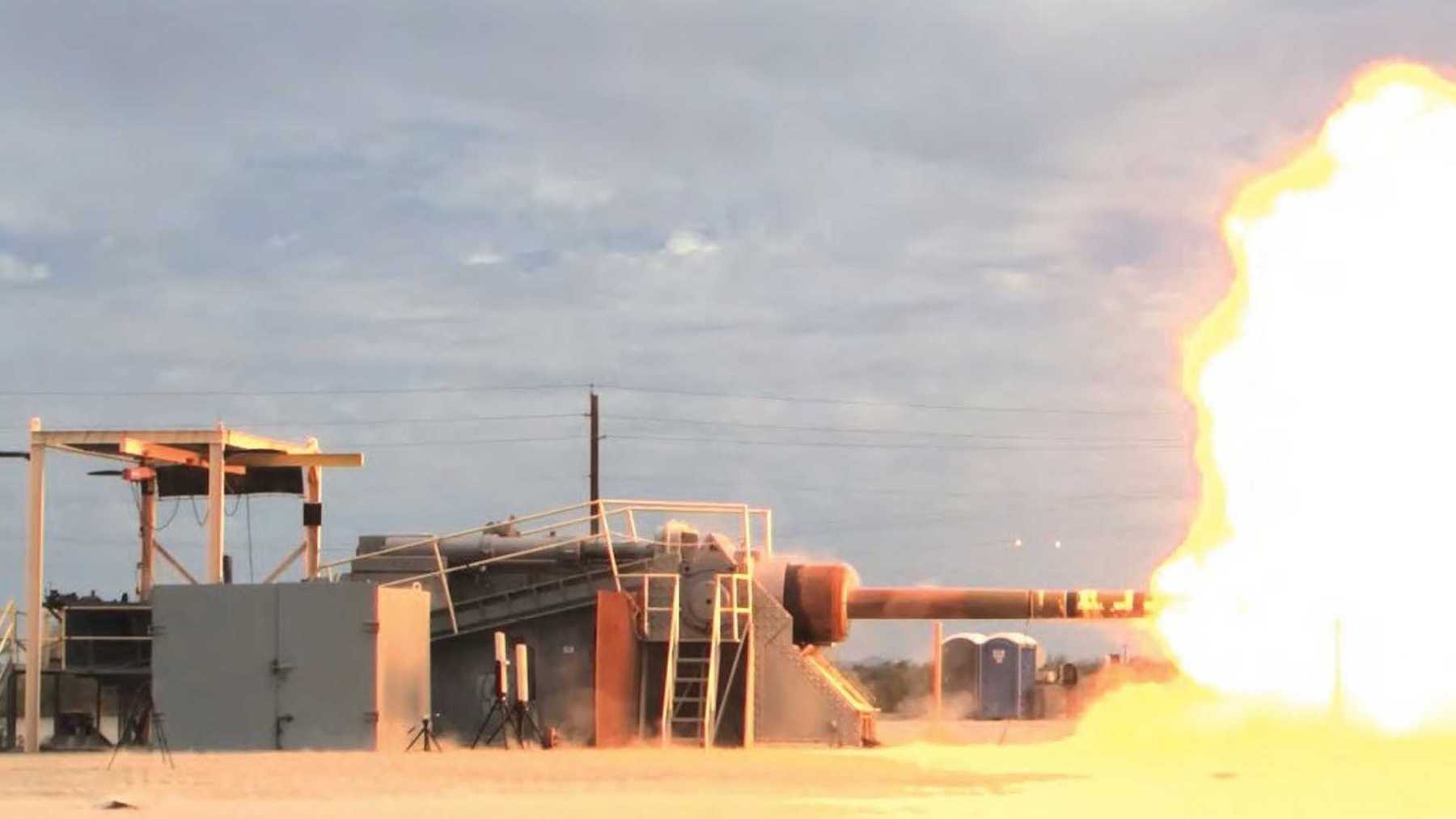
Yuma Proving Ground’s in-house newspaper, The Outpost, reported the shot in its July 30 issue, calling it the first successful live-fire test of a full-scale hypersonic warhead launched from what the Army will only call a cannon base test system, with no weapon named anywhere in the piece. The effort took roughly two years and pulled in Lawrence Livermore National Laboratory alongside the Army’s DEVCOM Armaments Center.
Congress defunded the gun in 2022. The barrel stayed.
The Army release never names the weapon. Thomas Newdick at TWZ identified the gun in the accompanying Army photo as the Heavy Artillery Test System, or a modified version of it, built under the Strategic Long Range Cannon program before that program was killed.
Worth being precise about what SLRC was and wasn’t. It was a science and technology effort aimed at a gun that could put a rocket-assisted projectile on a target 1,000 miles away or more. That was the design goal. Nothing was ever fielded, and nothing about the Yuma shot suggests the Army got anywhere near that range.
The program had been getting around $62 million a year. Appropriators cut the $72.6 million the Army wanted for fiscal 2022, citing an undefined requirement, and that was effectively that.
Army spokesperson Ellen Lovett confirmed the termination in a May 20, 2022 statement to Defense News, and her reasoning was mostly about what came after the research. Even a successful S&T effort, she said, would have meant standing up a development program, buying the system, and creating entirely new units to operate it. Her estimate for all of that was billions of dollars.
So the Army stopped paying to build a giant cannon. It did not stop having one.
Firing the warhead on its own is the entire point
A hypersonic weapon does most of its damage by arriving very fast. Hypersonic means Mach 5 and up, and at those speeds the kinetic energy carried into the target does a lot of the work that explosives normally handle.
The Army’s own Dark Eagle is the clearest illustration. Senior Army officers briefing Defense Secretary Pete Hegseth at Redstone Arsenal last December put its conventional warhead at under 30 pounds, on a missile with a range of 3,500 kilometers, according to Arms Control Today. Thirty pounds of anything is not much. Thirty pounds arriving at Mach 5-plus is a different conversation.
Which is the opening the gun exploits. If the destructive effect is mostly about speed and mass at impact, you don’t strictly need the rocket motor, the stage separation, the guidance package or the flight profile to study what happens when the thing lands. You need the warhead moving fast enough, pointed at a target, with cameras running.
That is roughly what a large-caliber gun does for a living.
The engineering problem is that firing something out of a cannon is violent in ways a missile flight is not. DEVCOM-AC built a launch package designed to survive the acceleration inside the barrel and fitted it with an electronic safe-and-arm fuze, then worked through the internal ballistic loads the warhead would take on the way out. The team fired an inert version first as a proof of concept, made design changes based on what came back, and only then loaded a live warhead.
What the Army chose to describe about the final shot is mostly procedure, and it reads like any other range day. Instruments get checked. The target gets set up. Somebody loads a warhead and a propelling charge into a very large gun, arms the fuze, and then everyone walks to a bunker and watches telemetry from a safe distance.
Then the test director calls the shot, and the Army’s account of what followed is “a massive boom” rolling across the range. Nobody declared anything a success on the spot. The engineers went to the high-speed footage first, which is the correct order of operations and also the least cinematic sentence in the release.
Hypersonic programs are already cutting flight tests to save money
The reason a cheap terminal-effects rig matters right now has nothing to do with the gun and everything to do with the missiles.
The Government Accountability Office published its annual review of major Pentagon acquisitions in early July, and the hypersonic section is rough reading. DefenseScoop’s Mikayla Easley walked through the findings, which cover the Air Force’s HACM, the Army’s Dark Eagle and the Navy’s Conventional Prompt Strike.
HACM is the one that tells the story. Design delays forced the Air Force to cut its planned flight tests from seven to five. GAO’s warning about what happens next is blunt: one significant failure and the program likely can’t finish the remaining five inside its five-year prototyping window.
Five tests, and no room to lose any of them. That is the budget for learning whether a missile works.
The production side isn’t helping. GAO found unclear work standards pushed the Army’s second Dark Eagle battery back by at least six months, and a separate July report found Lockheed Martin’s line building roughly half the hypersonic missiles the Pentagon has asked for.
Put those together and you get the actual argument for the cannon. Missiles are scarce, slow to build and expensive, and every flight test consumes one. A gun-launched surrogate consumes a warhead and a propelling charge. The Army’s stated goal for the capability is a high throughput method of assessing terminal effects at velocity and scale, and throughput is the operative word there. Nobody is short of ideas. They’re short of shots.
We covered the other end of this same problem when the Army finished its first Dark Eagle battery after nearly a decade, and again when two startups put a cheaper hypersonic on an uncrewed boat. The cost of a single shot keeps turning out to be the thing that shapes the program.
The Army left out the two numbers that would settle it
Here is where you should keep your expectations reasonable.
The Army did not disclose what velocity the warhead reached. It also did not say what day the shot happened. The Outpost issue carrying the story is dated July 30, and that date is the publication, not the event.
Velocity is the number that decides how useful any of this is. A gun that gets a warhead to the low end of hypersonic is a useful but partial simulation. A gun that reaches the speeds these weapons actually arrive at is a genuinely different tool. Without the figure, outsiders can’t tell which one Yuma has.
There’s also the question of how closely a gun-launched warhead reproduces a real terminal environment. A missile arrives after minutes of aerodynamic heating and structural loading. A gun-launched package arrives after a short, brutally accelerated hop down a range. Those are not the same history, even if the impact speed matches.
None of which makes the test less real. The Army says multiple hypersonic programs have already asked about folding the method into their own test campaigns, which is the most concrete endorsement in the whole release. It just means the interesting claims are still classified or unmeasured, and the honest version of this story stops there.
Yuma is about to get a lot busier
The range itself is the quiet reason any of this was possible. The Army puts Yuma Proving Ground at over 838,000 acres, which makes it larger than Rhode Island, and it holds the longest overland artillery range in the country. Established in 1943, it is where American long-range fires get shot at things.
Yuma is also about to take on more traffic. On Friday, Army Secretary Dan Driscoll announced a plan to cut how long defense companies wait for range access, from as much as 12 to 18 months down to a target of 30 days, using a reservation portal and a dedicated concierge team. Driscoll’s assessment of the current wait, per DefenseScoop, was that it “is not sufficient.”
Five ranges are in the first tranche, one of them Arizona’s West Cibola Range, a new addition to the Yuma complex. The advertised focus there is drone, counter-drone, missile and interceptor work rather than hypersonics, and a request guarantees nobody a slot.
But the direction is consistent. The Army has decided its bottleneck is test throughput, and it is attacking that from both ends: opening the ranges to more customers, and finding cheaper ways to fill them.
Congress spent a budget cycle deciding the supergun wasn’t worth building, and the reasoning held up. A mobile 1,000-mile cannon would have needed its own development program, its own procurement line and its own units, and the Army walked away from all three.
What nobody costed at the time was the barrel. It was already built, already at Yuma, and already capable of throwing something heavy very fast. Six years after the program died, that leftover is being used to check whether the missiles the Army did buy actually do what the brochures say when they land.
The Army will need to release a velocity figure before anyone outside the program can judge how well that works. Until it does, the most defensible thing to say about the gun nobody wanted is that it finally has a job.