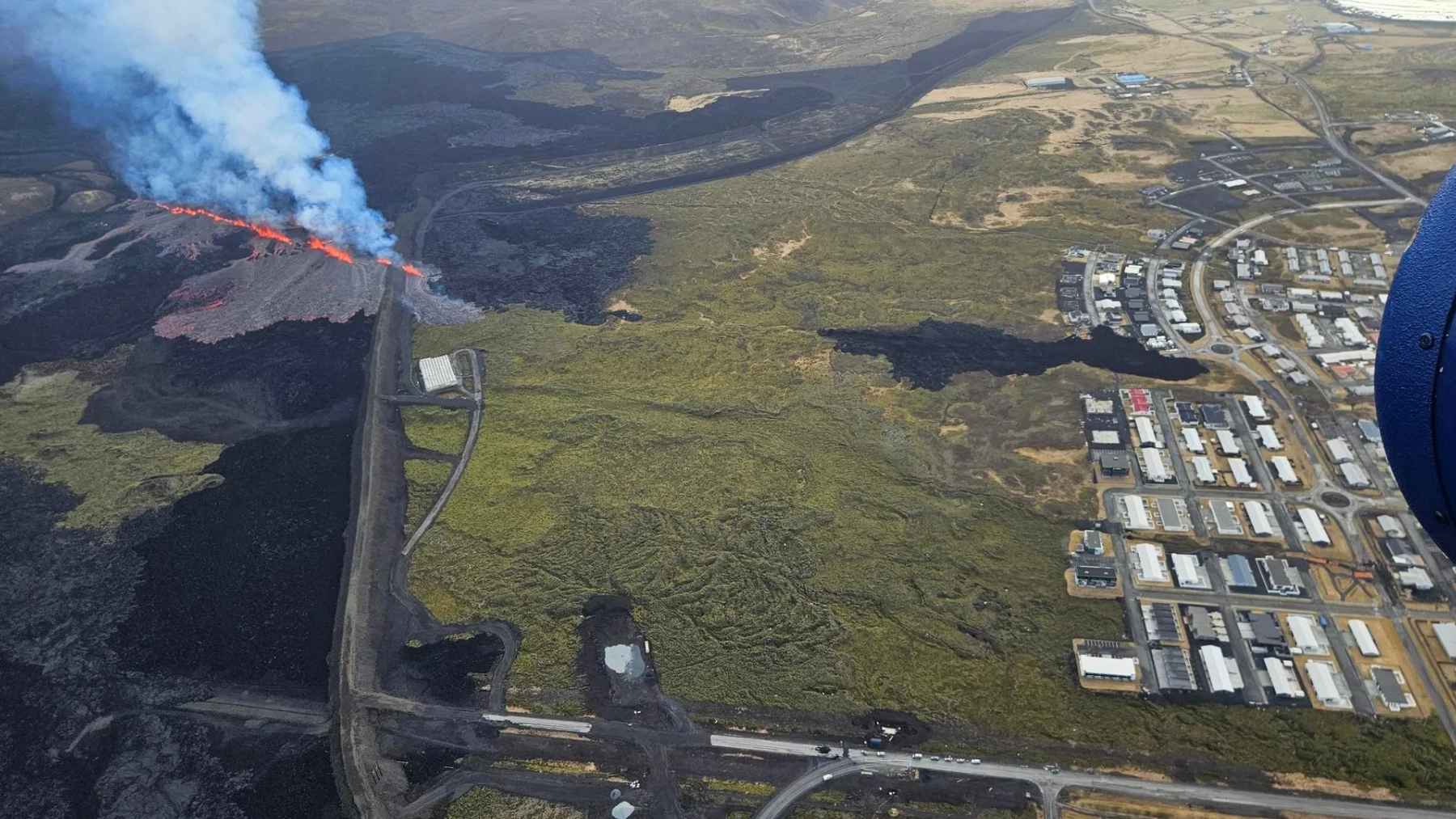

A volcano evacuation looks about the same wherever it happens. Sirens, buses, a line of taillights heading away from the mountain. Iceland does all of that, and then it sends in a hundred bulldozers to argue with the lava.
That argument has been running on the Reykjanes Peninsula since late 2023, and it is now in its strangest phase. The last eruption there, the ninth since December 2023, ended on August 5, 2025. Nothing has broken the surface since, which makes this the longest quiet stretch of the entire sequence.
The quiet is the part worth watching. In its July 21 update, the Icelandic Meteorological Office put the magma now pooled under Svartsengi at 28.3 million cubic meters, with a range of 27.5 to 29.1 million. That is close to a billion cubic feet, and more than the Met Office has measured between any two eruptions since this sequence started.
Sitting on top of it is a set of dirt embankments 8.7 miles long, up to 82 feet tall in the highest sections, built for about $95 million. They are finished, they are idle, and they have not been needed since last summer.
The barriers are ramps, not walls
Start with what these things actually do, because the mental image most people have is wrong. Nobody in Iceland is trying to stop lava with a wall.
Víðir Reynisson, then head of Iceland’s Department of Civil Protection and Emergency Management, explained the logic to Reuters in January 2024: try to block a flow and “the lava will just build up and eventually go over the barriers.” So the embankments are angled across the likely paths instead, built to turn a flow toward ground where nothing matters.
Verkís, the Icelandic engineering firm that designed the system, modeled the flows in HEC-RAS, software the US Army Corps of Engineers wrote for rivers. The inputs were drone surveys of the ground and of the fresh lava piling on top of it.
Molten basalt is not water. It is close enough to a very heavy, very slow fluid that river hydraulics gives you a usable answer, and the models were recalibrated against real flow behavior after every eruption.
Icelandic engineering has an unusually direct relationship with molten rock. A separate project in the north of the country is preparing to drill a borehole into a magma chamber at Krafla on purpose, after a crew hit one there by accident in 2009.
What the ramps are made of is whatever was nearby: basaltic lava, tuff and tephra dug from local borrow pits. The Natural Hazards review of the response calls that fill remarkably loose by the standards of a river levee, and notes that it has been impermeable to lava so far.
Roughly 3 million cubic meters of it had been moved by September 2025, about 3.9 million cubic yards.
A hundred machines, 22 hours a day, and a surcharge on every house in Iceland
Construction on the ring protecting the Svartsengi plant and the Blue Lagoon started on November 15, 2023, days after Grindavík’s 3,790 residents were ordered out with whatever they could carry.
Ari Guðmundsson, a division manager at Verkís, described the tempo to Construction Briefing that month: “We are working both day shifts and night shifts, 22 hours a day.”
Six of Iceland’s largest contractors put about 70 people on site, running Caterpillar D11, D10 and D9 dozers alongside heavy Komatsu and Liebherr machines, with the rock coming out of a quarry at Stapafell mountain.
By late January 2024 there were close to 100 bulldozers, excavators and haul trucks working around the plant, according to HS Orka operations chief Kristinn Hardarson, speaking to Reuters. The plan for that one barrier called for 560,000 cubic meters of gravel and broken lava, roughly 730,000 cubic yards, or 20,000 truckloads.
The ring around Grindavík itself began on January 2, 2024, at an average height of about 13 feet, and needed something like twice the material. The largest sections run about 130 feet wide at the base, 26 to 33 feet tall, and 13 feet across the crest.
Nobody was working under normal conditions. Everyone on site carried a trunked radio and a gas detector, and the whole area was cleared once on an instrument reading that turned out to be false. Work restarted four hours later.
Iceland paid for the first phase by taxing itself. Parliament approved a three-year surcharge of 0.08 percent on the fire insurance value of every property in the country, expected to raise at least 1 billion krónur a year.
The one time the defense failed, the lava came up inside it
On January 14, 2024, a fissure opened at the north end of Grindavík, inside the defended perimeter, and burned three houses. No embankment design solves that. The ground split in the wrong place.
It happened again on April 1, 2025, when a fissure roughly 1,600 feet long opened in the same vicinity. That eruption stayed small and ended fast.
The closest call for the wider region came on February 8, 2024, when lava between Svartsengi and Grindavík cut the pipeline carrying hot water to most of the Reykjanes Peninsula, including Keflavík and the international airport.
With temperatures dropping and plumbing at risk of bursting, tankers hauled hot water to the airport until engineers rerouted the line and restored supply on February 12.
The Blue Lagoon has taken real losses as well. Lava covered much of its original parking area and destroyed its transit center and restrooms during the November and December 2024 eruption, and the spa has closed and reopened with every event since.
Set against all of that, the authors of the Natural Hazards review credit the barrier system with saving the spa complex, the geothermal plant and the town from being overrun. Direct lava damage across the whole sequence has stayed limited and local, which for nine eruptions in a populated area is a strange thing to be able to write.
The published price tag dropped by 60 million dollars in July
Anyone who read that paper when it appeared in April walked away with a different number. The original text put the barriers at 19 billion krónur, about $155 million.
On July 7 the authors filed a correction. The real figure, sourced to a written communication from May 2026, is 11.6 billion krónur through the end of 2025, about $95.1 million at February 2026 exchange rates. Same walls, same rock, $60 million off the headline.
The walls are the cheap part of this. Iceland’s total outlay on this emergency has passed $1.0 billion, around 2.6 percent of its annual GDP. Þórkatla, the state company created to buy out the town, has taken on about 950 homes for 72 billion krónur, roughly $587 million. The barriers cost about a sixth of what the houses did.
In 1973, Iceland tried the other method and needed 6 million tons of seawater
There is a stubborn idea that Icelanders fight lava with water. They did, once, and the numbers are the reason nobody reached for a hose at Grindavík.
When Eldfell opened up on the island of Heimaey in January 1973 and started burying the town of Vestmannaeyjar, crews began pumping seawater onto the flow on February 7. The USGS account of the operation records the dredge Sandy pumping the equivalent of 400 liters per second, about 6,300 gallons a minute, uninterrupted for more than ten days.
The full campaign ran to 6.2 million metric tons of seawater, somewhere near 1.6 billion gallons. It cooled about 111 acres of lava, a layer roughly 30 feet thick brought down to around 212 degrees Fahrenheit, and left an estimated 220,000 tons of salt sitting on the rock afterward.
Grindavík has used water too, but for a different job and in far smaller quantities: hardening the crust on fresh lava so machines can drive over it and keep building. The steering is done with dirt.
The machines are parked and the crews are watching one gap
Barrier work is currently paused. Equipment and crews stay staged nearby so they can move the moment the ground opens, and Verkís construction technologist Arnar Smári Þorvarðarson told Iceland Review in January that the focus is the point where Grindavíkurvegur, Road 43, cuts through the barrier north of town. “That may be the most vulnerable point,” he said.
The Met Office hazard assessment runs to September 30 and has not changed. Seismic activity along the crater row is low, uplift is steady, and the most likely scenario remains a dike pushing out from Svartsengi toward Sundhnúkur.
Volume is not a schedule, and a fuller reservoir does not have to produce a bigger eruption. That distinction gets lost every time someone starts counting cubic miles under Yellowstone. What a fuller reservoir does change is the odds that something gives.
That leaves the warning window as the operative number. Previous intrusions gave between 20 minutes and a little over four hours, which is the entire explanation for why heavy equipment sits parked next to a finished wall. You cannot get a D11 down from Reykjavík in 20 minutes.
What is under the peninsula is not going to reabsorb itself. The 225-megawatt Svartsengi complex supplies electricity and district heating to around 30,000 people who have no realistic backup, and the only thing built to keep lava away from it is 8.7 miles of piled basalt that has spent a year doing nothing at all.