
The American nuclear story for the past two years has been about resurrection. Holtec is trying to wake up Palisades in Michigan on the back of a federal loan guarantee worth up to $1.52 billion. Constellation is doing the same to the surviving reactor at Three Mile Island, renamed the Crane Clean Energy Center, with Microsoft footing the bill.
Spain is running a smaller version of the same argument. On July 16 its nuclear safety regulator backed keeping Almaraz, the country’s largest plant, online until 2030 rather than shutting its two units in 2027 and 2028. The government still has to sign off, and it is deciding in a summer when French reactors keep switching off because the rivers beside them are legally too warm.
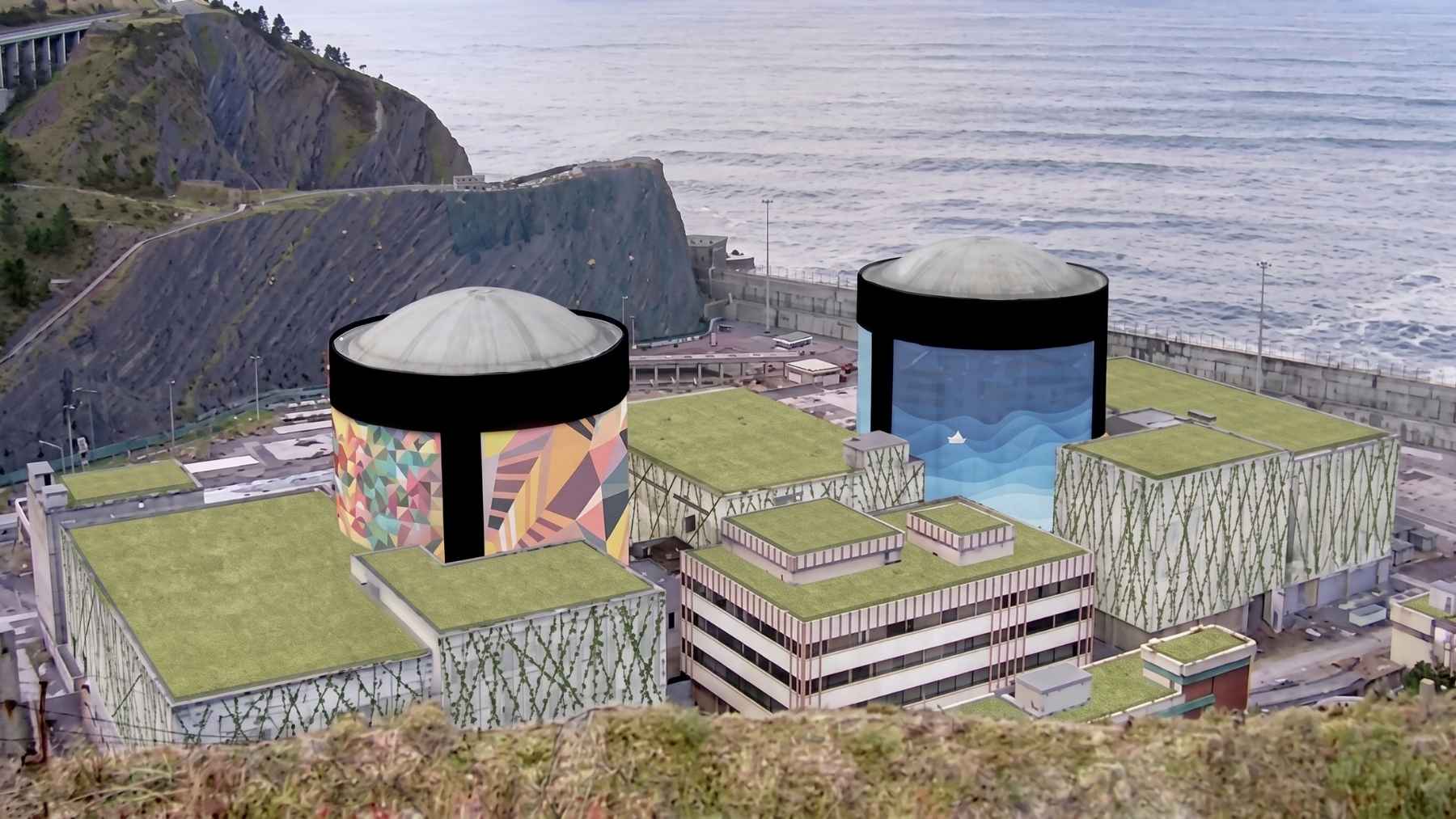
Then there’s Lemóniz. Two reactors on the Basque coast, both close to finished, neither ever fueled, neither ever switched on. Nobody is arguing about restarting that one, because there is nothing to restart.
Instead, the Basque Government has handed the site to a fish company that wants to raise 3,000 metric tons of sole a year inside it.
The plant that never loaded a fuel rod
Lemóniz sits on Basordas cove in Bizkaia, about 12 miles north of Bilbao as the crow flies. Iberduero, the utility that later became part of Iberdrola, got the project approved in 1972 and started building two pressurized water reactors of roughly 900 megawatts each.
Both got close to done. Neither ever received fuel.
What killed it was a stack of things landing at once: a large Basque anti-nuclear movement, a campaign of attacks by the Basque separatist group ETA in which five people connected to the plant were killed between 1978 and 1982, and a national moratorium on new nuclear plants imposed in 1984 after a change of government.
The concrete stayed where it was. So did the seawater intakes, and that turns out to be the part that matters.
Ownership took another three decades to settle. The land passed to the Basque Government in 2019, which is why a regional administration, rather than a utility, is the one deciding what gets built there.
Sole, not salmon, and the first fish is five years out
The project is called Aquacría Basordas. It was presented at the site on April 27 by Basque premier Imanol Pradales, alongside Aritza Rodero, chief executive of the Valencian investment group Atitlan, and Jaime León, chief executive of Sea Eight, the group’s aquaculture arm.
Sea Eight is not learning on the job here. It already runs land-based sole farms at Gijón and Cambados in Spain and at Torreira and Póvoa de Varzim in Portugal, and it bills itself as the world’s largest land-based producer of Senegalese sole.
That is the fish going into Lemóniz: Solea senegalensis, a flatfish close enough to Dover sole that the trade treats both as premium. It gets farmed in RAS tanks, short for recirculating aquaculture systems, which clean and reuse the same water instead of pumping seawater through once and flushing it back out.
The numbers the Basque Government put out are these. A footprint of 46,600 square meters, about 11.5 acres. Three phases spread across ten years. €170 million, roughly $193 million, in combined public and private money. Around 200 direct jobs. Up to 3,000 metric tons of sole a year at full build, which is about 6.6 million pounds of flatfish.
The timeline is the part that keeps getting garbled in translation. Construction on phase one is not due to begin until 2027. First fish reared in 2029. First sale in 2031.
Norway offered more money and more jobs, and lost anyway
That is the version everyone ran in April. The better story surfaced on June 2, when Crónica Vasca published the contents of a written answer from Basque industry minister Mikel Jauregi to a question filed by a regional lawmaker.
Two bidders had made it to the final round. Sea Eight was one. The other was Haugland, a Norwegian firm, and it wanted to farm salmon.
On paper Haugland’s offer was the bigger one by a wide margin: €350 million, close to $398 million, and 250 jobs. Sea Eight’s bid, according to the same document, came in at €54 million, about $61 million, and 190 jobs.
The split between them was what each side planned to do with the buildings. Haugland wanted to demolish the plant and put a new facility up on the cleared ground. Sea Eight wanted to reuse part of what is already standing.
The evaluation ran on three headings. The aquaculture project itself was worth 40 points, economic and social impact 30, and territorial compatibility 30. Haugland won the first two. Sea Eight took the third by enough to win outright, 76.01 points against 64.82.
On March 25 the region’s deputy minister for fisheries, ports and coastline, Leandro Azcue, moved to select the Spanish bid. Azpilur, the public company handling the award, signed it off the following day.
Nothing has actually been signed
The €54 million in that parliamentary answer and the €170 million announced in April are not the same number measuring the same thing, and the answer itself explains the gap.
Jauregi wrote that the €170 million is an estimate, and that the real figure gets fixed once the demolition, site works, construction and operating plans are drafted and approved. He also confirmed there is still no signed agreement between Sea Eight and the Basque Government, and that how much each side contributes has not been settled.
What does exist is a preliminary understanding: the government picks up the civil engineering work and takes a stake in whichever company ends up operating the farm. Everything past that is open.
Which makes €170 million a plan rather than a commitment, and worth reading as one.
The coast is not unanimous about this
Greenpeace Spain called for the project to be dropped the day after it was unveiled, and its case runs on two tracks.
The first is about the ground. The group says the state concession Iberduero held for Lemóniz expired on July 29, 2018, and that Spanish coastal law would have let the government order the company to return the site to its original condition. The Basque administration took the ruins on instead, which Greenpeace estimates saved the utility around €17 million in restoration costs.
The second is about the fish. Sole is carnivorous, so farming it at industrial scale means buying feed made from other fish, and the group argues that pushes the pressure onto wild stocks somewhere else. Spokesperson Lorea Flores made the case that conservation alone no longer covers it and that the cove should be restored rather than built on.
Local government is unsettled too. Nine town halls in the Uribe Kosta district, Lemoiz among them, agreed back in June 2025 to push for a public consultation on what the site should become and asked the regional government for a meeting. As of February this year, it had not been held.
None of that is a legal roadblock. Permits, environmental assessment and a signed agreement all still have to land before anyone breaks ground.
America already turned one of these into an office park
If repurposing an unused nuclear plant sounds like an exotic European idea, the United States got there first and aimed considerably lower.
Washington State’s Satsop site, units WNP-3 and WNP-5, went up starting in 1977 and was cancelled in the early 1980s with one reactor building roughly three-quarters complete and the reactor itself already installed. The bond default that followed ran past $2 billion, the largest by a municipal issuer at the time.
The two cooling towers never passed steam. What the site got instead was tenants. It now operates as the Satsop Business Park under the Port of Grays Harbor, around 1,700 acres with roughly 50 businesses on it. An acoustics lab has been testing loudspeakers inside the old reactor and turbine buildings since 2010, and for a stretch there was a licensed cannabis grow in one of the outbuildings.
Spain’s version is far more ambitious and much further from happening. The country has form for the unconventional industrial answer, though. It is also where a startup has spent more than a decade building a wind generator with no blades on it at all.
For now, nobody has signed anything at Lemóniz, the first excavator is a year out, and the first sole a customer can actually buy is booked for 2031. That is a long runway for a project to fall off.
The concrete, at least, is going nowhere. It has had forty-two years of practice.













Americans on the left coast, meanwhile, are too stupid.