
Every nuclear startup will tell you its reactor is safe. That’s pretty much part of the job. It’s a lot rarer for one to hand you the actual paperwork and let you check the reasoning yourself.
Deep Fission, the company that wants to run a small reactor at the bottom of a mile-deep borehole in Parsons, Kansas, just did that. On September 15, it posted its full Nuclear Safety Design Agreement for the Gravity reactor on its website, along with an FAQ. No one made it do this. Deep Fission says publication isn’t required, and that it’s the first of the companies in the Department of Energy’s Reactor Pilot Program to make the whole thing public.
CEO and co-founder Liz Muller said in the announcement that “the public deserves to see the actual safety case behind this reactor.” It’s a good line, and frankly one I’d like to hear from more nuclear companies.
If you haven’t been following along, an NSDA is basically the agreement between a reactor developer and DOE on which rules the safety case has to follow and how it’ll get graded. It isn’t a license, and it doesn’t let anyone switch anything on. We went through what DOE’s sign-off does and doesn’t cover when it came through.
I read through all 81 pages. A few chunks are redacted, though the cover page says Deep Fission used strikeouts instead of full redactions wherever it could.
So why would a publicly traded company volunteer an 81-page safety file?
I’d guess there are a couple of reasons. Deep Fission trades on the Nasdaq, so looking open doesn’t hurt with investors, and it’s asking a small Kansas town to get comfortable with a reactor under an industrial park. Whatever the motive, the document is out there now, and it’s a lot more specific than the usual press release.
So how does a reactor run at the bottom of a hole?
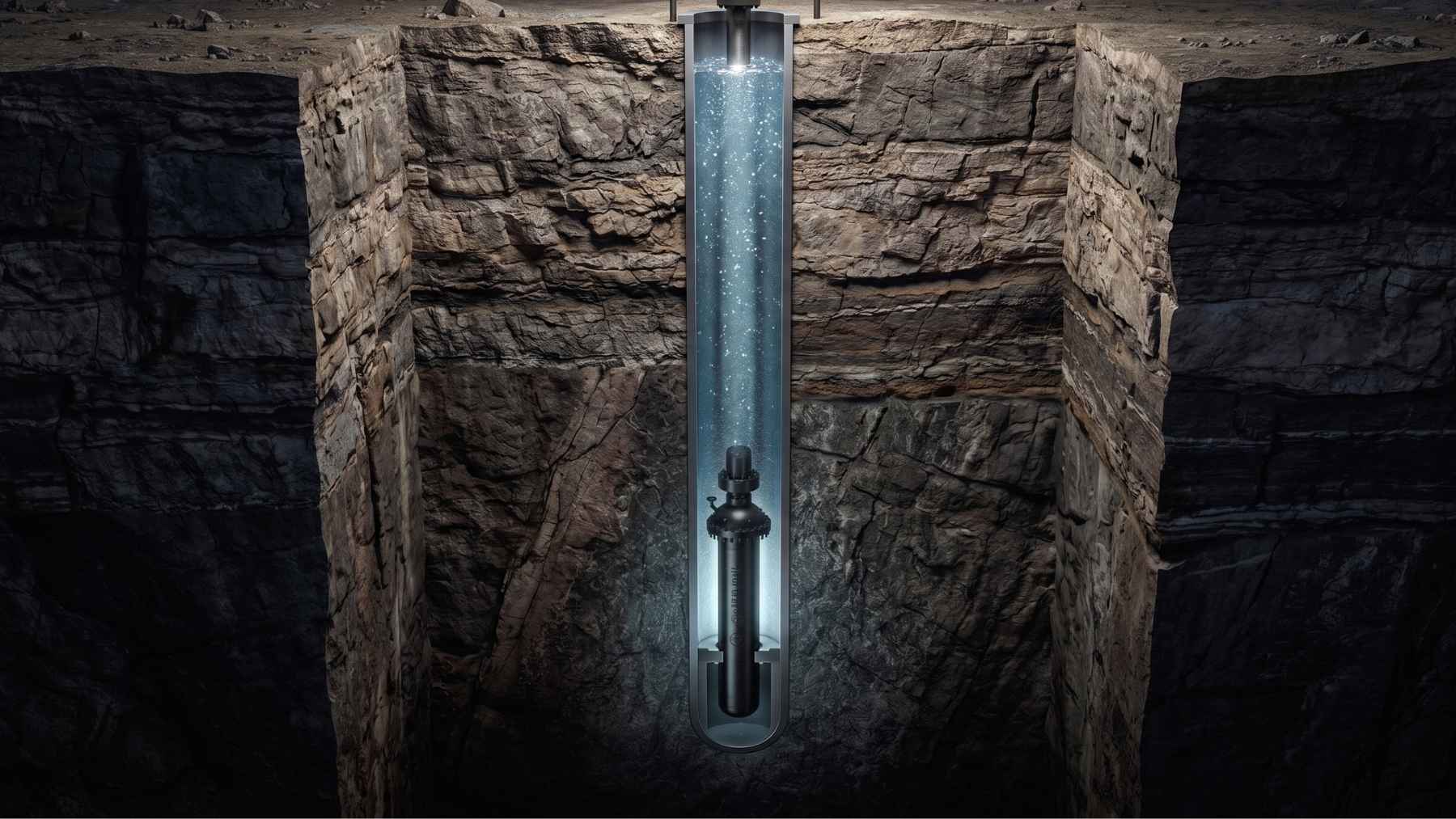
A regular pressurized water reactor uses big pumps to push coolant through the core and a pressurizer to keep that water from boiling. Gravity gets its pressure from the mile of water sitting on top of it, and the NSDA says it doesn’t use primary coolant pumps at all.
Hot water rises through an inner pipe to a heat exchanger, gives up its heat, and the cooler water sinks back down an outer pipe to the core. It’s the same reason hot air goes up a chimney, just with a lot more paperwork.
Operators start the reactor from the surface by slowly thinning out the boron in the coolant. Boron soaks up neutrons, so less of it lets the chain reaction pick up. To shut it down, they add boron back, and there’s a separate pressurized tank of concentrated boron solution next to the canister that can dump into the core automatically.
You may be wondering what happens if the borehole floods. Well, it’s supposed to be flooded. The water in the hole is kept laced with boron too, so if a pipe breaks and that water mixes with the coolant, the document says it should shut the core down on its own.
The pilot unit is rated for up to 19.5 megawatts thermal, and that last word matters. Thermal means the heat the core makes, and the electricity you get out of it is always a good deal smaller, because turning heat into power wastes plenty along the way.
Deep Fission’s FAQ puts the target for each commercial reactor at up to 15 megawatts of electricity. No water-cooled reactor turns 19.5 megawatts of heat into 15 megawatts of power, so that 15-megawatt figure presumably describes a bigger unit down the line than the first one going into the Parsons hole.
The NSDA also plans around a core that runs 1,095 effective full-power days. That’s three years flat out.
Deep Fission’s worst case assumes every fuel rod ruptures
If you only read one section, make it the maximum hypothetical accident. Deep Fission pictured the reactor at full power near the end of that three-year run, when the most radioactive material has built up inside the fuel, and then assumed every fuel rod in the core ruptures. It gave itself no credit for any engineered safety system. The only protection it counted was the stuff built into the site and the design, basically the water column, the depth and the rock.
The company’s estimate is that a worker standing 328 feet from the release would get less than 5 rem.
Rem is the unit US regulators use for radiation dose, adjusted for how much harm that radiation does to a body. According to the Nuclear Regulatory Commission, the average American picks up about 0.62 rem a year from everything, radon and medical scans included, while people who work with nuclear material are allowed up to 5 rem a year. DOE’s own guideline for judging accidents like this runs from 5 to 25 rem, and Deep Fission’s estimate lands under the bottom of that range.
Is that a big deal? Kind of. I’d still file it under promising but preliminary. Deep Fission ran the numbers without weather data from the Parsons site, which it doesn’t have yet, so it plugged in a deliberately pessimistic assumption about how a release would spread through the air. The FAQ says the analysis will be refined as the design matures, and you should keep in mind it’s the company’s own calculation, sitting inside a document DOE approved.
Some of the file is blacked out
The fuel section is one of the redacted bits, so I can’t tell you exactly how much uranium goes into the core. The NSDA only says the reactor uses a fraction of a conventional fuel load, and that it runs qualified low-enriched uranium fuel assemblies already used in pressurized water reactors around the world.
The document also lists the accidents Deep Fission still has to analyze in detail, and it’s a long one. It includes a total loss of AC power, a leaking heat exchanger tube, an operator mistake while bringing the reactor critical, an earthquake or tornado, a plane crash, sabotage, and my personal favorite, dropping the reactor canister while lowering it down the hole. The answers to those are due in later safety documents.
Then there’s a line that jumped out at me. Deep Fission writes that it “does not claim to conform to all preexisting LWR regulatory guidance.”
LWR means light-water reactor, which covers every commercial power reactor running in the US, and the company argues that rules written for big reactors on the surface could add cost without a matching safety benefit for one sitting in a hole. It says it’ll show how it meets the goals behind those rules instead. That’s arguably the whole idea behind the pilot program, but it’s also the kind of sentence that makes people nervous.
Deep Fission also admits parts of the design have moved on since this version was drafted. It hasn’t listed which ones, and it says it’ll share updates as DOE’s review moves along.
The used fuel stays down the hole
At a regular plant, spent fuel gets lifted out and parked in a cooling pool. According to the NSDA, Gravity’s spent fuel stays inside the reactor canister hanging in the borehole, where the rock and water around it carry off the leftover heat. Deep Fission says it can still fish that fuel back out with standard deep-well methods, and it may bring the whole reactor module up for hands-on inspections too.
Oil and gas crews call that kind of job a workover. It’s basically pulling equipment out of a well to check or fix it, then sending it back down.
The company has already rehearsed the up-and-down trip, sort of. On September 3, a commercial drilling crew lowered a 20-foot prototype canister with no fuel inside 100 feet down a 34-inch borehole in Parsons and brought it back up. The real one is supposed to sit around a mile down, so it’s a start. We covered the prototype’s arrival in Parsons over the summer.
The NSDA also mentions a 99-year lease on the site with options for two more 25-year terms, 149 years in all. That’s a long time to rent a patch of Kansas with a hole in it.
Deep Fission posted the NSDA and its FAQ on September 15, and according to that FAQ, the next paperwork DOE needs to approve is a preliminary safety analysis along with a quality assurance program.