
An offshore wind farm usually arrives before the hardware that carries its power to shore. A developer wins the seabed, orders the turbines, and the grid operator builds a connection out to meet them. Belgium did it the other way around.
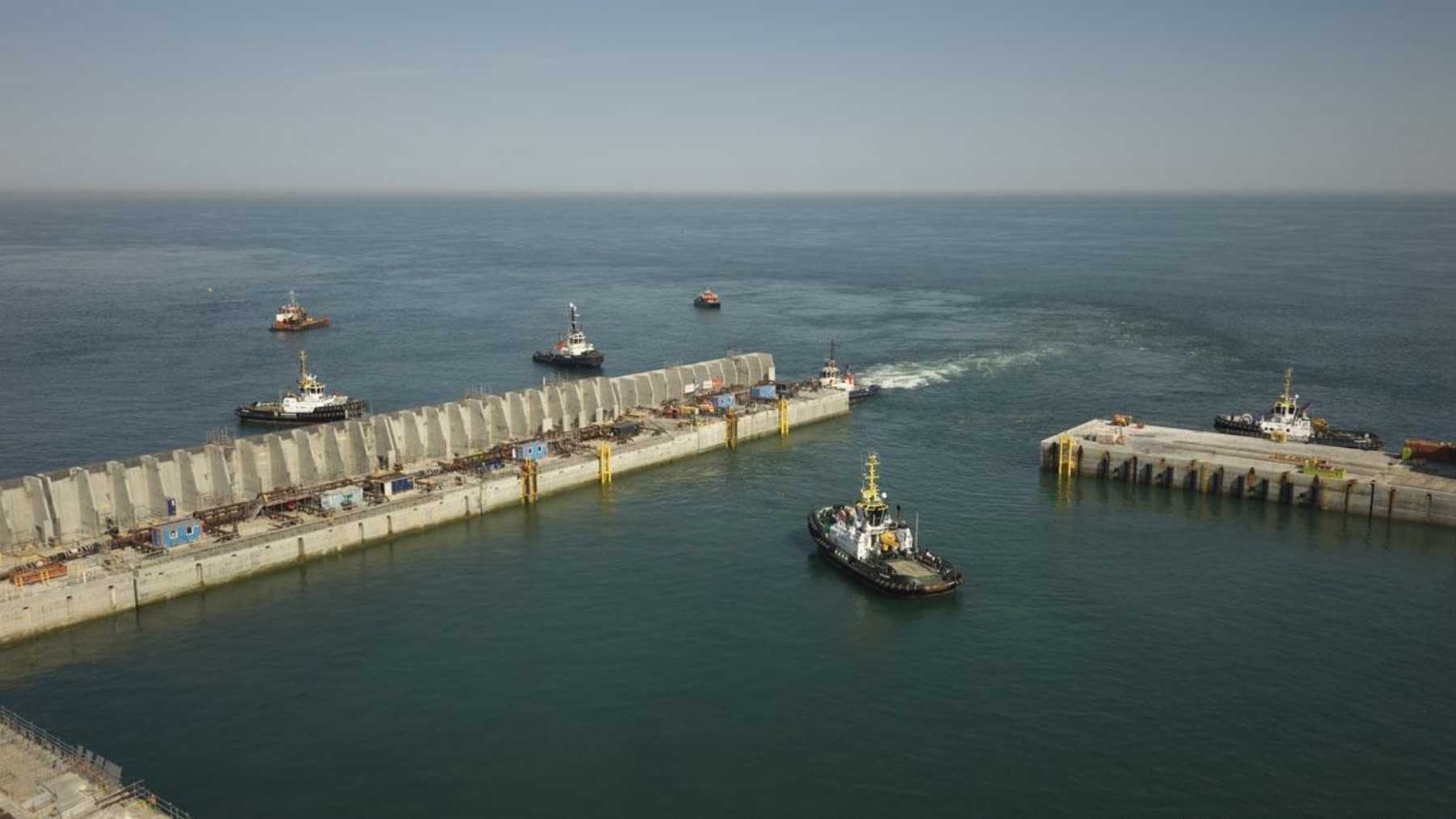
On August 20, a crew working 28 miles off the Belgian coast lowered the 23rd and final concrete caisson onto a prepared bed of rock, and the outer wall of the world’s first artificial energy island closed.
Not one turbine inside that ring belongs to anybody yet.
Elia Transmission Belgium owns the project and runs the country’s high-voltage grid. Jan De Nul and DEME built the ring together as a consortium called TM Edison. Elia had a €99 million European Union subsidy (about $115 million) attached to finishing the foundations on schedule, and Jan De Nul said the consortium worked to land inside that window.
Each box weighs 24,250 tons and took three months to pour
Every one of the 23 caissons weighs approximately 22,000 metric tons, or about 24,250 US tons. Each runs 190 feet long and 92 feet wide, which is 58 by 28 meters. Heights range from 75 to 105 feet, and the tall ones are the ones carrying a storm wall on top.
Vlissingen cast all 23. Jan De Nul had around 300 people on that yard every working day and says a single caisson took roughly three months to finish.
Then the tugs took over.
Each box was floated out, walked to its position in the ring, and sunk onto the rock by filling it with sand until it stopped moving. Fill the middle with more sand, compact it, and open water becomes ground. Elia has permitted about six hectares, or roughly 15 acres, for the electrical gear that goes on top.
Sixteen months separate the first box from the last. Crews submerged the first two in April 2025, wrapped the 2025 offshore season in October, and picked the job back up this spring. The North Sea sets that pace rather than the yard. Vlissingen had finished casting all 23 caissons by January 2026, months before the last of them reached its slot in the ring.
We went through the casting line, the slipforming and the 98-kilometer tow route back when the ring was still going in. The same trick is on the drawing board in Britain, where a proposed tidal lagoon in Somerset would use 206 caissons to build a 14-mile wall instead of a circle.
The oyster reefs went down before the last box did
At the end of July, crews lowered rocks seeded with young oysters around the island’s perimeter. The Reefcovery project grew them.
Bart Callens, Project Director for the Princess Elisabeth Island at Jan De Nul, said “the rocks protect the island against erosion” and give a new oyster reef something to start on.
Belgium wrote a nature-inclusive design into the island’s environmental permit, so the reef work sits in the contract next to the concrete. Rock armor was going down around the caissons anyway to stop storms scouring out the seabed underneath them. Somebody decided it might as well have oysters on it.
Belgium threw out the direct-current half of the island
The version of this island that got approved looked different. Elia designed it to carry both alternating current and high-voltage direct current, with the DC gear feeding a hybrid interconnector to the United Kingdom called Nautilus and a second one to Denmark called TritonLink. Two HVDC converters were meant to do that job, one on the island and one on the Belgian coast. They would also have connected the third and largest wind farm in the zone.
None of that is happening. Elia’s board postponed signing the HVDC contracts on February 4, 2025, blaming an overheated global supply chain and quoted prices far above its own estimates. Elia warned at the time that the delay would push the overall project back by roughly three years. Later in 2025 the Belgian government removed the DC component from the project entirely and handed Elia a mandate to draw up an alternative concept, one that still includes a second link to Britain. Trade reporting at the time put the saving from that decision at a minimum of €3 billion, about $3.4 billion. The European Investment Bank had already committed €650 million, around $703 million, to the first phase of the island’s transmission infrastructure.
So the island now bundles AC.
Elia’s already-signed alternating-current contracts cover two wind farms of 700 and 1,400 megawatts, or 2.1 gigawatts between them. The Princess Elisabeth Zone is drawn for 3.5 gigawatts across three sites, which leaves the third one, another 1,400 megawatts, as the piece that lost its connection.
Nobody owns the first 700 megawatts yet
The Belgian federal government launched the tender for the first site, PEZ 1, in November 2024 and cancelled it in July 2025. Legal uncertainty around the support mechanism, state aid approval, the island’s delivery date and the onshore grid reinforcements all fed into that.
A replacement framework cleared the Council of Ministers this summer. Federal Energy Minister Mathieu Bihet presented it on July 18, saying the government had gone for a tender that “holds up legally” rather than a fast one.
The new rules stretch the construction window from four years to five, remove the cap on the strike price, and run a single two-sided contract for difference where the lowest bid wins. Mandatory citizen participation is gone, though developers can still offer it voluntarily.
One clause will look familiar to anyone tracking American turbine procurement. Belgium aligned the tender with the EU’s Net-Zero Industry Act, so at least 75% of the project’s wind turbines cannot be manufactured or assembled in China, and the rules put separate limits on Chinese-made critical turbine components and permanent magnets.
Nothing goes to auction yet. The revised rules head to the Belgian Council of State for review, then to the European Commission for state aid clearance, and only then can the PEZ 1 auction restart.
Sand now, cables in 2027, electricity in 2031
Dredgers will spend the coming months pumping sand inside the ring and compacting it into ground. Cable connections to the mainland follow across 2027 and 2028, and Jan De Nul plans to lay three AC cables to shore using one of its new cable-laying vessels. Installation of the island’s electrical infrastructure starts in 2029.
A royal decree approved alongside the tender framework sets October 1, 2031 as the latest date for the island’s first phase to enter service. Jan De Nul describes the 2031 completion as a timeline confirmed by law, which is a sentence you do not often get to write about a construction schedule.
Denmark is running a version of the same experiment with better geology. Bornholm already exists, 39,500 people live on it, and its converter buildings came in 85% over budget before a single turbine went out to auction. Belgium had no island to start with and had to pour one.
Elia now has a closed ring of concrete, a sand fill about to start and a legal deadline of October 1, 2031. The 23rd caisson went onto the seabed on August 20, 2026. The tender for the first 700 megawatts that will plug into it has been suspended since July 2025, and it still has to clear the Belgian Council of State and the European Commission before anyone can bid.