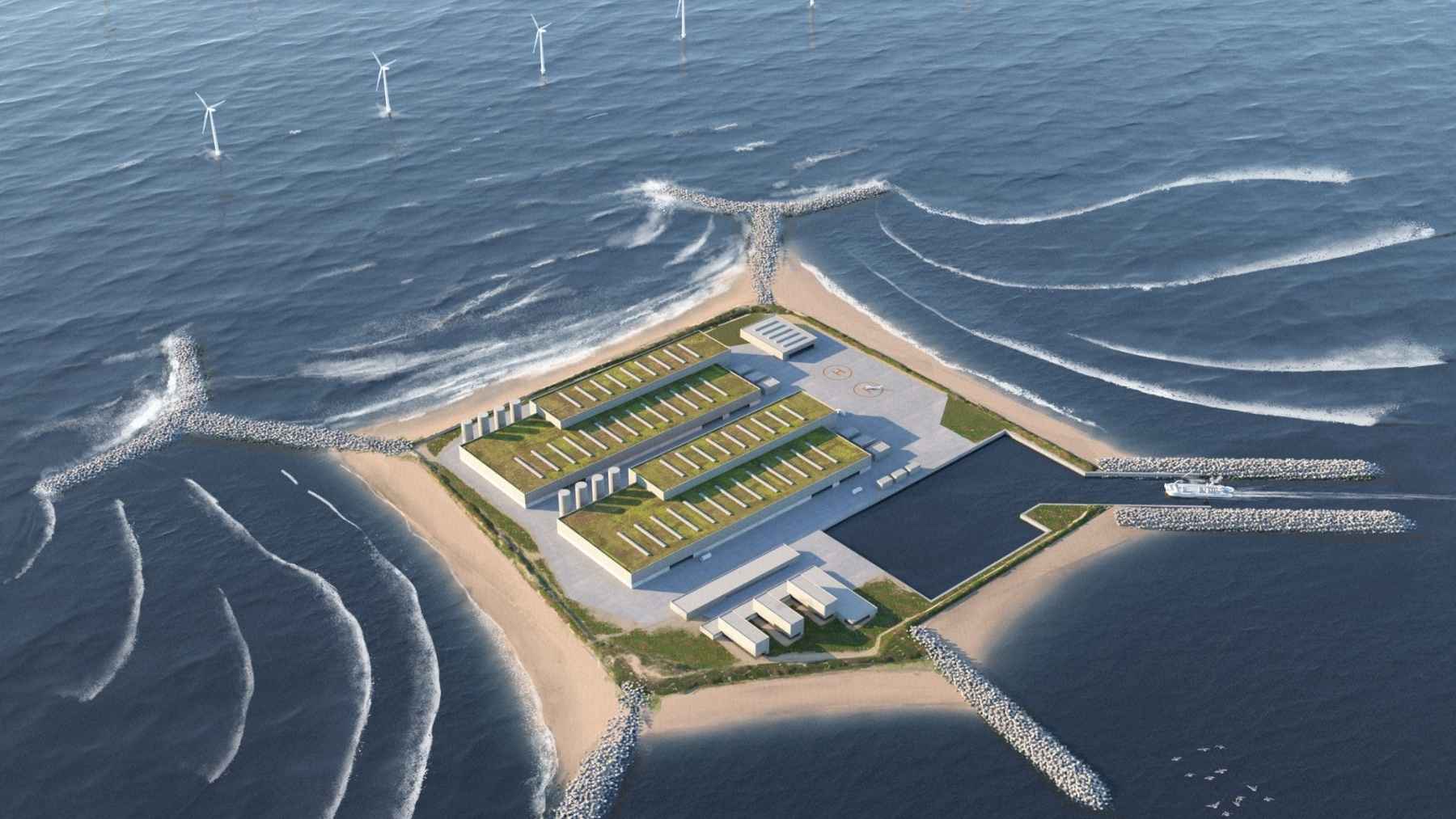

Big construction projects go over budget. Nobody in Denmark is pretending otherwise, least of all the state-owned company running this one. The odd part about the overrun that surfaced on Bornholm Energy Island last week is where it landed.
None of it is in the 124 miles of undersea cable, and none of it is in the four converter systems Siemens Energy is building. The extra 1.7 billion Danish kroner, about $260 million, went into the buildings that house all that equipment, and a good share of that went into the ground those buildings have to stand on.
Energinet, the Danish transmission system operator, awarded the onshore works to contractor Per Aarsleff A/S on July 17 for 3.7 billion kroner, roughly $565 million. Two companies bid. Aarsleff was the cheaper one.
Four days later, Climate, Energy and Utilities Minister Samira Nawa told the nine parties backing the project that the construction budget for those buildings had run 1.7 billion kroner past plan. TV2 Bornholm, citing local paper Bornholms Tidende, put that at 85 percent above the figure approved last September.
The buildings matter more than the word suggests. Bornholm is being rebuilt into a hub that gathers offshore wind out in the Baltic and splits it between two national grids, which the Danish climate ministry describes as the first energy island in the world doing that particular job. The machinery doing the splitting has to live somewhere.
The overrun is in concrete, not copper
Energinet gave four reasons for the jump, and only one of them is the usual inflation excuse. Construction prices rose, which everybody expected. The soil turned out to be difficult, and the requirements for physically protecting the station were tightened. Then there is the plain fact that hauling that much material to an island and erecting buildings that size on it costs money in a way a spreadsheet in Copenhagen tends to underrate.
The soil is the interesting one. Energinet told TV2 Bornholm that the geotechnical survey results arrived in December 2025 and January 2026, and were written into an updated tender package before bidders submitted their final numbers.
So the contractors were not guessing. They read what the drills found, priced the risk of building on it, and the bids came back where they came back. The 1.7 billion is the market telling Denmark what that ground is worth.
Energinet says it is too early to know whether the overrun changes the onshore installation itself. Nawa told the backing parties the gap does not require a new political process, but her ministry will be telling Energinet to cut costs where it can and to budget more carefully next time.
That has not gone down quietly. Mads Fuglede of the Denmark Democrats has criticized Nawa for not keeping the backing parties properly informed, according to Danish engineering outlet Ingeniøren. She has held the job since June 3, having taken over from Lars Aagaard, who negotiated the deal that created this bill in the first place.
Everything on Bornholm costs more because it is on Bornholm
Bornholm sits closer to Sweden and Poland than to the rest of Denmark, which is the whole reason it works as a collection point for Baltic wind, and also the reason nothing about building there is cheap.
Around 39,500 people live on it. Its link to the wider grid today is a single sea cable to Sweden, which the European Commission’s clean energy for EU islands programme rates at 60 megawatts. The project now under construction is sized for 3 gigawatts.
The onshore site is on the southwestern side of the island, roughly half a mile south of the villages of Nylars, Lobbæk and Aakirkeby, per the Danish Energy Agency. Three of the four large station buildings go there, with the fourth at Lindehøj on Zealand. Between them they house the project’s three converter stations in Denmark.
Every beam, every transformer and every load of concrete for those three buildings crosses water first. Danish trade outlet Dagens Byggeri reports that Artelia is advising on the build and C.F. Møller Architects handled the design of the buildings and the landscaping around them, which tells you how much attention the visual side of this got before anyone costed the foundations.
Ground conditions have a habit of being the expensive line item up here. Norway is currently blasting the world’s deepest road tunnel under the Boknafjord through rock nobody had mapped in detail, for the same reason nobody prices these things right: you do not know what is down there until you drill it.
The cable contract still looks like the cheap part
Denmark’s side of the wiring went to NKT in September 2025 for around €650 million, about $740 million. That covers a 525 kV high-voltage direct current system running 124 miles offshore between Bornholm and Zealand, plus 10.4 miles onshore.
NKT is making the cable at its plant in Karlskrona, Sweden, which is a short trip across the Baltic from where it goes in the seabed. Installation is planned for the NKT Eleonora, a cable-laying vessel that is still being built and is expected to start work in 2027. The German link runs off a separate framework NKT signed with grid operator 50Hertz back in 2023.
Siemens Energy has the converters. Energinet and 50Hertz placed a joint order for turnkey delivery of four converter systems split across Bornholm, Zealand and the German mainland, with the systems due by the mid-2030s.
The two exits are not the same size. The line to the German coast near Lubmin is rated at 2 GW. The line to Zealand is rated at 1.2 GW. Most of this power is going south, which becomes relevant to who pays for it.
The two grid operators have done a smaller version of this before. Kriegers Flak, their combined grid solution wiring Danish and German offshore wind into both countries at once, has been running since 2021. Bornholm is the same idea scaled up, with an island in the middle doing the collecting.
Nobody has auctioned the wind farms yet
The ministerial photo calls tend to blur a split that matters. Energinet builds the cables and the onshore stations. A separate body, the Danish Energy Agency, runs the tender for the wind farms themselves, on its own timetable.
The cables and converters are ordered. The buildings now have a contractor and a price. The 3 gigawatts of turbines those cables exist to carry have not been put out to auction.
Denmark has reason to be careful about that. Its December 2024 offshore wind tender attracted zero bids, which is what pushed the government into offering subsidies through contracts for difference. That redesign worked: bids arrived for both Nordsøen Midt and Hesselø when the deadline closed on May 20 this year, and results are expected by January 2027.
Brian Vad Mathiesen, professor of energy planning at Aalborg University, told TV2 Bornholm the Hesselø numbers are the ones to watch, because the wind resource there resembles the water off Bornholm more closely than the North Sea sites do.
Germany pays 70 percent, and that is the actual first
The reason this project survived at all is that Denmark stopped trying to pay for it alone. On January 26, at the North Sea Summit in Hamburg, the two governments signed a bilateral agreement in front of Chancellor Friedrich Merz and Prime Minister Mette Frederiksen. The European Commission, which is putting €645.2 million of Connecting Europe Facility money into the interconnector, calls the result a first of its kind.
The specific first is the cost split. Germany takes 70 percent of the support, Denmark 30, on the logic that Germany consumes most of the electricity. Danish broadcaster DR reported the combined worst-case exposure at up to 139 billion kroner, around $21 billion, with the Danish government putting its own realistic bill closer to 23 billion kroner. A broad Folketing majority signed off on the Danish share on February 3.
Denmark has other things pointed at Germany besides electrons. It is also working on converting salt caverns at Lille Torup into hydrogen storage and a pipeline south to the German border, a plan that has already been shortened and delayed once.
Belgium went the other way entirely and built its energy island out of 23 concrete caissons dropped into open North Sea water, because there was no land out there to build on. Denmark picked an island that already existed, with a ferry port and 39,500 residents attached. Last week put a price on what the ready-made island costs instead.
Denmark finally has one number that is not a model
Nothing here suggests the project is in trouble. The cable is ordered, the converters are ordered, the buildings have a contractor, and two governments and the European Commission have all committed money in writing. Operation is targeted for 2036, against an original goal of 2030.
What the overrun does is put a real number on a project that has run on estimates for six years. Every figure attached to Bornholm Energy Island until now came from a model. This one came from two companies looking at drill logs and quoting a price.
The next real number arrives when someone bids to put 3 gigawatts of turbines in the Baltic south of the island. Until that happens, 1.7 billion kroner over on the buildings is the most honest price anyone has on this thing.