
Sweden gets about 30 percent of its electricity from six nuclear reactors, and every single one of them was switched on before the first Top Gun hit theaters. The newest machines on the Swedish grid date to 1985. Since then the country has spent four decades running old reactors, closing a few, and arguing about whether it would ever build another one.
On June 15, that argument produced an answer with a spec sheet attached. A project company called Videberg Kraft selected Rolls-Royce SMR to deliver three small modular reactors on the Värö peninsula, on Sweden’s west coast, right next to the Ringhals plant that has been running since the early 1980s.
The numbers are not small for something with “small” in the name. Three reactors, 1,500 megawatts of electric capacity between them, around 6 percent of everything Sweden consumes in a year, designed to run for more than 60 years. It would be the country’s first new nuclear power plant in more than four decades, with the first unit targeted for the mid-2030s.
Then, ten days later, the Swedish state bought 60 percent of the company. Which is the part that separates this from every nuclear press release you have ever skimmed.
Sweden looked at more than 70 reactors and picked the British one
This was not a quick decision. Vattenfall, the Swedish state utility behind Videberg Kraft, says the supplier hunt ran for four years and started with more than 70 reactor designs on the table. Rolls-Royce dates the process to 2022, and it covered both full-size plants and small modular ones.
By the end, two options were left standing. Five BWRX-300 units from GE Vernova Hitachi, the American small reactor Canada is already assembling at Darlington, or three of the bigger British boxes from Rolls-Royce SMR. Sweden went British.
The reasoning is refreshingly unromantic. The Rolls-Royce design is a pressurized water reactor, “the same type used at Ringhals today,” as Anna Borg, Videberg Kraft board member and Vattenfall’s CEO, put it. The operators next door have run that flavor of physics for four decades. Borg also pointed at a commercially attractive contract structure, and acting Videberg Kraft CEO Desirée Comstedt noted that most of Rolls-Royce’s subcontractor network sits in Sweden’s geographic neighborhood.
There is also safety in numbers. Sweden is the third European country to pick this exact machine, after Britain signed Rolls-Royce SMR in April to build three of them at Wylfa in Wales, and the Czech Republic lined up its own units at Temelín. Tufan Erginbilgic, CEO of parent company Rolls-Royce plc, called his nuclear unit “the only company with multiple contractual commitments to deliver SMR units in Europe.” That is a CEO talking his own book, but the book does currently have three countries in it.
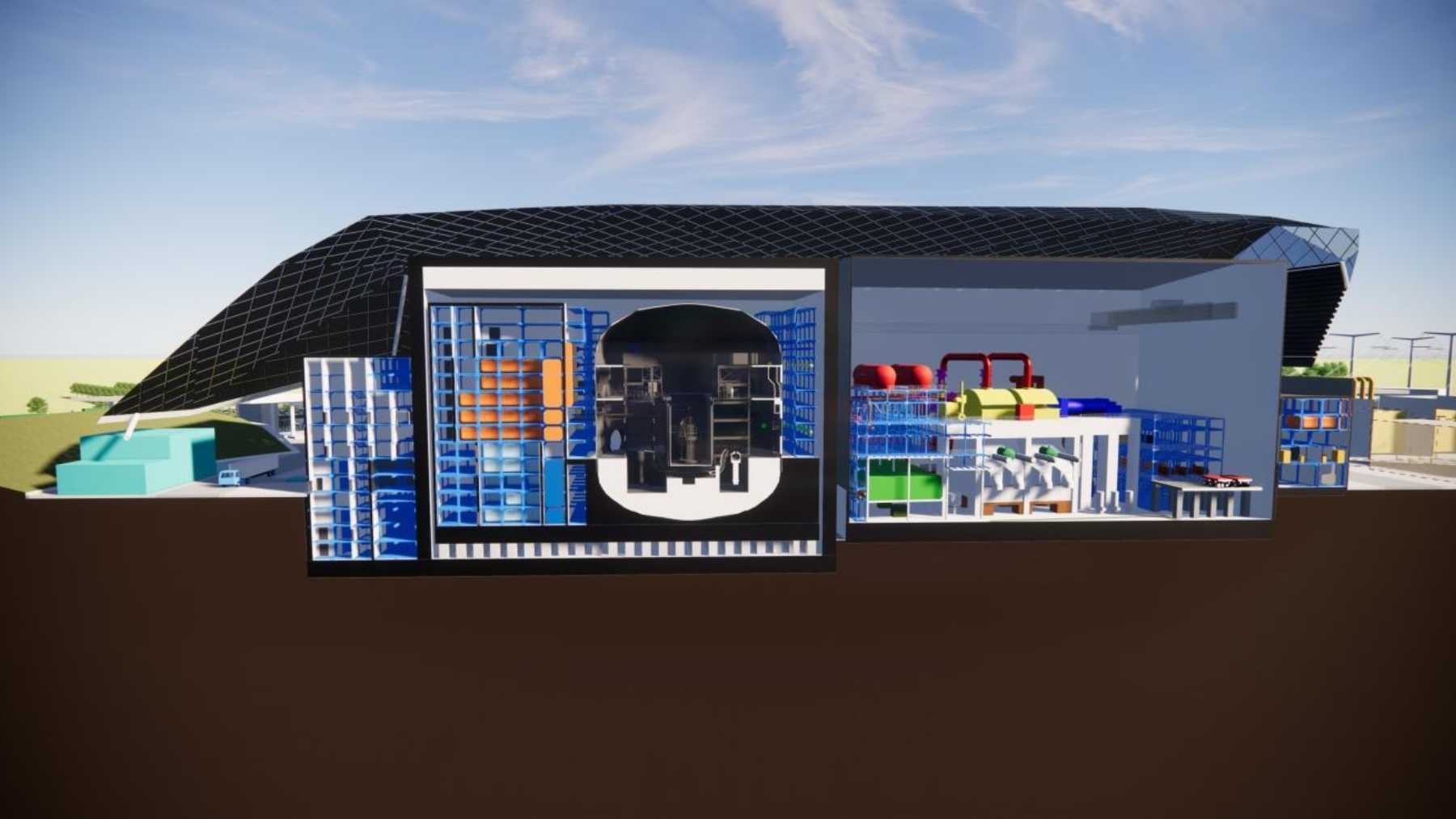
The machine is a 470-megawatt box built mostly in a factory
Each Rolls-Royce SMR is rated at 470 megawatts. Vattenfall figures the three units together can put out around 12 terawatt-hours of fossil-free electricity a year, which is serious output for southern Sweden, where the power-hungry industry lives.
The pitch that won the competition is manufacturing, not physics. Rolls-Royce says roughly 90 percent of the manufacturing and assembly happens under factory conditions, with modules shipped to the site and bolted together. Build the same standardized plant over and over, and each copy should get cheaper and faster than the last. That theory has never been proven at fleet scale in Western nuclear. It is now being tested with real money in three countries at once.
The design itself is deep into the UK’s regulatory review, in its final stages according to the company. And the supply chain is already moving: this summer Rolls-Royce SMR picked Škoda JS in the Czech Republic and Doosan Enerbility in South Korea for pre-production work on nuclear island components, including the reactor pressure vessel body.
The Swedish state just bought most of the project
Here is where Sweden did something governments usually avoid. On June 25, after approval from the Riksdag, the government announced the state will acquire 60 percent of Videberg Kraft for a maximum of SEK 1.8 billion, about $190 million, according to World Nuclear News. Vattenfall drops from 80 percent to 20, and Industrikraft, a consortium of some of Sweden’s largest industrial companies, keeps its 20.
The fine print is where the commitment lives. The state has authorization to flex its ownership between 51 and 65 percent until the reactors are running, and to inject up to SEK 34.3 billion in capital during construction, with those funds penciled in from 2030 onward. The support package layered on top includes state loans, two-way contracts for difference to hedge the power price, and a risk and profit-sharing model.
“Building new nuclear power is expensive and complicated,” said Niklas Wykman, Sweden’s minister for financial markets, which is about as honest as a minister gets at a press conference. The whole framework exists because Sweden passed a nuclear financing law that took effect on August 1, 2025, covering up to roughly 5,000 megawatts of new capacity. Videberg Kraft filed the first application under it last December.
One approval still sits outside Stockholm’s control. State aid on this scale needs a green light from the European Commission, and the government expects that decision in late 2027. The encouraging precedent: Brussels recently cleared similar backing for Poland’s first nuclear plant.
Nobody is pouring concrete yet
Now the part that keeps this honest. What happened in June was a supplier selection and a shareholding decision, not a construction start. Detailed planning is only now kicking off. The formal share transfer to the state lands in the second half of 2027, the Brussels ruling arrives around the same time, and the big construction capital starts flowing from 2030.
So Värö will stay quiet for a while. Sweden has been here before in spirit, if not in scale: the country’s nuclear revival is running on several tracks at once, including a startup called Blykalla that filed to build six lead-cooled reactors at a port town north of Stockholm in May. Sweden wants 2,500 megawatts of new nuclear by 2035. Videberg alone would cover more than half of that.
Meanwhile the machine at the center of this has still never been built anywhere. Not in Britain, not in the Czech Republic, and its designer is the same parent company that will happily sell you a snap-together gas plant to cover the years in between.
So Sweden did not buy a finished product. It bought the third copy of a reactor nobody has completed yet, which sounds like a punchline until you remember how factories work. The first copy is the expensive one. The third copy is where the price is supposed to start falling, and Sweden just volunteered to find out if that part of the brochure is true.