
Everybody has seen the Ukraine footage by now. A quadcopter worth less than a used motorcycle flies into the open hatch of a tank worth a few million dollars, the operator watches the whole thing through goggles, and the video ends in static.
What had not happened, until this month, was U.S. Marines doing exactly that with live explosives on a range in South Korea.
On August 5, at the Rodriguez Live-Fire Complex in Pocheon, roughly 15 miles south of the North Korean border, Marines from 3rd Battalion, 7th Marine Regiment flew six first-person view drones into a set of mock barracks. All six hit.
That closed out the Marine Corps’ first live-fire FPV attack drone series on the Korean peninsula, which had opened six days earlier near Pohang with a different unit.
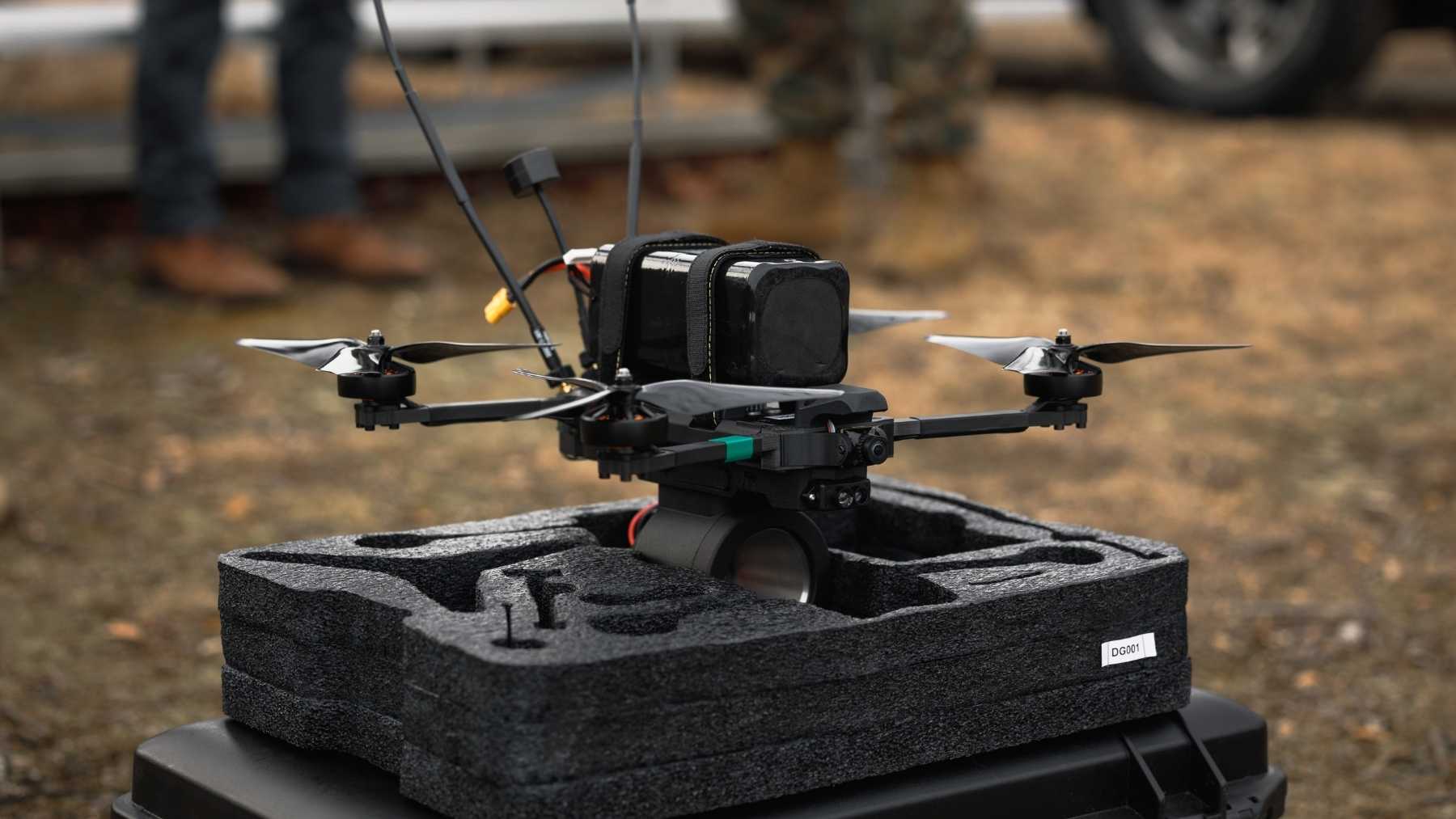
The drone is called the Archer, it is assembled in California, and the airframe costs about $2,000.
Six drones, six mock barracks, 900 meters of Korean hillside
The opening event ran July 30 near Pohang, about 210 miles southeast of Seoul, handled by the 3rd Light Armored Reconnaissance Battalion. The second one was the event reporters were allowed to watch.
Both sat under the 4th Marine Regiment, 3rd Marine Division, with the firing units forward-deployed to the Pacific through the unit deployment program. Both were folded into the Korea Marine Exchange Program, the field exercise the two countries run together every year.
Yonhap had people at the range and reported six strikes on makeshift barracks about 900 meters out, all six on target. The Marines flew them hit-to-kill, steering by the drone’s own camera until the picture cut at impact.
The radio call before each one was “splash.” The Korea Times had reporters at an observation post about 2.5 kilometers back, close enough to hear each detonation roll across the valley three seconds later.
The Army was on the same range that day. Soldiers from the 2nd Infantry Division/ROK-U.S. Combined Division worked alongside 3/7, packing C4 into the drones’ payload carriers. It was the division’s first time putting live ordnance on the system.
Pfc. Gavin Zerrull, an intelligence systems maintainer who also coaches FPV operators for the 2nd Combat Aviation Brigade’s innovation shop, framed the appeal in terms of who has to be asked. A platoon that can reach 20 kilometers on its own no longer has to phone a company or battalion to get something hit.
The Archer costs $2,000, and that is not what it costs to use one
Neros Technologies builds it. The airframe runs about $2,000, and a complete system, meaning drone plus warhead plus the support gear an operator actually needs, lands closer to $5,000.
Neither figure moves the needle against the armored vehicle it is designed to destroy, which is the entire reason every military on earth is suddenly interested. We have covered the same math running the other way, with Western firms trying to build interceptors cheap enough to shoot at drones that cost less than the missile.
The company was founded in 2023 by Soren Monroe-Anderson and Olaf Hichwa, two former competitive drone racers who went to Kyiv early to learn how Ukrainians were mass-producing these things.
The Marine Corps puts the Archer’s effective range at approximately 20 kilometers, or 12.4 miles. The Corps’ own release pegs traditional squad-level infantry weapons at one to two kilometers. That gap is the whole argument.
Neros’ numbers are looser. Kenneth Inocencio, the company’s Asia-Pacific growth lead, told Stars and Stripes at the range that the Archer reaches out about 15½ miles, tops out around 81 mph, and punches through close to four inches of steel with an anti-armor payload.
A Marine Corps demonstration at Twentynine Palms in March 2025 had the same family of drone doing over 90 mph and hauling five pounds out to 20 kilometers.
Three sources, three sets of numbers, none of which line up. Part of that is variant drift. The Archer now ships in five-, eight- and ten-inch configurations with swappable arms, motors and payloads, and a five-inch airframe is never going to fly like a ten-inch one carrying a warhead.
The spec sheet says 12 miles. The targets sat 900 meters out.
That gap deserves more attention than it has gotten. Flying a high-explosive quadcopter 12 miles downrange, in a country roughly the size of Indiana, 15 miles from a hostile border, is not a permission slip anybody hands out casually.
So the Marines did not use the range they advertise. They shot at barracks 900 meters away, a distance a Javelin gunner would find unambitious.
The paperwork was arguably the point. The 4th Marine Regiment had to work through the 2nd Infantry Division, Eighth Army, the 2nd Combat Aviation Brigade and South Korean authorities to build an airspace and safety framework that did not previously exist, then run dry-fire rehearsals before every live iteration.
Getting a $2,000 drone to hit a shed is easy. Getting a treaty ally to sign off on flying live warheads through airspace already crowded with helicopters, artillery trajectories and its own counter-drone systems is the actual engineering problem, and it is the one nobody films.
Beijing tightened drone exports to America on the same day
The timing on the other side of the Yellow Sea was better than anything a press officer could have arranged.
On August 5, while Marines were detonating Archers in Pocheon, China’s Ministry of Commerce issued Announcement No. 34. It subjects drones, key components and related technologies on the country’s dual-use control list to strict case-by-case review for anything bound for the United States, effective immediately, with no license facilitation.
It was one piece of a four-part retaliation package answering recent U.S. restrictions, among them an FCC ban on imports of Chinese drones.
For most American drone builders that is a supply-chain headache, because motors, batteries, flight controllers and radios still trace back to Shenzhen more often than anyone in the industry enjoys admitting.
For Neros it reads as a sales pitch. The Archer sits on the Blue UAS list, which means the Pentagon has audited it down to the component level and found nothing Chinese inside. Inocencio’s own description at the range was “probably the least Chinese drone in the market,” which is a strange sentence and also a genuine product category now.
The company closed $250 million six days after the Korean range went quiet
On August 11, Neros announced a $250 million Series C at a $2.5 billion post-money valuation, co-led by Sequoia Capital and the American Strategic Technology Fund.
Interlagos, Valor Equity Partners, Allen & Company, Thiel Capital, Spark Capital and Figma co-founder Dylan Field came along for the ride. Nine months earlier the company had raised $75 million at roughly a third of that valuation.
Two products carry the new money. Archer AI keeps a human on the sticks but adds terminal guidance for the final stretch of an attack run, where jamming concentrates and most drones die, plus a position hold that keeps working after satellite navigation drops out.
Bandit points the other direction entirely: a counter-drone interceptor built to bring down Class 2 and 3 threats, Shahed-style aircraft included. That is a crowded field, and a bet against the jammers, which have aged badly against fiber-optic quadcopters that simply do not care about radio interference. Neros says both platforms will be in combat theaters before the end of 2026.
Output has to go up sixteen times for any of this to mean what it says
Neros is currently turning out about 1,200 Archers a week, or roughly 62,000 a year. The stated destination is a million a year by 2028.
CEO Soren Monroe-Anderson has not softened it. “Our mission to produce one million drones per year hasn’t changed,” he said in the funding announcement, adding that the range of drones and mission sets the company can support is what has expanded.
The nearer checkpoint is 10,000 drones a month by December, and because Neros published that figure itself, it is the one anybody can check without a clearance. Production now runs out of a 250,000-square-foot plant in Torrance, up from the 15,000-square-foot El Segundo shop where the whole operation started.
The order book is softer than the headlines suggest. The Army awarded Neros an indefinite-delivery contract on June 30 with a $500 million ceiling running through June 2031, and a ceiling is not an order.
The first actual order is in the thousands of aircraft, not the hundreds of thousands, and neither the Army nor the company has published a guaranteed minimum.
The Marine Corps got there first, with a multimillion-dollar delivery order in November 2025 and an attack drone team that the service stood up back in March 2025.
Sixteen months from a California range to a Korean one
At that Twentynine Palms demonstration in March 2025, a Marine Corps exercise planner mentioned that 3rd Light Armored Reconnaissance Battalion would be among the first units to receive the drone. Sixteen months later, 3rd LAR flew the first live-fire FPV range in Korea.
That is a quick turn by Pentagon standards, and it happened largely because the hardware costs less than a decent used car, so losing one is a budget line rather than an incident. The same logic is showing up at sea, where the Navy has been firing loitering munitions off unmanned boats nobody has to crew.
Whether the Archer works is not really the open question. Six for six on a hillside handles that.
Whether a company that built 2,000 drones a month last November can build 83,000 a month within two years, on a supply chain Beijing just made more expensive to argue about, is a different problem entirely. The Korean range settled the drone. The factory floor in Torrance settles the rest.