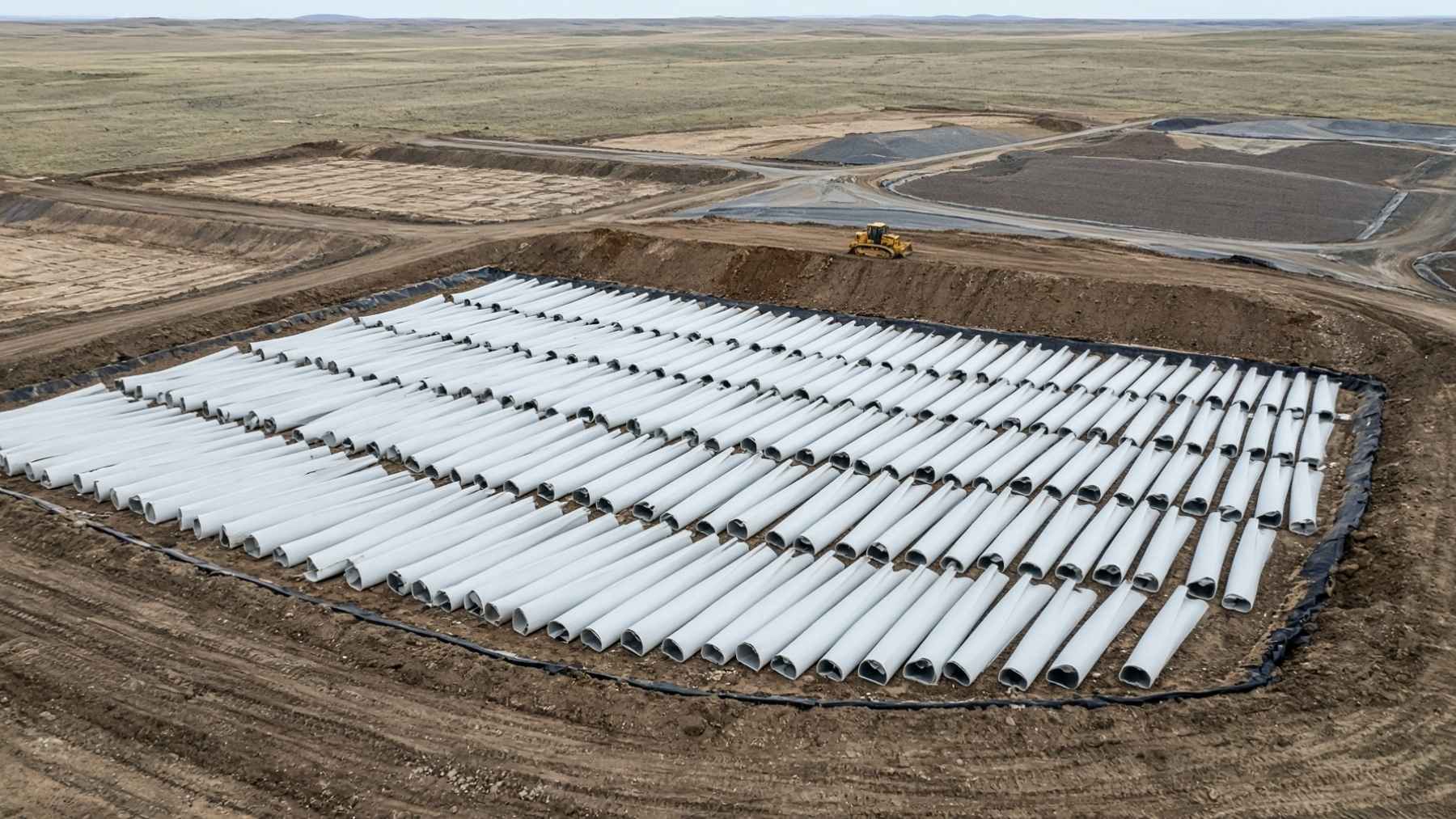

You have seen the photograph. A trench in Wyoming, white blades stacked like whale bones, usually captioned with something smug about how green energy really works. It has been circulating since 2019 and it gets dragged out every time somebody wants to score a point about wind power.
The photo is real. The problem is that it stopped being current about five years ago, and what replaced it is stranger than either side of that argument wants to admit.
Casper hasn’t taken a wind blade since the middle of 2021. A plant in a Mississippi River town in Missouri has run more than 7,000 of them through industrial shredders. And this week, in Casper itself, a crew is pulling blades off an 11-turbine wind farm that Chevron built in 2009 and barely ever ran.
Nobody will say where those blades are going.
Casper stopped taking blades five years ago
The Casper Regional Landfill began accepting decommissioned blades in spring 2019, as utilities repowered older Wyoming wind farms with bigger hardware. The count reached 1,124 blades by September 16, 2020, sourced from projects around Glenrock, Arlington, Saratoga and Hanna.
Then it stopped. Cindie Langston, the city’s solid waste division manager, told Cowboy State Daily that Casper would still take them, but no wind farm operator had called in years. No blades have arrived since mid-2021. The city collected a little over $602,000 for the ones it has.
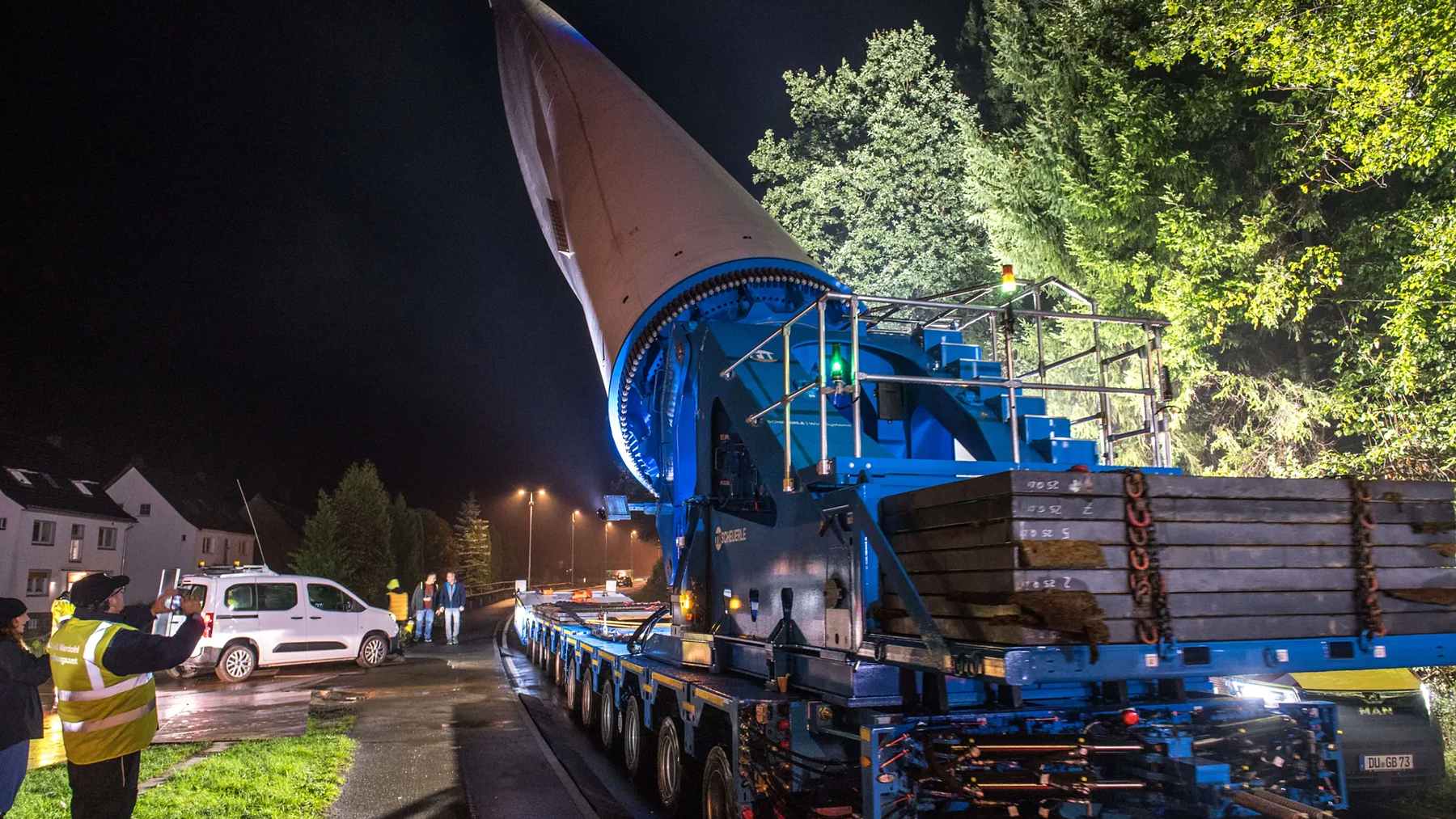
The logistics explain why nobody misses the business. Each blade arrived at roughly 120 feet long and had to be cut into three sections with diamond-wire saws before anything could move it. Crews nested the smaller cuts inside the larger ones and dropped them into a special-waste trench.
Even nested, one blade eats something like 44 cubic yards of cell. That is roughly three cement-mixer trucks of hole, per blade, and a landfill only has so much hole.
Landfills didn’t get greener, they got pickier
The comfortable story is that recycling won and burial lost. The actual mechanism was duller and less flattering.
Landfills across the northern plains simply raised the bar until nobody could clear it. Ryan Bechtold, who supervises the Sioux Falls Regional Landfill in South Dakota, said his site now requires blades ground into four-inch chunks or smaller, which is cost-prohibitive, so operators stopped calling. His site took 18 or 19 blades in a pilot program and never went further.
Asked where the blades go now, Bechtold’s answer was that he assumes “they’re just getting stored somewhere.”
He is probably right, and there is a market signal to prove it. Veolia’s blade program now advertises a service line it calls graveyard cleanups, aimed squarely at operators sitting on piles of abandoned blades. Somebody built that product because the piles exist.
Fiberglass is mostly silica, and kilns want silica
A cured composite does not behave like scrap metal. Steel gets melted, copper gets stripped, aluminum comes back as beer cans. The fiberglass-and-epoxy sandwich that lets a blade shrug off lightning and 25 years of storm loading is chemically locked once it cures, and heat does not undo it at a price anyone wants to pay.
Which is why the Missouri answer works. Fiberglass is largely silica. Cement kilns need silica and they need heat, and a shredded blade supplies both.
Veolia North America has been running blades through its Louisiana, Missouri, plant since late 2020, under a deal originally signed with GE Renewable Energy. Sectioned blades get shredded down through progressively finer stages until the output is a dust the company sells to cement plants.
The split, per the original 2020 GE announcement, is that more than 65% of a blade’s weight substitutes for raw materials headed into the kiln and about 28% burns as process energy. Veolia says one blade displaces five US tons of coal, 2.7 tons of silica, 1.9 tons of limestone and a ton of other feedstock.
The carbon claim needs a label on it. The widely quoted figure of a 27% CO2 reduction and 13% less water use comes from a Quantis US analysis that Veolia commissioned and publishes itself. It is not independent third-party verification, and no one has published a competing number.
Missouri is where the kilns already are
The location is not sentimental. Missouri is the second-largest cement-producing state in the country behind Texas, according to USGS shipment data, and second in clinker production behind California.
So the shredder sits inside its own customer base. Blade dust does not have to cross the country to find a kiln that will take it, which matters when your feedstock arrives on flatbeds several times a day.
Kiln operators get something real out of the trade too. Coal, sand and clay all cost money and all come out of mines and quarries. A feedstock that somebody else has already sawed, hauled and ground is arithmetic a plant manager understands without a slide deck.
Co-processing scaled first because it needed no new infrastructure. Mechanical routes into industrial plastics and chemical breakdown routes both exist, and C&EN has tracked several. The kilns were simply already built and already hungry.
Europe banned it, America didn’t
Here is the part that actually changed this year, and it happened on the other side of the Atlantic.
On January 1, 2026, the European wind industry’s self-imposed landfill ban on decommissioned blades took effect. It is a voluntary industry commitment rather than EU law, and WindEurope is lobbying Brussels to write it into legislation so member states apply it consistently. The trade body says roughly 90% of a turbine’s mass is already recyclable through standard channels and the blade is the leftover problem.
The volumes behind that are not enormous yet. Europe expects annual decommissioned blade material to climb from around 20,000 metric tons in 2025 to about 55,000 by 2030, out of a 290 GW fleet where 80 GW hits its theoretical design life by the end of the decade.
The United States has no equivalent commitment. What it has instead is more than 70,000 land-based turbines, roughly 7,500 of them past 20 years of service, and NREL analysis putting cumulative US blade waste at about 1.5 million metric tons by 2040 and 2.2 million by 2050. Regulation is doing the work in Europe that spreadsheets are doing here, and Germany’s habit of writing hard numbers into renewables rules is the same instinct applied to a different problem.
Chevron won’t say where the Casper blades are going
Which brings it back to Wyoming, where this is not a 2019 photograph but a job site.
Chevron’s 11-turbine, 16.5 MW Casper Wind Farm went up in 2009 on a former Texaco refinery site. Natrona County Commissioner Dave North says it never had a purchase agreement with Rocky Mountain Power and never ran properly, with Chevron switching it on each year just long enough to hold the permit. A former commissioner who voted for it in 2009 now calls it an eyesore.
Crews started dismantling it a few weeks ago and Cowboy State Daily found one tower already stripped of its blades on Tuesday. Four turbines have reportedly been sold and shipped elsewhere. The rest of the 240-foot, 450,000-pound machines come down through the end of the year, with site reclamation in 2027 and remediation running to 2029, the same slow land-restoration tail that follows retired renewable sites everywhere.
Asked what happens to the parts, Chevron spokesperson Christine Dobbyn said metal would go through “established salvage and recycling channels” and that components unsuitable for reuse may be sent to permitted disposal or recycling facilities. Metal was never the hard part. The blades are the hard part, and that sentence does not mention them.
Casper’s landfill sits a few miles away with 1,124 blades already in the ground and an open policy on accepting more. Louisiana, Missouri, has shredders running and a stated interest in cleaning up graveyards. Both options are sitting there, and the company taking the turbines down has not said which one it picked.