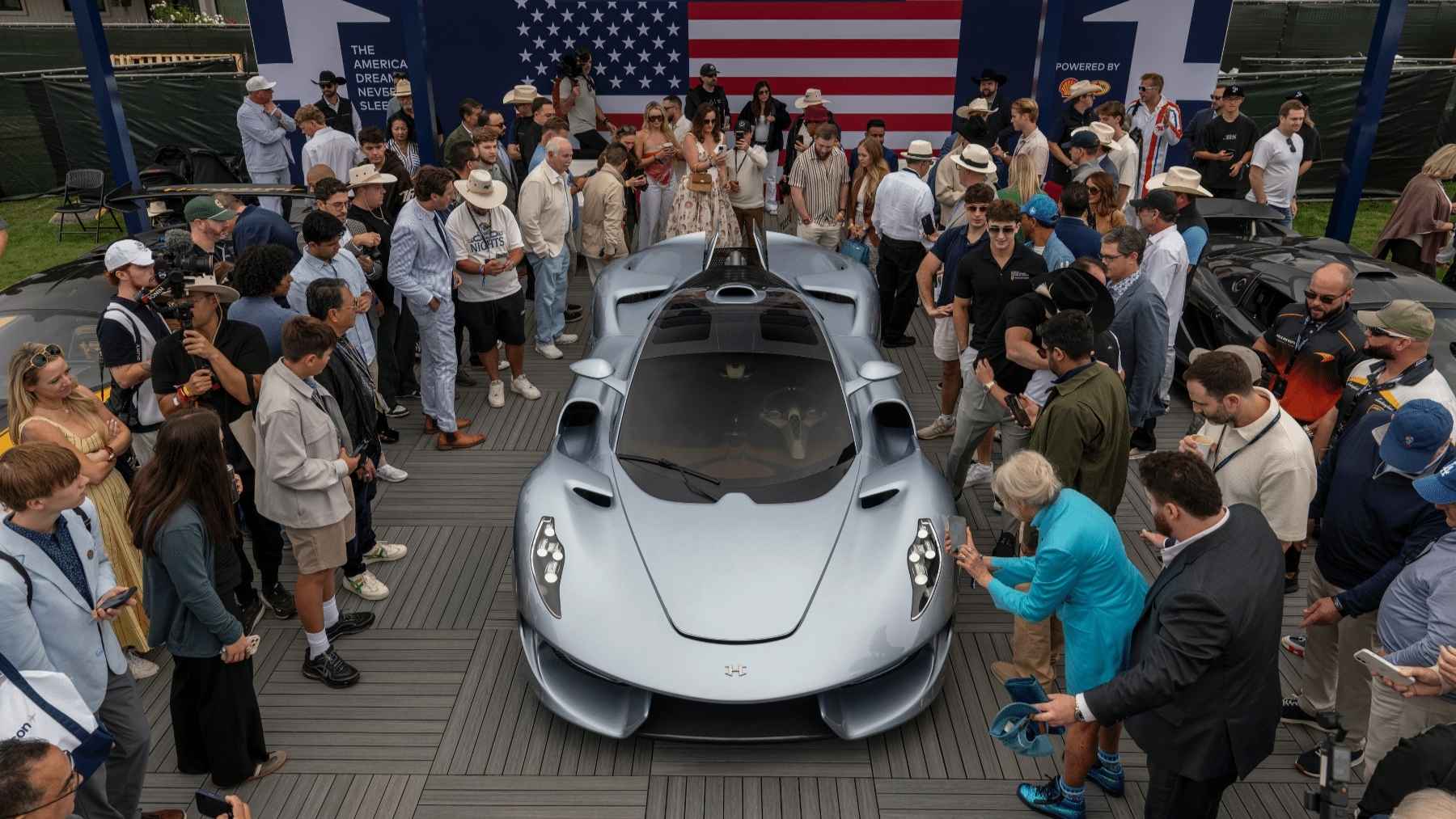

Hennessey Special Vehicles announced its Blackbird hypercar earlier in August, and it’s already completely sold out.
The Blackbird had its public debut at Monterey Car Week in California, an extremely curvy and aerodynamic vehicle featuring plenty of carbon fiber and an all-new 6.2-liter V8 that Hennessey is targeting at 800 to 850 horsepower.
It’s not meant to be the fastest hypercar in the world — Hennessey’s previous models are faster — but it has a manual transmission to “deliver an analog experience where beauty and drama define every moment,” according to CEO John Hennessey. And yes, that means zero screens inside.
The engine is worth pausing on. It was developed with Ilmor Engineering, the IndyCar and NASCAR specialist, and it’s meant to rev past 9,000 rpm with no turbos and no hybrid assist, sending everything to the rear wheels.
Hennessey believes it will end up the most powerful naturally aspirated V8 ever fitted to a road car. For that to happen it has to beat the Corvette Z06, whose 5.5-liter LT6 makes 670 horsepower at 8,400 rpm — a title Chevrolet still claims on its own configurator today. Hennessey’s number is a target. Chevy’s is on sale.
Despite Hennessey’s reiteration that the Blackbird isn’t about breaking any speed records, it’s not slow by any means. The targets are 60 miles per hour in 2.5 seconds and a top speed of 220 mph.
With a dry weight goal under 3,000 pounds, adaptive suspension, traction control, and Michelin Pilot Sport Cup 2 tires, the Blackbird should have serious performance. Every one of those numbers is an aim rather than a tested result, because the production car doesn’t exist yet.
The weight one deserves a second look. Dry weight leaves out fluids, and the Venom F5 already carries a listed curb weight of 3,053 pounds. So the “lighter” new car is targeting roughly what the old one already weighs, measured a friendlier way.
Interestingly enough, Hennessey has also made a big deal about the car’s comfort and cargo space. It may be one of the most practical hypercars ever made, with gullwing doors, a touring-ready cabin, four cup holders, and a front trunk (frunk) that can fit two full-size carry-on bags.
The design is inspired by the SR-71 Blackbird, a spy plane. I have to say, it’s one of the more dramatic and breathtaking hypercar designs out there. I’d say it’s even better than the Lotus Evija, which has had my heart for a while. But nothing will ever dethrone the Apollo Project EVO, which looks like a five-year-old’s fever dream. Still, the Blackbird is Hennessey’s most stunning hypercar yet.
But don’t get your hopes up.
Sold out in four hours
Only 71 Hennessey Blackbirds were released, each of them costing $2.5 million before taxes. And all of them are spoken for.
Before Monterey Car Week, Hennessey had already pre-sold 60 of the 71 hypercars to buyers around the world. Hennessey noted that this included existing and new customers.
The remaining handful didn’t last the afternoon. duPont Registry reported that within four hours of the covers coming off at The Quail on August 14, every single Blackbird was contracted and backed by a deposit.
In a press release, Hennessey said the decision to build the car around driving enjoyment ticked every box for customers who had grown tired of complicated, hybridized machines stuffed with screens. Even so, he admitted the speed of it caught the company off guard: “none of us expected such an overwhelmingly positive response.”
Here’s the part that didn’t make many headlines, though. Nobody is getting one any time soon.
Blackbird production doesn’t start until 2029, once Venom F5 assembly wraps up in 2028, with deliveries running into 2030. So 71 people just committed $2.5 million each to a car that won’t reach them for three or four years, built around an engine that is still in development.
The Texas company behind it is younger than you think
If you follow the hypercar world at all, you’ve probably heard the Hennessey name thrown around alongside claims of absurd horsepower and even more absurd top speeds. The tuning business has been going in Sealy, Texas since 1991. The hypercar arm, Hennessey Special Vehicles, was only established in 2017.
It’s also worth being precise about what “built in Texas” has historically meant. The Venom GT and the Venom F5 were both developed with Delta Motorsport in Silverstone, England, and Delta produced the Venom GT cars there. Hennessey has taken progressively more of the work in-house since, and the Blackbird is billed as its most significant engineering commitment yet.
Then there’s the manual thing, which is messier than the headlines suggest. Hennessey has built exactly one bespoke manual commission, the 1-of-1 Venom F5 Revolution LF, and one production manual model: the Venom F5-M revealed at Goodwood in July, which is roadster-only and capped at 12 examples.
So the gated stick isn’t a lineup-wide option at Hennessey. Before the Blackbird, it was a club of thirteen cars. That context makes 71 more of them a genuine bet rather than a marketing line.
We covered the full Venom GT and Venom F5 lineage, the Ilmor engine and the SR-71 design cues when the Blackbird first broke cover.
What the buyers actually bought
The analog commitment goes past deleting the touchscreen. There’s no digital instrument cluster, no steering-wheel buttons, an exposed shift linkage and an insert-and-twist ignition key. Your phone goes in a mount Hennessey calls the “holster.”
The aircraft references go deeper than the badge, too. Active vertical stabilizers at the rear deploy at 71 mph and lock at 71 degrees, which is both a nod to the SR-71 and to the number of cars being built.
But the Blackbird represents something bigger than just another fast car. Hennessey describes it as the next phase of the company’s mission, applying its hypercar expertise to a vehicle centered on beauty, emotion, engagement, and long-distance driving enjoyment rather than chasing another top-speed record.
Seventy-one people bought into that pitch in a single afternoon. They’ll find out in 2029 whether it holds up.