
Anything complicated gets a break-in period. New cars want a first service, new houses want a snagging list, and new warships get hauled back to the yard after their first months at sea so the builders can fix whatever rattled loose.
For the Navy that period has a name and a slot on the calendar: the Post-Shakedown Availability. Every hull gets one. It is dull, it is scheduled, and it is the least controversial thing in naval maintenance.
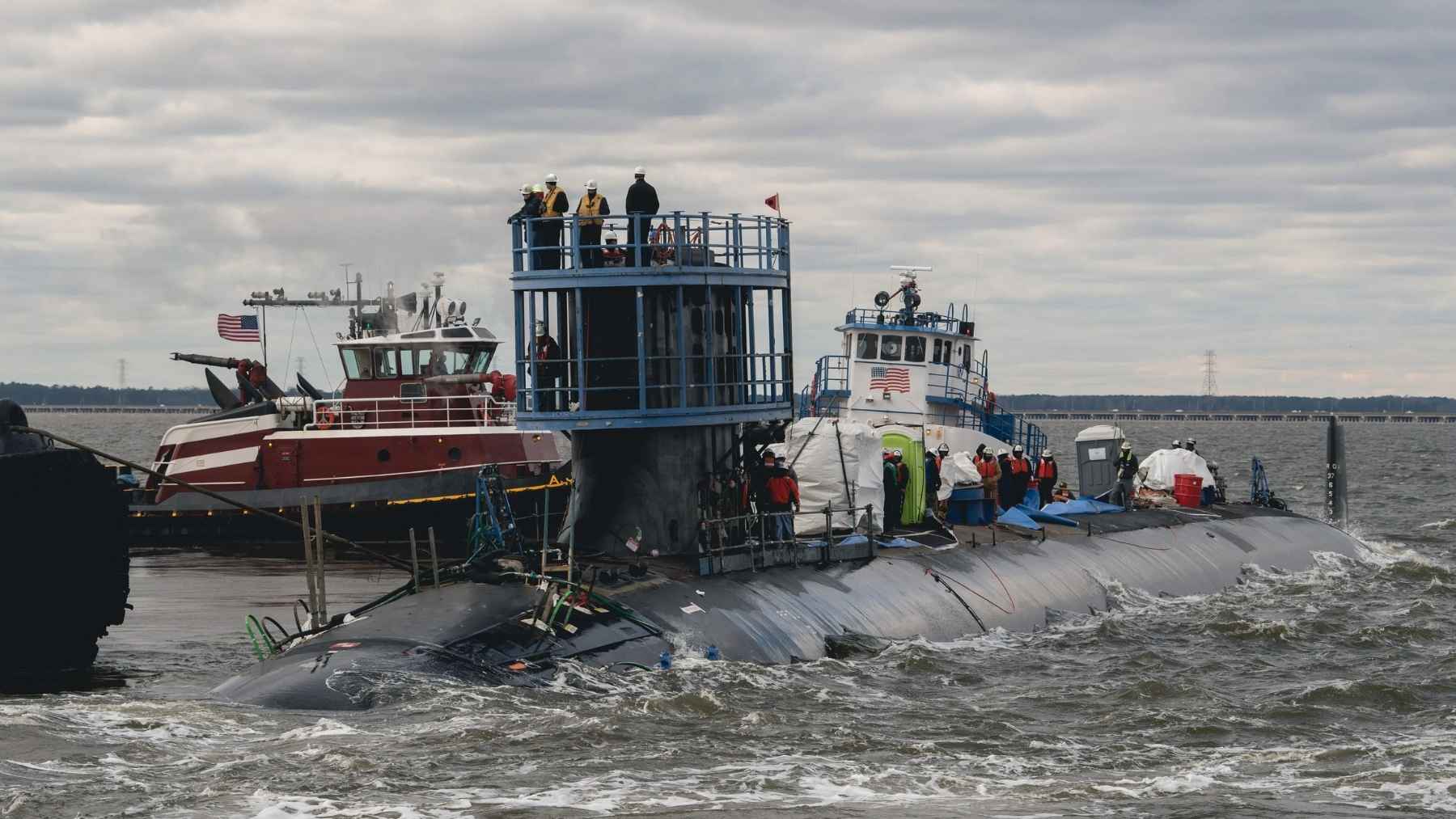
On August 17 the Navy looked at USS Massachusetts, a brand-new Virginia-class nuclear attack submarine, and cancelled hers.
The boat goes straight onto the tasking board instead. The Navy says her condition and readiness after shakedown were strong enough to justify it, and that the yard workers who would have spent this fall crawling over her can go build the next hull instead.
The yard period is not a sea trial, whatever the headlines say
A few outlets have described this as skipping a final sea trial. That is not what a PSA is.
It is a dry-dock industrial period. Engineers work through the deficiency list generated during shakedown, fold in combat system and electronics updates, and hand the boat back a second time. In Navy language that handback is called redelivery.
So the question is not whether Massachusetts got tested enough. It is whether the list of things worth fixing was short enough to live with while she deploys.
Vice Adm. Rob Gaucher, the Navy’s director of submarine programs, went on record calling the decision a “calculated risk.” That is an unusually direct word for a service release, and it is doing real work in the sentence.
The boat before this one took nearly two years
Here is the comparison nobody put next to the announcement.
USS New Jersey (SSN-796) is also a Block IV Virginia. She was delivered to the Navy on April 24, 2024, went through her full PSA at Newport News, and was redelivered in April 2026, per The National Interest. Close to two years between the first handover and the second.
Massachusetts was delivered on November 21, 2025. Nine months later she is cleared for tasking with no yard period at all.
That is the actual size of the change. Not a few weeks trimmed off a schedule, but an entire industrial cycle removed from the front end of one submarine’s service life.
The math nobody put in the press release
The Navy’s formal requirement is 66 fast-attack submarines. Naval Technology counted 53 boats available when it covered the waiver.
It gets worse before it gets better. Writing in USNI Proceedings in February, analysts projected the attack fleet bottoming out around 46 hulls in 2030, recovering only to the low 50s by 2040, and not reaching 66 until the middle of the century.
Los Angeles-class boats are retiring faster than Virginias arrive. Those hulls were commissioned between 1976 and 1996 and several are going early because the Navy cancelled mid-life refuelings to protect budget elsewhere.
Meanwhile Australia is due to take three to five Virginias in the 2030s under AUKUS, out of the same production line. Getting to 66 assumes lifting output from roughly 1.2 boats a year to well over two, which the yards have not managed yet.
Read the waiver against those numbers and it stops looking like a compliment to the shipbuilders. It looks like arithmetic.
Sheryl Sandberg christened this submarine
The boat has a stranger history than the announcement suggests.
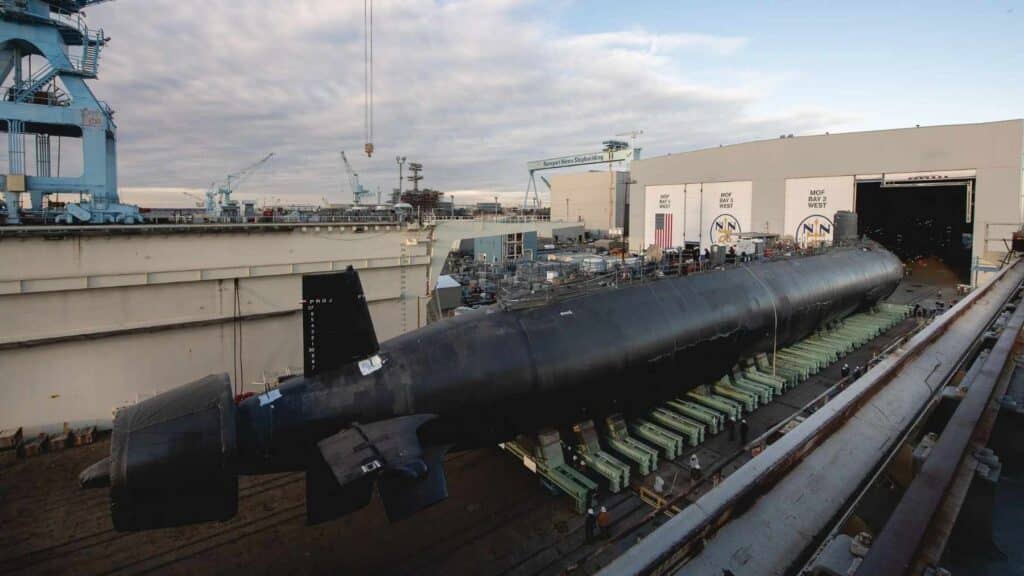
She was ordered on April 28, 2014, under a $17.6 billion contract covering ten Block IV hulls split between the two yards. Her keel was laid on December 11, 2020, in a virtual ceremony, because that is what December 2020 looked like.
Sheryl Sandberg, the former Meta chief operating officer, served as ship’s sponsor and christened her at Newport News on May 6, 2023. She was floated out into the James River in February 2024.
Massachusetts is the fifth Navy vessel to carry the name, and the name had been sitting unused since 1947. The last one was a South Dakota-class fast battleship commissioned in 1942. The first was an 1845 steamer the War Department bought as a transport for the Mexican-American War.
Commissioning was on March 28, 2026, in Boston Harbor, with USS Constitution sailing past the new boat. A wooden frigate launched in 1797 escorting a nuclear submarine is the kind of image the Navy plans months in advance, and it worked.
Block IV was designed for exactly this
The waiver is less of a leap than it sounds, because Block IV was engineered to need less shipyard time in the first place.
The design brief for this batch was durability. Components were specified to last longer so the boats spend fewer years of their service life in maintenance and more of it at sea, which is the whole point of a submarine you cannot easily replace.
Mission set is unchanged from the rest of the class. Anti-submarine and anti-surface work, strike, intelligence and surveillance, mine warfare, special operations support, shallow water and deep.
The undersea fleet around her has changed a lot faster than the boats themselves. Virginias are now expected to work alongside underwater drones being built at car-factory rates in Rhode Island, and a French Suffren-class boat has already launched and recovered an American Razorback drone while submerged.
Nobody has called this a first
Worth being careful here, because the temptation to write “unprecedented” is strong and none of the coverage supports it.
The Navy’s release does not describe the waiver as a first. Neither does Janes, Naval Technology, The National Interest or Stars and Stripes. They describe it as a decision about this boat, taken on its merits and on yard capacity.
What is fair to say is that it sets a reference point. If Massachusetts comes back from her maiden deployment without a list of things a PSA would have caught, the argument for running the same play on the remaining Block IV and Block V hulls gets much easier to make.
If she comes back with problems, the maintenance bill lands later and bigger, and it lands on yards that are already the bottleneck. Gaucher’s phrase covers both outcomes, which is presumably why he used it.
What the Navy actually bought
Strip out the messaging and the trade is legible. The service accepted some deferred maintenance risk on one submarine in exchange for a hull on station now and a few hundred thousand skilled labor hours redirected.
Those hours matter more than the boat does. Electric Boat and Newport News are building Virginias and Columbia-class ballistic missile submarines out of the same workforce, and Columbia is the higher national priority of the two.
Every welder not patching Massachusetts is a welder pointed at that problem. The Navy has been unusually open that this was part of the reasoning rather than a happy side effect.
A 377-foot attack submarine that would normally be sitting in a dry dock this autumn is instead available for tasking. Whether that was clever or merely necessary is a question her first deployment answers.