
The math on drone defense has been broken since roughly 2022, and everyone in the business knows it. You fire a $4 million interceptor at a $35,000 drone, you win the engagement and lose the war, because the other side can build a hundred more before you finish one.
Every defense ministry that has looked at those numbers has spent the last two years hunting for something cheap enough to fix the arithmetic. A Calgary company that was doing engineering consulting four years ago says it has one.
And on August 5, one of Europe’s largest ammunition manufacturers put money behind that claim.
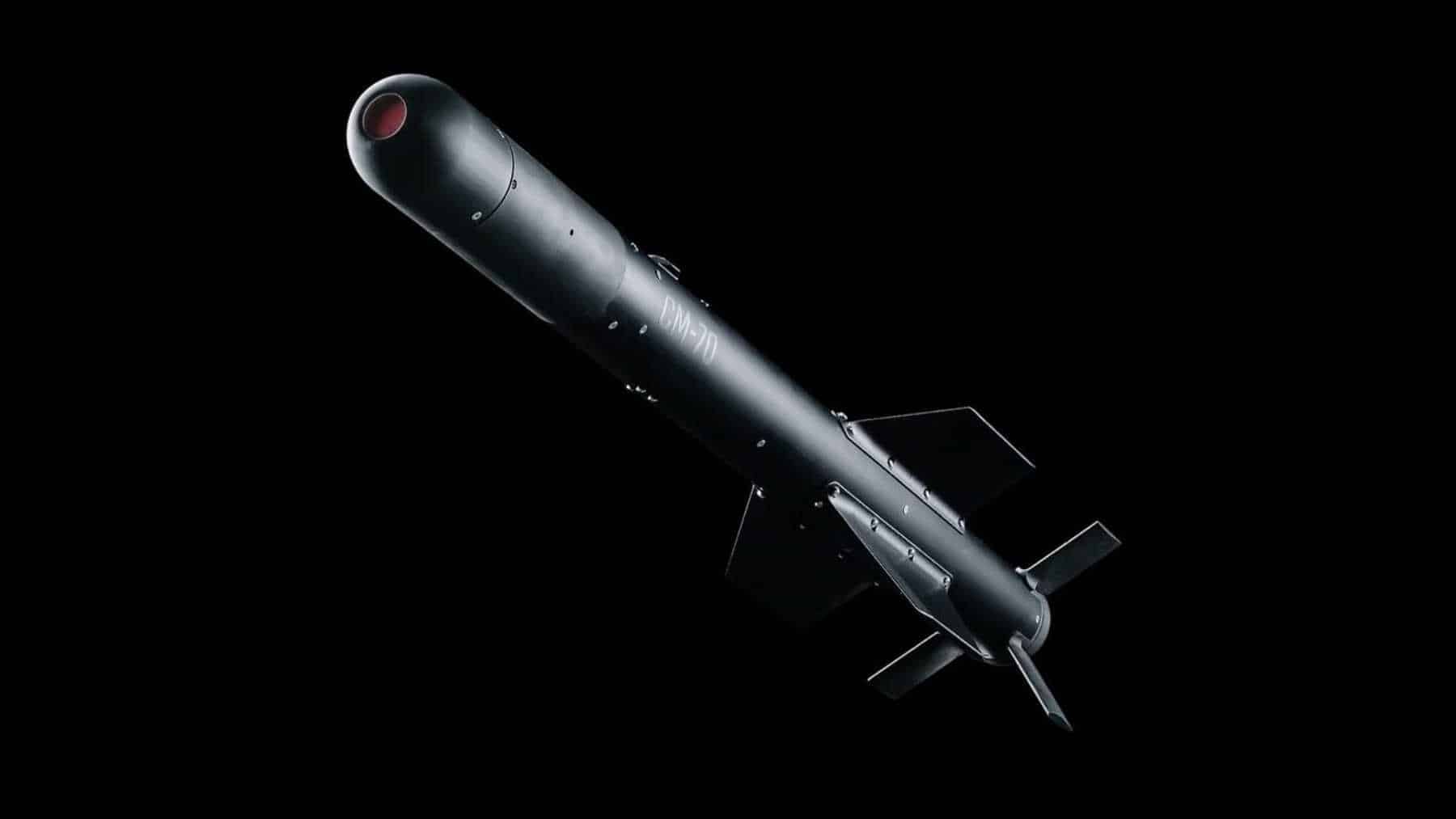
The company is North Vector Dynamics. The product is the CM-70, a guided interceptor built to knock small drones down before they reach a substation, a water plant or a forward operating base. It is not hypersonic and it is not glamorous. If the price holds, it may not need to be either.
It’s the size of a baseball bat and the specs keep moving
The published numbers are small enough to be startling. North Vector Dynamics lists a mass of 3 kilograms (6.6 lb), a length of 0.9 meters (35.4 inches), a range of 3.5 kilometers (2.2 miles) and a top speed of 900 km/h (559 mph).
So: a baseball bat that weighs about three times what a baseball bat weighs, traveling at roughly three-quarters the speed of sound. It carries a fragmentation warhead that fires forward instead of scattering in a sphere, which is the sensible geometry when your target is a lawnmower with wings and your closing angle is head-on.
Those figures are also the third set the company has published. Defense outlet Quwa tracked the revisions through archived versions of the product page and found the weapon has been listed since June 2025, originally under the name SPEAR, with the page renamed CM-70 around the start of this year.
The earlier entries were lighter, shorter and faster on paper. May of this year had it at 2.5 kg and 0.72 m doing over 1,000 km/h. The 2025 entry claimed a 2-kilometer reach and listed an energetic payload that has since vanished from the page entirely.
The guidance changed too, from an autonomous infrared seeker in the 2025 listing to the semi-active laser setup the company now markets. Speaking to Janes in April, CEO Paul Ziadé described a missile of roughly 2 kg and said the firm had been working in air defense since early 2024.
None of that is disqualifying. Startups iterate, and a design that gained half a kilo and lost 100 km/h probably grew a real warhead somewhere along the way. It does mean nobody outside the company is looking at a frozen configuration.
The whole product is a price tag
Here is why anyone cares about a 6.6-pound Canadian missile. Quwa reported Ziadé’s target unit cost as something below $10,000, set against the roughly $3.7 million he attributes to a Patriot round and the $35,000 he assigns to a Shahed-class attack drone.
Both of his comparison figures are defensible. US Army budget documents put a PAC-3 MSE at about $4 million a round. Shahed pricing is murkier, and CSIS has walked through why, with published estimates running anywhere from $20,000 to $80,000 depending on who inspected which wreckage and when.
Take the middle of that spread and the exchange ratio is well past 100 to 1 against the defender. Flip it to a $10,000 interceptor and the defender is finally the one spending less per engagement.
The CM-70 is not the first weapon aimed at this gap, and the company does not claim it is. Ukrainian interceptor drones have been killing Shaheds for $2,500 to $5,000 a unit since late 2025.
X-Bow Systems used Farnborough to unveil Buckler, a Shahed-focused interceptor targeting about $100,000 a round. Lockheed showed up at the same airshow with a Patriot variant priced at roughly half an MSE.
The category is crowded, and the CM-70 is competing at the cheap end of it. It is also arriving into a procurement climate that increasingly favors many cheap machines over a few expensive ones, across every domain the Pentagon buys in.
Its stated target set is what the Pentagon calls Group I through III, which per a Congressional Research Service primer covers everything from hand-launched quadcopters up to aircraft of 1,320 pounds. That is a wide bracket, and almost all of it sits in the zone where a Patriot is financial malpractice and doing nothing gets a transformer yard destroyed.
Laser guidance works when the spectrum is a mess
Modern battlefields are electronic warfare soup. Navigation signals get jammed as routine housekeeping, radio links get spoofed, and any weapon depending on either has a habit of failing at the exact moment it matters.
North Vector Dynamics went around the problem instead of through it. The CM-70 uses semi-active laser homing, which the company brands SALG: an operator illuminates the target with a designator, the missile reads the reflected spot and flies at it. No satellite fix, no datalink, nothing for a jammer to grab.
The technique is decades old, lifted straight from laser-guided bombs, and that is the point. It is boring, it is proven, and it is indifferent to whatever the other side is doing to the electromagnetic spectrum.
It also imposes a cost. Somebody or something has to keep the laser on the drone for the entire flight, which means the CM-70 only works as part of a kit that includes a designator and a tracker good enough to hold a small fast target. The missile is the cheap part. The sensor chain around it is not.
The company says the round can launch from portable ground mounts, vehicles or airborne platforms, and pairs it with a tactical launcher of the same name. It also claims compatibility with NATO command-and-control through an open architecture, though no completed integration has been announced.
Compare that to the alternatives Western militaries are testing for the same job. High-powered microwave systems like the airborne drone-frying rotor Lockheed has been developing kill in volume and drop no shrapnel, which is why they get the nod for domestic sites. A laser-guided missile is a one-target-at-a-time answer.
A Czech ammunition giant just bought in
The August 5 news is the part that changes the company’s odds. CSG N.V., the Dutch-registered group run out of Prague, took a minority stake in North Vector Dynamics. The parties did not disclose the amount, but the company confirmed its valuation now exceeds $90 million.
CSG is not a boutique. It trades on Euronext Amsterdam, employs more than 14,000 people, exports to over 70 countries and booked 6.7 billion euros in revenue last year. Its holdings include Tatra Trucks, Excalibur Army, Slovakia’s MSM Group and The Kinetic Group in the United States.
CEO Michal Strnad said the group intends to bring “our industrial expertise, manufacturing capabilities, and commercial network in Ukraine” to the partnership, alongside NATO members and partner nations. Read that as an ammunition manufacturer with a Ukrainian sales channel telling you where it expects these to end up.
The capital table filled in fast this year. CSG’s Tech Horizons fund took a position in May, NordSpace Ventures came in during July as a strategic investor and propulsion partner, and the August round moved CSG from fund investor to strategic partner.
On the government side, the firm was awarded a four-year, $4.2 million contract by Defence Research and Development Canada in 2025. That one covers propulsion research at the top end of the speed range, hypersonics included, and it sits on top of roughly $2.5 million in earlier federal grants.
The founders came out of the University of Calgary’s Schulich School of Engineering. Ziadé is an aerodynamics academic who told his former employer that Canada will never be a military superpower, so the goal should be to “become a very prickly porcupine” and make aggression expensive. Retired General Tom Lawson, once Canada’s top soldier and deputy commander at NORAD, signed on as strategic advisor.
Not being American is now a selling point
One of the CM-70’s better features has nothing to do with the hardware. It is Canadian, and it contains no US-controlled components, which puts it outside the International Traffic in Arms Regulations.
ITAR governs practically every American-built weapon and requires State Department sign-off before an ally can resell or transfer one. North Vector markets the missile as “ITAR-free for seamless procurement and integration into allied systems,” which in practice means a NATO government could buy a batch, wire it into a national air defense network and ship some to Kyiv without a permission slip from Washington.
The company also claims NDAA compliance, the US procurement standard that screens out certain foreign components. So the pitch is a weapon Washington can buy and everyone else can re-export. Given how transatlantic arms politics have been running lately, that is a real commercial asset rather than a footnote.
Nobody has seen it hit anything
What exists publicly is a spec sheet, a set of renders, a social media post and an investor list. No live-fire intercept against a drone target has been reported by any outlet covering this, including Quwa’s technical breakdown. No customer order, production rate or delivery schedule has been announced either.
The company has been selected for Canada’s IDEaS counter-UAS sandbox at Suffield, Alberta starting September 14, one of 26 participants. Worth noting that it entered under a different system called SHIELD, not the CM-70.
Then there is the range. At 900 km/h the missile covers its full 3.5 kilometers in about 14 seconds, which sounds fine until you work out what 3.5 kilometers of standoff actually buys the defender.
A piston-engined Shahed cruising at 185 km/h crosses that entire envelope in roughly 70 seconds. Detection, identification, designation, launch and terminal guidance all have to fit inside that window, and the launcher has to already be sitting near whatever it is protecting.
The jet-powered Geran variants make it worse. Those fly at 400 to 500 km/h and compress the same window to around 25 seconds. The CM-70’s 900 km/h top speed exists precisely because of them, but speed does not manufacture reaction time.
Any serious deployment means dozens of rounds, a radar or optical tracker feeding a designator, and crews rehearsed enough to run the sequence in under a minute at three in the morning. That is a system, not a missile, and the system is the expensive half.
Still, the direction is right, and it is the same direction the Pentagon is pushing with its own cheap-interceptor competitions. Counter-drone is an economics problem wearing an engineering costume, and the fix is volume at a price that does not bankrupt the defender.
Whether the CM-70 becomes the round that scales or just proves a European ammunition group will pay $90 million for the idea, a Czech industrial base and a Ukrainian sales channel are a lot more than most 6.6-pound missiles ever get.