
Construction crews lose days to wind all the time. Crane operators won’t fly a load in a stiff breeze, roofers pack it in early, and no one gets a story out of it. But when the thing being built is the tallest wind turbine on Earth, getting shut down by wind is frankly a little funny.
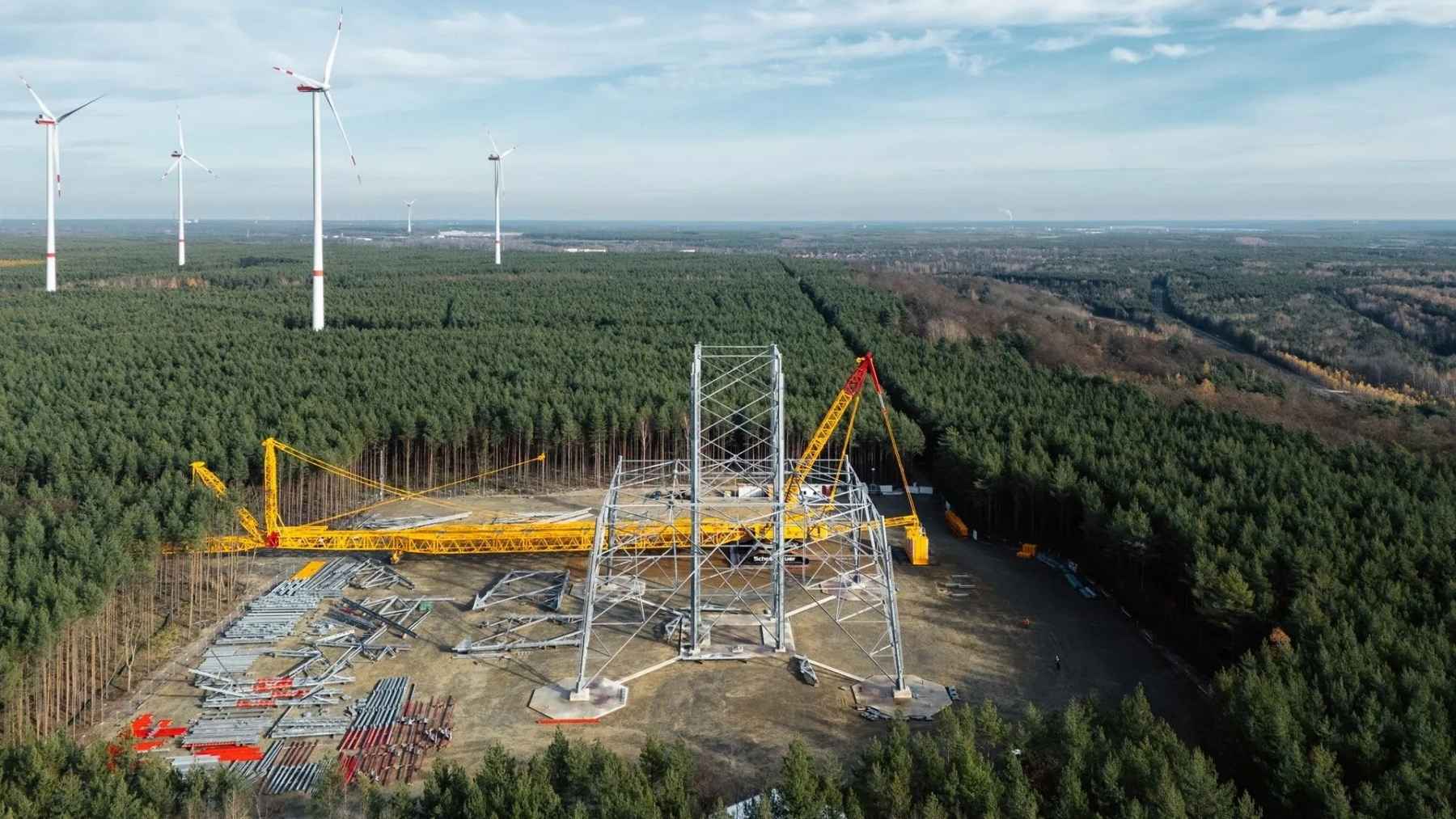
That’s where things stand in Schipkau, a town in the old coal country of eastern Germany about 71 miles south of Berlin. A Dresden engineering group called GICON has spent two years putting up a lattice tower there that’s supposed to top out at 1,198 feet, and the last big step was scheduled for Sunday, September 20. The weather scrapped it. Strong wind pushed the operation into this week, dpa reported, and the three rotor blades the machine still needs couldn’t even go on.
So what’s the last big step, exactly?
GICON assembled the turbine at a height cranes can actually reach. Hydraulic jacks now have to push it up through the lattice until the hub sits 984 feet off the ground, and the moving load comes to 827 tons (750 metric tons) once you count the inner tower it rides on. The climb runs at about 30 feet an hour, so you’d barely see it move.
So why can’t a crane just do this?
No one makes a crane that can set a nacelle at 984 feet. When a conventional wind turbine goes up, a big mobile crane stacks the tube sections and then swings the nacelle and blades onto the top, and that works because today’s tallest conventional onshore turbines stop around 820 feet in total. Schipkau tops that by well over 300 feet.
The industry has kicked around plenty of ideas for getting hubs higher, and we’ve covered a few of the stranger ones, from wooden modular turbine towers to a bladeless generator that skips the rotor entirely. GICON’s answer is a tower inside a tower.
The outer one is the wide lattice you see in photos, just under 525 feet tall and built like a power pylon that ate its vegetables. A slimmer inner tower hangs inside it, and the turbine got mounted on that one down low, where a crane could still do the honors. To finish the job, the inner tower rides up through the outer one like a telescope and locks in at full height.
Hydraulic strand jacks do the pushing, the same gear heavy-lift companies use to raise bridge decks. Picture a cylinder gripping a bundle of steel cables and crawling up them a few inches at a stroke, over and over, for most of a day. It’s slow, and it’ll move pretty much anything you bolt to it.
GICON hasn’t published how far the inner tower actually travels on this ride. Ingenieur.de, the German engineering association’s trade outlet, ran the known heights and figures roughly 430 to 460 feet of travel. At 30 feet an hour that’s about 15 hours of climbing, and GICON budgets around 24 hours for the whole operation, so locking the tower in place at the top takes up the rest.
The blades are still on the ground
The turbine itself is already sitting on the inner tower at crane height, but its three rotor blades aren’t on it, and as far as I can tell no English-language outlet has picked that up yet. GICON wanted every major component installed before the climb, and the wind that scrubbed Sunday’s start kept the blades from going on at all. Bolting them to the hub comes first. The 24-hour ride comes after. The company hasn’t put a day on either job.
GICON’s announcement puts it as “safety comes before speed,” and the company says it’ll call the actual start about 48 hours ahead. So the record could land any day now, or slide again if the forecast stays ugly.
Schipkau kept its community festival on for Sunday anyway, record or no record. I can respect that.
Why build a wind turbine this tall at all?
Because the wind up there is better. Air near the ground gets chopped up by trees, buildings and terrain, while a few hundred feet higher it blows harder and steadier. A turbine sitting in steady wind spends more hours of the year producing at full power instead of idling through lulls.
GICON didn’t guess at that. The company ran a 984-foot measurement mast at the site and logged the wind for a year before committing to the tower, and its numbers say the air at that height carries about 40 percent more energy, which it says works out to roughly double the electricity from the same rotor. Those are GICON’s own measurements. The machine gets to prove them once it’s spinning.
The turbine getting this record perch is honestly modest hardware, a 3.8-megawatt Vensys unit with a 413-foot rotor that GICON rates for at least about 18 gigawatt-hours a year. I suspect the modesty is deliberate. The tower is the experiment here. It stands in the middle of an existing wind farm because GICON’s pitch is a second story of wind power over land that’s already producing, and if the telescoping trick proves out, the company has floated building up to 4,000 of these towers across Germany. The federal innovation agency SPRIND has bankrolled the project since 2020, lately through a subsidiary called beventum.
The structure itself holds more than 2,200 tons of steel, held together by about 80,000 high-strength bolts, and German outlet t-online reports that every bolt field carries a QR code so installers scan it and torque it to spec. The build hasn’t been smooth, either. GICON broke ground in September 2024, lost the winter after its own quality control flagged faulty steel parts from a subcontractor, and restarted work on March 2, 2026, per the company. The steel shell was finished in mid-July.
GICON’s latest public word, from September 20, is that the climb happens sometime this week, weather permitting, with commissioning planned for late 2026. Once the inner tower locks in, the finished machine will stand 1,198 feet, about 10 feet shy of the Berlin TV Tower, and Germany’s second-tallest structure will be a wind turbine standing on the spoil pile of an old coal strip mine.