
Pulling drinking water out of the ocean is a problem humanity technically solved decades ago. Coastal cities from San Diego to Dubai run desalination plants around the clock, and with the United Nations estimating that 2.2 billion people still lack safely managed drinking water, we are going to need plenty more of them. The hard part was never getting the salt out of the water. The hard part is what you are left holding once you do.
That leftover is brine, a hyper-concentrated salt sludge that conventional plants pump straight back into the sea, where it raises salinity, drags down oxygen levels, and generally ruins the neighborhood for anything with gills. Brine is such a dependable byproduct that Japan recently built Asia’s first osmotic power plant around the concentrated discharge of a desalination facility in Fukuoka, squeezing electricity out of the waste stream. Smart engineering. Still a workaround, though, for a mess nobody had actually eliminated.
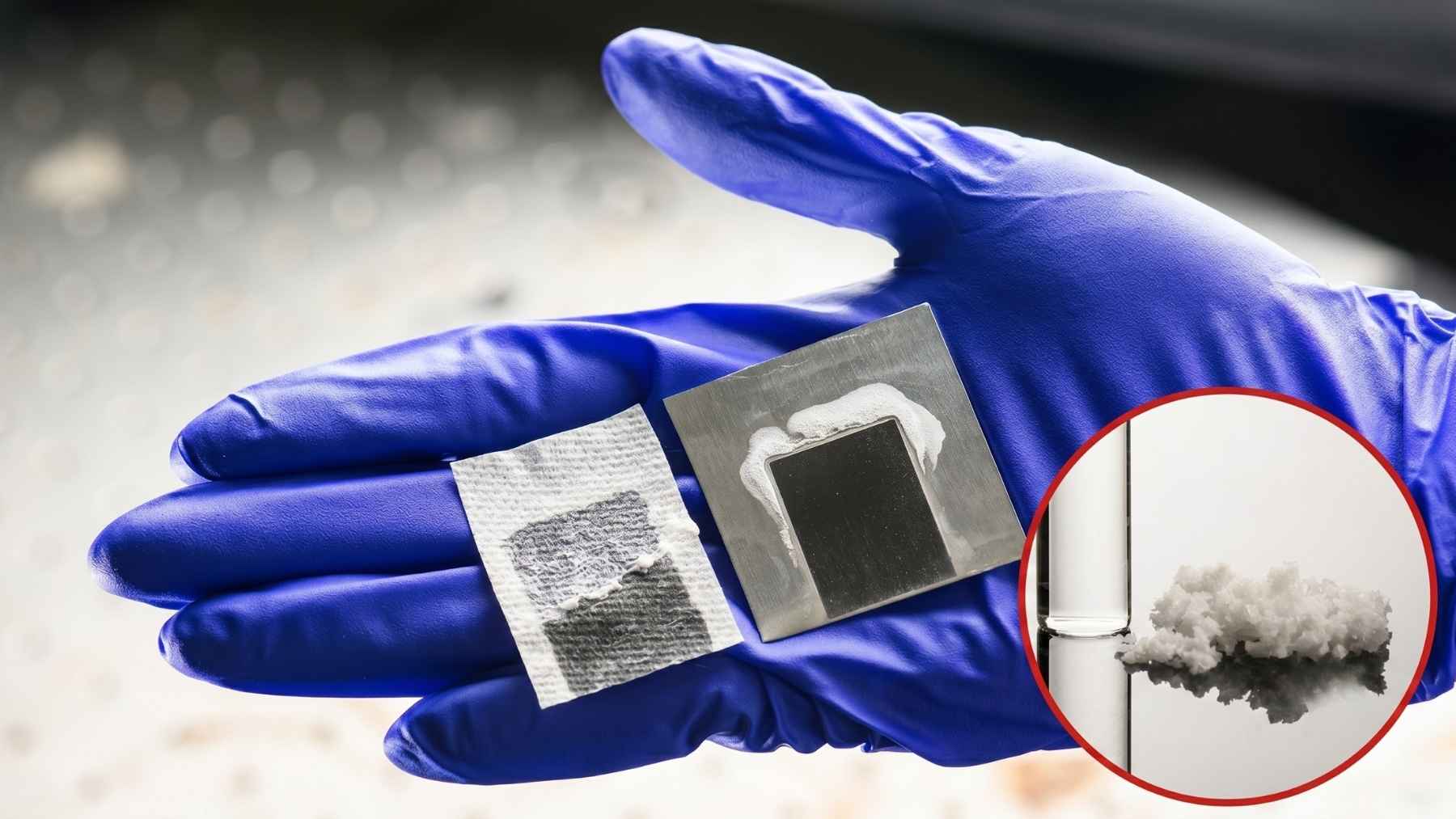
A lab at the University of Rochester now claims to have eliminated it. In a study published May 27 in Light: Science & Applications, a team led by Chunlei Guo, a professor of optics and physics, describes a desalination panel made of laser-etched black metal that turns real seawater into fresh water using nothing but sunlight. No chemicals, no pumps, no membranes, and no liquid brine whatsoever. The salts come off the panel as dry solids. And in a companion paper, the same surface pulled roughly half of the lithium out of water samples from the Great Salt Lake. One slab of metal, two of the decade’s biggest resource problems.
Lasers turned a plain sheet of metal into a sponge for light and water
The core material is something Guo’s group calls superwicking black metal, and the recipe is shorter than you would expect. Take a sheet of ordinary metal and blast it with femtosecond laser pulses, bursts of light lasting a millionth of a billionth of a second. The pulses carve microscopic grooves into the surface, and those grooves change the metal’s behavior in two useful ways at once. It turns nearly pitch black, absorbing almost all incoming sunlight. And it becomes intensely attracted to water, wicking a thin film of liquid across itself the way a paper towel grabs a spill.
Put that panel in seawater under the sun and the physics does the rest. A laser-treated “active” region pulls a thin layer of water across the surface, the absorbed sunlight evaporates it, and the distilled vapor gets collected as fresh water. The salts and minerals left behind migrate toward the panel’s untreated edges, which the team calls the passive region, instead of piling up where the work happens. There are no high-pressure pumps forcing water through membranes, which is how reverse osmosis does it, and no industrial heat plants boiling the ocean, which is how thermal distillation does it. Both of those mainstream approaches are energy-intensive and need chemical treatment before and after the water passes through. Guo’s panel asks for sunshine and a place to sit.
The self-cleaning trick came from spilled coffee
Solar desalination itself is not new, and that is exactly why the field has a graveyard. Plenty of lab demonstrations have worked beautifully with simulated seawater, which is usually just water and sodium chloride. Plain salt crystallizes in a grainy, porous way that rinses off a panel without much fuss. Real ocean water is a different animal. It carries magnesium and calcium compounds that crystallize into hard, non-porous crusts, the same scale that slowly chokes your showerhead and lines your kettle, except seawater holds hundreds of times more dissolved salts than whatever comes out of your tap. Those crusts have killed essentially every previous attempt at this once it left the lab bench.
Guo’s team attacked the clogging problem with geometry. They tuned the size and shape of the laser-carved grooves so the various salts in ocean water slide off rather than cement themselves in place. Then they recruited a phenomenon familiar to anyone who has ever set a dripping mug down on paperwork: the coffee ring effect. When a droplet evaporates, the outward flow of liquid carries suspended particles to the rim, leaving that telltale dark circle. The panel uses the same outward migration to march crystallizing salts away from the active center and into the passive edges, where they pile up for collection without ever touching the panel’s output.
The team ran the system on real water samples from the Pacific, Atlantic, and Indian Oceans, and the surface kept itself clean the whole way through. Fresh water kept condensing, salts kept marching to the edges, and nothing gummed up. The panel does its own janitorial work, which is the single feature that separates it from a long list of promising solar stills that died of mineral buildup.
The leftover salt pile turned out to be a lithium play
Here is where the story stops being only about water. Because nothing leaves the system as liquid, the process recovers nearly 100 percent of the dissolved salts in solid form. Most of that is ordinary table salt, which has a market but will not make anyone rich. Buried in the mix, though, are scarcer minerals, and one of them happens to sit at the center of the entire electric vehicle supply chain.
In a companion study published earlier this year in the Journal of Materials Chemistry A, Guo’s team embedded hydrogen titanate nanoparticles into the laser grooves of the same black metal. Those particles selectively grab lithium ions while letting the rest of the mineral soup pass by. Running water samples from the Great Salt Lake through the process, the researchers recovered about 50 percent of the lithium from the solids left behind by desalination. Worth being precise here: that result came from lake brine, which is far saltier than the open ocean, not from the Pacific samples. Ocean water carries lithium at a famously stingy 0.17 parts per million or so, which is why nobody mines the sea for it commercially, even though the total amount dissolved out there dwarfs every land deposit on the planet.
Guo is not shy about the implication. Digging lithium out of the ground has proven punishing from an energy and environmental standpoint, he noted in the university’s announcement, and “pulling lithium directly from saltwater could be a very important future route.”
The timing is not subtle either. The International Energy Agency projects lithium demand growing fivefold by 2040 under current policy settings, driven overwhelmingly by EV batteries and grid storage. The hunt for cheaper, cleaner sources has already produced some strange bedfellows: Alberta recently figured out that the salty wastewater its oil crews have been dumping for 75 years hides what the province values at close to a trillion dollars in lithium. Brine, it turns out, is having a moment. Rochester’s panel just proposes skipping the drilling entirely.
A panel in a lab is not a plant on a coastline
Time for the cold water, so to speak. Everything above happened at proof-of-concept scale, on small devices in a laboratory. Nobody has built a desalination plant out of this, nobody has published a cost per gallon, and the durability question, meaning how the surface holds up after months of salt crystallizing on it rather than days, remains open. The 50 percent lithium figure came from Great Salt Lake brine under controlled conditions, not from an industrial operation. Treat every forward-looking sentence about this technology, including the ones in this article, as conditional.
The case for optimism rests on what the system does not need. There is no exotic material in the build. It is metal, carved by femtosecond lasers, a tool that long ago graduated from physics labs into factories and eye-surgery clinics. Guo, whose group has spent years patterning metals with these lasers for other applications, argues the design is inherently scalable precisely because making more of it mostly means etching more metal. The work was backed by the National Science Foundation, the Bill & Melinda Gates Foundation, and the Worldwide Universities Network, which is not the funding profile of a vanity project.
The natural customers write themselves: sun-drenched, water-stressed coastlines. The Persian Gulf, southern California, North Africa, the same arid geographies where researchers are already testing whether a big enough solar farm can conjure its own rainfall over the desert. Places with too much sun, too much seawater, and not nearly enough of anything drinkable.
The honest pitch is not that black metal panels will replace reverse osmosis megaplants next year. They will not. The pitch is that on this one surface, drinking water and battery metal stopped being separate problems, handled by separate industries, each generating its own waste. The same ray of sunlight that distills the water shoves the lithium into a corner where nanoparticles are waiting for it. Reverse osmosis has a head start measured in decades, and it has never once handed anybody a usable pile of minerals on the way out the door.