
Offshore wind farms look effortless from a helicopter. Blades turning, blue water underneath, the whole array behaving like it grew there.
The part nobody films happened a year earlier and involved considerably less grace. Somebody had to take a steel tube weighing as much as a loaded cargo ship and hit it, repeatedly, until it disappeared into the seabed.
The machine that does the hitting is a hydraulic impact hammer. The largest one ever built weighs 700 metric tons, or roughly 1.5 million pounds, and its Dutch manufacturer says it lands more than 7,500 kilojoules on every blow.
That figure only means something next to what came before it. IQIP, based in Sliedrecht, built its reputation on a hammer range that tops out at 2,000 kilojoules and has been in service since the early 1980s. The new one is close to four times stronger.
Seven hundred tons is nothing next to the heaviest machine that has ever moved across land, a 14,196-ton German bucket-wheel excavator. It is a great deal for something that hangs off a crane hook over open water.
The piles got heavier, so the hammers got heavier
A monopile is the foundation of an offshore wind turbine. One tube of rolled steel, driven into the seabed, with everything else stacked on top of it.
Twenty years ago those tubes were manageable. The current generation is not. The monopiles at Inch Cape, off the Scottish coast, run up to 11.5 meters (37.7 feet) across, reach 102 meters (335 feet) in length, and weigh around 2,300 metric tons apiece.
Turbines drove that escalation. Bigger rotors need bigger foundations, those foundations sit in deeper and less cooperative ground, and the energy required to push one of them home scales with all of it.
Robert Diepenbroek, IQIP’s chief executive, said it plainly when the IQ8 was announced in October 2025: “As turbine sizes grow, so do the monopiles.”
IQIP publishes the whole ladder on its own IQ-series spec sheet, and the four models read in sequence tell the story better than any launch announcement.
The IQ8 measures 23.6 meters (77 feet) end to end, pushes 9,900 liters of hydraulic oil a minute (about 2,615 gallons), and ships with a 9.3-meter sleeve, with larger sleeves built to order.
Every hammer in the range runs continuously at full energy and can be pushed to 120% when the ground refuses to cooperate. That last feature is not a marketing line, as Scotland found out.
Scotland’s job needed booster mode to finish
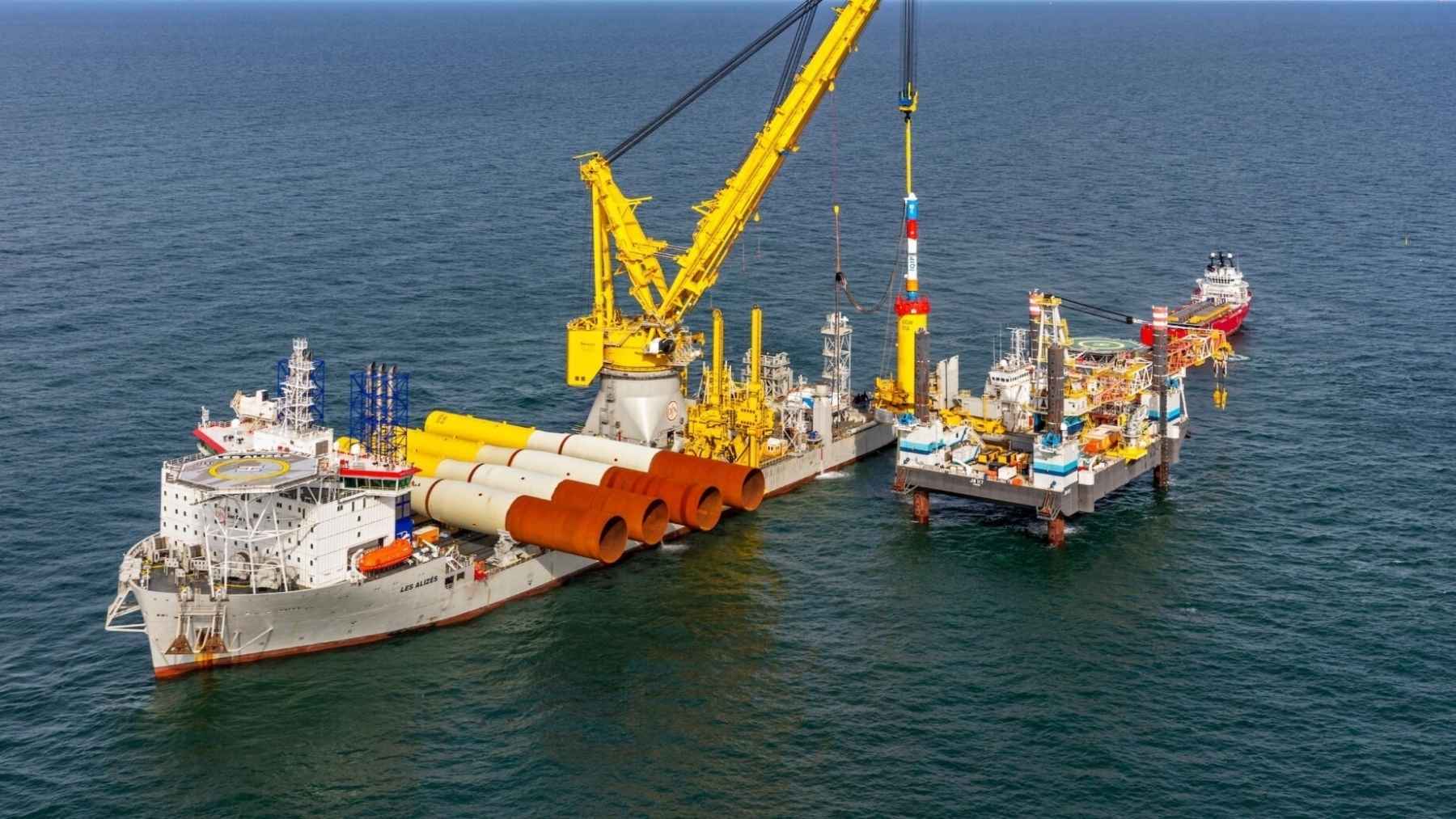
Inch Cape closed out its foundation campaign this summer. On June 11, IQIP confirmed all 54 monopiles were in the seabed, installed by Jan De Nul using the heavy lift vessel Les Alizés, on a 1.1 GW project owned 50/50 by ESB and Red Rock Renewables.
The hammer on that job was not the IQ8. It was the IQ6, the 525-ton, 6,600-kilojoule model the IQ8 has since displaced at the top of the range.
IQIP says the IQ6 ran at record capacity there and had to be pushed into booster mode to reach final penetration under difficult soil conditions. That is a polite way of saying the seabed fought back.
Two other tools made their debut on the same campaign. The CLT1700 combi lifting tool, and the FPUT3500, an upending tool rated to 3,500 tons that flips each pile from horizontal to vertical by remote control, with nobody standing near it.
Those are the piles now sitting under the bright yellow transition pieces Edinburgh started calling Minions.
Two companies build these, and both claim a record
The “world’s most powerful” line comes with a competitor asterisk, because IQIP is not alone in this business.
The other name is MENCK, a German hammer maker owned by the marine services group Acteon. Acteon’s own guide to hammer selection describes its MHU 6000W as the world’s largest impact-driving wind hammer, at 6,250 kilojoules, for monopiles of 9 meters and beyond.
On raw blow energy, IQIP’s 7,500-plus is the larger number. Both claims can sit on the internet at the same time if you read the categories closely enough, which is how records tend to work in heavy equipment.
MENCK is no footnote regardless. Ørsted picked it for Hornsea 3, where it supplies an MHU4400S submersible hammer plus a pile sleeve and anvil sized for monopiles up to 11 meters in diameter.
Britain started hammering in May, Germany in July
Hornsea 3 sits about 120 kilometers (75 miles) off the Norfolk coast and will be, at 2.9 GW, the largest single offshore wind farm in the world. Ørsted installed the first of 197 monopiles in May.
Each averages 1,670 metric tons and 90 meters (295 feet), measuring 8 meters across at the top and up to 11 at the base. Ørsted says the remaining 196 go in across 2026 and into 2027, and has put the size of the installation team at more than 200 people drawn from the developer, Cadeler and MENCK.
Germany’s turn began on July 1, when DEME installed the first monopile at Vattenfall’s Nordlicht I, roughly 85 kilometers north of the island of Borkum. Nordlicht I takes 68 foundations of up to 80.5 meters (264 feet) and up to 1,290 tons each.
DEME hired IQIP for that one, and the kit is again an IQ6 spread, this time paired with PULSE, a noise mitigation add-on that uses a dual-piston system and a fluid-filled chamber. The contract covers all 112 monopiles across Nordlicht I and II.
The company selling the biggest hammer is also selling the way around it
Driving piles is loud underwater, and that has been a regulatory problem rather than a theoretical one for years now. Harbor porpoises clear out of the area while it is happening, and researchers at St Andrews have measured what the noise does to seals in the North Sea.
IQIP’s answer is a technology called EQ-Piling, which is a peculiar thing for a hammer manufacturer to develop.
Instead of short violent impacts, it uses a large seawater-filled tank, lifted hydraulically and released onto buffer cylinders. That stretches each blow out 15 to 20 times longer than conventional impact piling. Same job, spread over more time, with less noise and less fatigue in the steel.
On May 13, IQIP announced that EQ-Piling had driven a full-scale monopile to target depth offshore for the first time, at EnBW’s planned Dreekant site in Germany. DEME executed it aboard the vessel Orion, with EnBW and Vattenfall as consortium partners.
The company instrumented the whole thing with geophones, hydrophones and accelerometers, then drove a reference pile in comparable conditions using a conventional impact hammer.
IQIP now rates EQ-Piling at TRL 9, the top of the technology readiness scale, meaning it considers the system proven in an operational environment rather than a test rig.
The reasoning IQIP gives for building it is the revealing part. Installation limits keep tightening, the company says, and conventional methods lean increasingly on additional noise mitigation just to stay compliant.
None of which stops the hammers getting bigger, because nothing else finishes the job when the ground is dense and the pile weighs 2,300 tons. Not everything at sea gets driven in, admittedly. Scotland’s tidal turbines just sit on the seabed under 1,450 tons of concrete, held down by weight alone. Those are 1.5-megawatt machines, not 15-megawatt ones.
One detail gets buried in the spec sheets. Inch Cape, Hornsea 3 and Nordlicht are all being driven by hammers that predate the IQ8. The 700-ton one was built for whatever gets ordered after them, which on current trends means monopiles that make 2,300 tons look moderate.