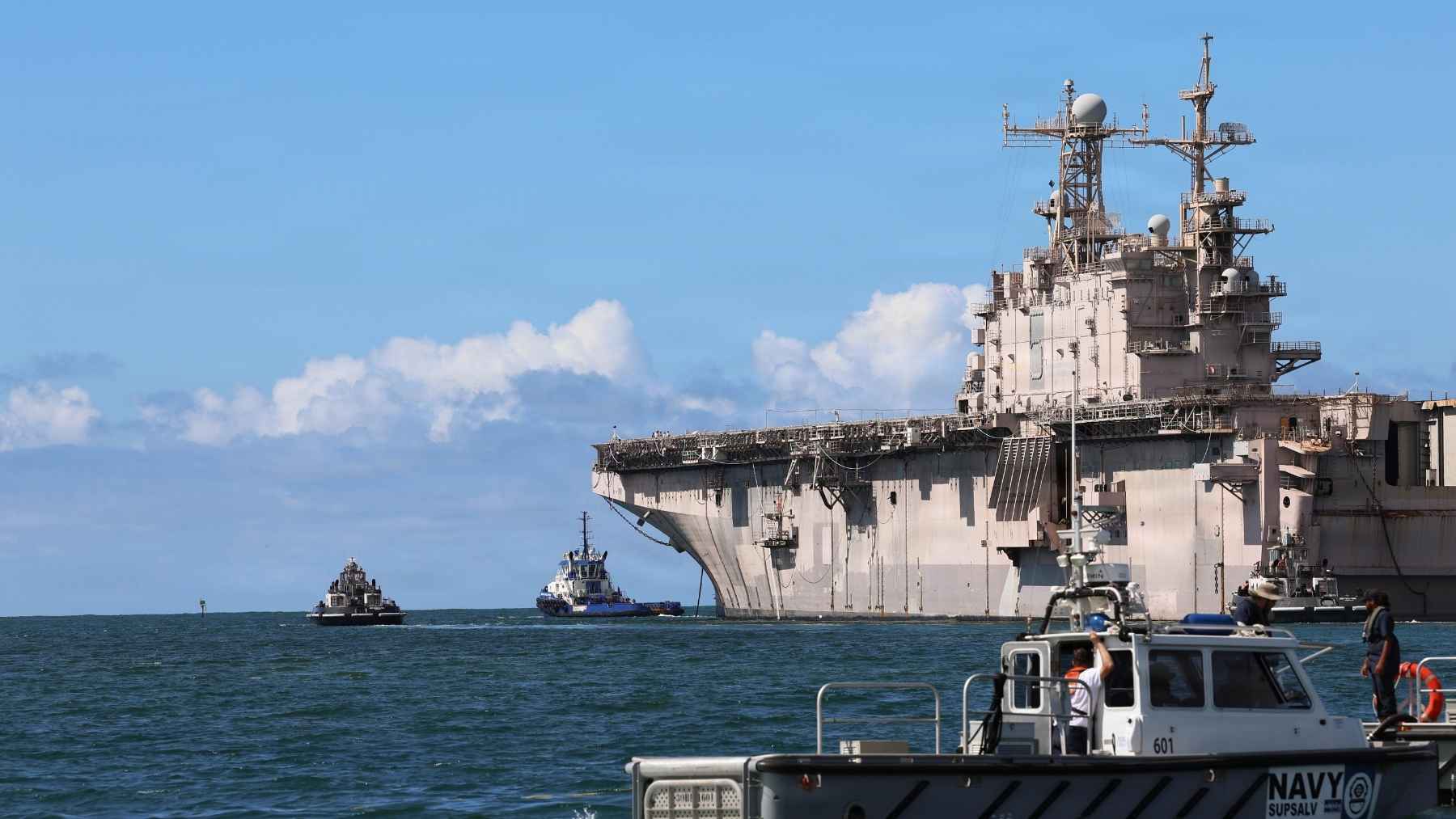

The Navy has been decommissioning Ticonderoga-class cruisers for years, and the standard fate for these 9,600-ton Cold War leftovers is either the scrapper’s torch or a slow rust at anchor while Congress argues about what to do with them.
One of them got a different sendoff. On July 12, a Canadian diesel-electric submarine came up to periscope depth somewhere off the north shore of Kauai, lined up on the drifting hulk of USS Mobile Bay, and put a heavyweight torpedo into her side as the finale of a live-fire sinking exercise at RIMPAC 2026.
The boat that pulled the trigger was HMCS Corner Brook. And here is the part that is almost funny if you follow Ottawa’s defense headlines: six days earlier, the Prime Minister’s Office had put out a release confirming that only one of Canada’s four submarines was seaworthy.
One boat. One shot. One 9,600-ton American cruiser on the bottom of the Pacific.
The shot: one Mk 48, one Ticonderoga
The weapon was a Mk 48 Mod 7AT heavyweight torpedo, the same 21-inch wire-guided fish the US Navy runs on its own attack submarines. Corner Brook is a Victoria-class boat, formerly the Royal Navy’s HMS Ursula, launched in 1989 and sold to Canada in 1998. NATO-standard tubes, NATO-standard torpedo, thirty-seven-year-old hull burning diesel instead of splitting atoms.
There is a nice piece of irony in that torpedo, too. Corner Brook spent from 2014 to 2021 stuck in an Extended Docking Work Period, repairing damage from a 2011 underwater grounding. One of the upgrades she picked up during those seven years in the shed was the ability to fire the Mod 7AT in the first place, replacing the older Mk 48 4M. The refit that kept her tied up is what armed her for this.
The target was no small thing either. Mobile Bay was CG 53, the seventh Ticonderoga built, a 567-foot Aegis cruiser of the kind that used to be the surface Navy’s answer to Soviet regiments of anti-ship missiles. Per the Navy, she was commissioned in February 1987 at the Alabama State Docks in Mobile, and decommissioned in August 2023. Call it 36 years in the fleet.
She was also one of the first Ticonderogas built around vertical launch cells rather than twin-arm rails. From CG 52 onward the class rolled out of the yard with Mk 41 VLS from the keel up, which is the single reason these ships carried Aegis usefully into the 2000s.
The clockwork mouse that finally got to shoot
This was not a courtesy assignment, and to understand why it mattered to Ottawa you need to know what submarines usually do at RIMPAC.
Mostly they play target. A boat at the exercise often works as what Paul Mitchell, a professor at the Canadian Forces College writing a book on the Victoria class, calls a “clockwork mouse,” moving predictably so surface ships can practice tracking it. Mitchell told the National Post that no submariner wants that job, describing it as “boring and dull and there’s no glory in it.”
Corner Brook did not get handed the mouse costume. She got the kill shot.
It was Canada’s first submarine at RIMPAC in twelve years, since HMCS Victoria attended in 2014, and the boat only returned to full operational service in April 2025 after more than a decade out of the normal cycle. Capt. Landon Creasy, the Canadian task group commander, said live-fire targeting work of this kind is “invaluable to our submariners.”
He is not wrong, and the reason is structural. Detect a contact, classify it, track it, solve the firing problem, launch a wire-guided torpedo, and put a real hull on the seabed. That is the entire engagement chain end to end, and Corner Brook ran it against an actual warship rather than a simulator.
Mitchell also made the practical point about why any of this matters. Canada has to keep these aging boats running for another decade, because they are the only thing available to train crews for the German-built fleet Ottawa just committed to buying. The same July 6 release that admitted three of four submarines could not sail was the one naming TKMS preferred supplier for up to 12 new ones.
Everything else that hit her first
Corner Brook did not sink the cruiser alone. Before the Canadians got their turn, Mobile Bay ate a full menu.
Coalition forces put HIMARS rockets, Japanese Type 12 anti-ship missiles, AGM-158C LRASMs, Spike NLOS missiles and heavyweight torpedoes into the hull. At least one LRASM came off a Navy Super Hornet.
The helicopters were the surprise act. US Army AH-64 Apaches from the 16th Combat Aviation Brigade fired Spike NLOS at the cruiser, a weapon most people file under anti-tank work, now cleared for shooting at warships. The Army has been integrating it under its Mobile Long-Range Precision Strike Missile effort since late 2023.
Over on the Peleliu shoot five days later, a Royal New Zealand Navy SH-2G(I) Seasprite off HMNZS Te Mana put a Penguin missile into the hulk, a Royal Australian MH-60R Seahawk fired a Hellfire, and an Italian Navy SH-101 launched a Marte anti-ship missile.
Three Harpoons converged on the same target from three different navies: the Spanish frigate ESPS Álvaro de Bazán, the Japanese destroyer JS Kongo, and the Los Angeles-class submarine USS Columbia firing an encapsulated UGM-84 from underwater.
The drone boat that finished the job
The last thing to hit Peleliu was the most interesting, and it is the part of RIMPAC 2026 that people will still be talking about in five years.
The Navy sent in Global Autonomous Reconnaissance Craft from Unmanned Surface Vessel Division 32. Two were present; one ran the full end-to-end attack. Video from the observing craft shows the drone boat motoring past holes already torn open by Harpoon, Spike and LRASM before detonating against the waterline.
It was the first time the US Navy has used a kamikaze sea drone against a large warship in a live-fire event.
The specifics matter. TWZ reports the GARC is roughly 16 feet long, displaces about 4,800 pounds fully loaded, and carried a 1,000-pound payload into the Peleliu. The autonomy package was Anduril’s Lattice, the same software family the company has been pushing across every uncrewed platform it can get it onto.
This is the weapon category Ukraine has ridden hard in the Black Sea, and which US forces reportedly used in combat against Iran earlier this year. Kyiv has already turned drone boats into launch platforms for other drones. Watching the US Navy send one into a 40,000-ton amphib in front of thirty navies was less a demonstration than an announcement.
Fifteen thousand feet down, fifty miles off Kauai
The geography is not incidental, and the Navy is specific about it. Both hulks went down in 15,000 feet of water, roughly 4,570 meters, more than 50 nautical miles off Kauai’s northern coast. That is deeper than the Titanic wreck field.
Those numbers are regulatory, not aesthetic. EPA rules for sinking exercises require at least 1,000 fathoms of depth and a 50-mile standoff from land, which is why these things always happen out past the Hawaiian shelf. The Navy also has to survey the area for people, vessels, aircraft and marine mammals before anyone fires, under permits tied to the Marine Mammal Protection Act and the Endangered Species Act.
Two hulks in one exercise is the notable part. RIMPAC 2024 also sank two, ex-USS Tarawa and ex-USS Dubuque, so this is the second consecutive edition running a pair. The SINKEX is traditionally the capstone event of the exercise, and the Navy now has enough surplus hulls to make it a double bill.
The politics of ships that were never supposed to be scrapped
Here is the piece that does not quite get said out loud in the press releases.
Ticonderoga-class cruisers have been at the center of a long fight between a Navy that wants them gone and a Congress that keeps objecting to how they are going. The service poured about $3.7 billion into modernizing seven of them, per a GAO review, and only three will finish the program. Four were divested after taking on billions in overhaul work without ever deploying again.
The Navy has since partially backtracked, extending Gettysburg, Chosin and Cape St. George into 2029. Chosin was actually at RIMPAC 2026 as a participant, which means a Ticonderoga was shooting in the same exercise where a sister ship was the target.
What a SINKEX does, and this is the quiet part, is make a decommissioning permanent in a way scrapping does not. A hulk at 15,000 feet is not coming back via a modernization amendment tucked into the next NDAA.
Vice Adm. Jeff Jablon, the RIMPAC 2026 Commander, Combined Task Force, framed the drills more diplomatically, calling them “a prime example of the strength and readiness our partnerships create.” Fair enough.
Operationally, though, RIMPAC 2026 was the largest live weapons demonstration against real Navy hulls in a generation. Land-based rockets hitting ships from shore. An Apache shooting an anti-tank missile at a cruiser. Harpoons from three navies including one fired from underwater. A kamikaze drone boat opening a hole at the waterline. And a Canadian diesel submarine delivering the coup de grâce.
What these two ships actually did
Worth remembering what got sunk.
Per the Navy, Mobile Bay was homeported in Mayport, Florida until 1990, then joined 7th Fleet in Yokosuka. Across her career she supported Desert Shield, Desert Storm and Iraqi Freedom, and delivered humanitarian assistance after the 1991 Mount Pinatubo eruption in the Philippines.
Peleliu had her own resume: commissioned in May 1980, homeported in San Diego, 17 deployments, Desert Storm and Iraqi Freedom, plus relief work after that same Pinatubo eruption and the 2010 Pakistan floods. Decommissioned in March 2015 after 35 years.
Two ships, roughly seven decades of combined service, now sitting on the same patch of seafloor.
The size of RIMPAC 26, and why it matters
RIMPAC has been a fixture since 1971, and the 2026 edition, which ran June 24 to July 31, was the 30th in the series.
The Navy counted 30 nations, 30 surface ships, five submarines, 15 national land forces, more than 190 aircraft and over 30,000 personnel. Other tallies ran differently, with UK Defence Journal reporting 31 nations and 36 surface ships but a lower headcount around 25,000. That kind of spread is normal for an exercise this size, where the roster shifts with arrivals and departures.
Either way, it is the largest maritime exercise on the planet, and the SINKEX is one of the few places allied navies get to shoot live weapons at a full-sized warship instead of a towed sled.
Engineers get damage-control data. Aircrews and submariners get a target that behaves like a target. And the Pentagon gets to demonstrate, in front of every naval attaché in the Indo-Pacific, that a coalition can turn a 9,600-ton cruiser into scrap on the seabed in one afternoon.
The last shot went to a Canadian submarine that spent most of the last decade waiting for its turn. That is the part Ottawa is going to be quoting for a while.