
Building anything large usually starts with the same step. Send in the earthmovers, cut the high ground, fill the low ground, and hand the crew a flat site. Utility-scale solar has followed that rule for most of its existence, and not for cosmetic reasons.
A conventional single-axis tracker is a long straight steel tube. A straight tube wants straight ground under it. Which is how a rolling Virginia hayfield ends up looking like a shopping mall parking lot weeks before the first panel shows up.
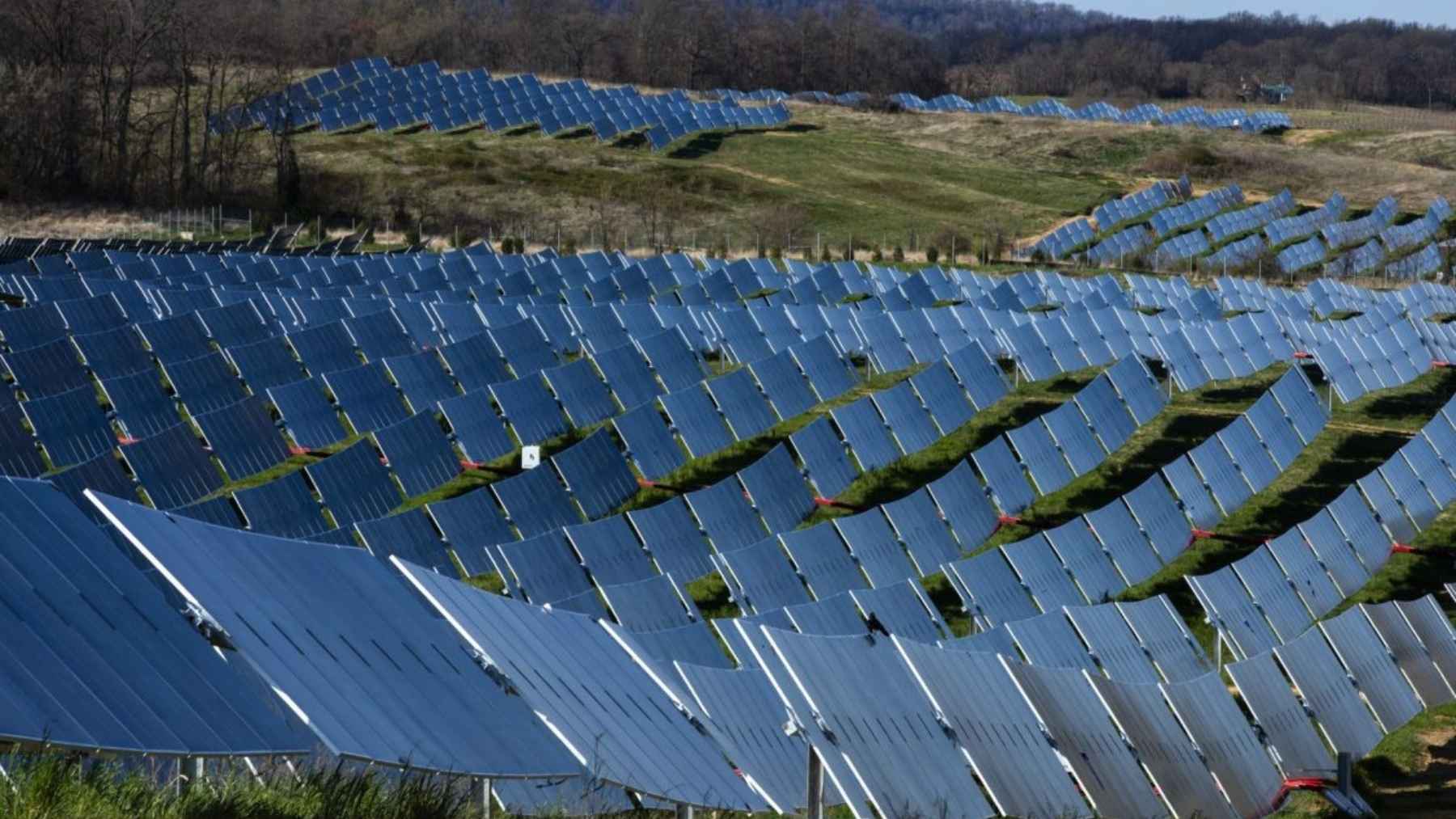
The Bartonsville Energy Facility in Frederick County, Virginia, did not go that route. The project was built by MYR Energy Services for D. E. Shaw Renewable Investments on trackers designed to hinge with the slope instead of arguing with it.
An independent civil consulting firm, Sierra Overhead Analytics, ran the numbers on what a conventional layout would have required. Its figure for the soil that would have been cut or filled: 406,413 cubic yards. Enough to fill 123 Olympic swimming pools, according to the case study Nevados published on the build.
Virginia’s Department of Environmental Quality gave the project a gold medal for it. The state’s own land-use research, published the same year by a different agency, tells a less flattering part of the story.
Straight torque tubes are the reason solar sites get flattened
A single-axis tracker is a row of panels on a horizontal shaft that rotates east to west across the day. The shaft is the torque tube, and on a standard system it runs dead straight down the row.
Put that on rolling ground and you have two options. Flatten the ground, or leave the ground alone and change the height of every foundation pile so the tops line up. Both cost money. The first costs it in diesel and dozer hours, the second in steel.
Grading is also the part regulators care about. Stripping topsoil off several hundred acres of Virginia hillside means erosion, sediment in the creeks, and a much heavier stormwater permit. The site sits in the Conococheague-Opequon and Shenandoah watersheds, which is not where you want a mud problem.
The US Department of Energy has been funding work on this specific bottleneck for a decade. Its Solar Energy Technologies Office put roughly $2 million behind Nevados starting in 2015, on the argument that grading eats a serious share of both the budget and the schedule on a new array.
The bending happens at the bearing, and that is where the steel came off
Nevados’ All Terrain Tracker breaks the torque tube into segments and joins them with articulating bearings. The row can follow an overall slope of up to 20 degrees, roughly a 37 percent grade, and change angle by up to 15 degrees between one post and the next.
Fifteen degrees at a joint works out to about a 26 percent change in slope at every single foundation. In practical terms the row drapes over the contour rather than spanning it.
The steel saving is the less obvious half. Because the structure itself absorbs the terrain, every pile can be driven to the same reveal height above grade. No taller piles on the low ground to meet a straight tube.
Sierra Overhead Analytics put that at 230,000 linear feet of steel piling not installed, or 43 miles of it, a 23 percent reduction. The 23 percent figure also appears in Virginia DEQ’s own award write-up, which is a useful cross-check on a number that otherwise comes from the vendor.
Nevados says the avoided earthmoving and the avoided steel each saved the project around $2.5 million, for roughly $5 million combined. That figure has not been confirmed by DESRI or MYR, so treat it as the supplier’s accounting rather than an audited line item.
Virginia’s environmental agency gave it a gold medal
The Governor’s Environmental Excellence Awards are run annually by Virginia DEQ with the Department of Conservation and Recreation. In 2024 the Bartonsville partners took gold in the Environmental and Sustainability Project category, alongside winners as varied as a cabinet finisher’s solvent recycling program and a Raytheon sustainability effort.
The DEQ write-up is worth reading because it is the one document in this story with no commercial interest in the outcome. It puts the site at roughly 1,000 acres at the foot of the Appalachian Mountains, and describes the Nevados hardware as the technology’s first use anywhere in Virginia.
It also lists the things the press releases skipped. Directional boring instead of open trenching where the route crossed sensitive water. And 28 retention ponds built into the layout for erosion control.
DEQ’s projected output for the facility is about 284,700 megawatt-hours of electricity a year. MYR Group lists completion in 2024, and federal generator inventory data has carried it as operating since then.
One point of confusion worth clearing up. Nevados quotes the project at 170 MW, Virginia’s permit file and MYR Group both say 130 MW. Both are correct. The modules add up to 170 megawatts of direct current, the inverters deliver 130 megawatts of alternating current to the grid, and solar projects get quoted either way depending on who is talking.
The state’s own land study is less flattering
In December 2024 the Virginia Department of Energy published a GIS study with Virginia Commonwealth University measuring the actual disturbed footprint of every utility-scale solar facility in the state, using aerial imagery rather than permit paperwork.
Bartonsville shows up in it. The measured disturbed area is 938.65 acres, which lines up closely with the 950 acres MYR Group lists. Divide that by 130 megawatts and you get 7.22 disturbed acres per megawatt, against a statewide average of 6.93.
So the trackers saved dirt, not acreage. The project used slightly more land per megawatt than the typical Virginia array, and the report does not explain why, so nobody should pretend to know. Following contours instead of imposing a grid is a plausible reason. It is not a documented one.
The land it sits on matters more than the ratio. Sixty-nine percent of the disturbed area was cropland, and 441 of those acres carry the state’s highest agricultural soil rating. Bartonsville is one of five facilities that together account for 51 percent of all Virginia solar development on Class V cropland soils.
The forest side reads better. The 105 acres of forest cover the project touched all fell into the two lowest conservation-value classes in the Department of Forestry’s model. None of it was rated High, Very High or Outstanding.
Which is roughly the trade Virginia keeps making. Good farm ground, poor woods, and a lot of megawatts.
Flat land is the thing Virginia is running out of
The Virginia Clean Economy Act put a target of 16,100 megawatts of solar or onshore wind in front of Dominion Energy by 2035. As of June 2024 the state had 94 utility-scale solar facilities totaling 4,423 megawatts AC, which leaves a long way to go and a finite supply of easy sites.
American Farmland Trust reckons more than 594,000 acres of Virginia farmland could be fragmented or converted to non-agricultural use by 2040 on current trends, before energy development is fully counted. “Farmers see both the opportunities and challenges of large-scale solar development,” said Jamie Mierau, the group’s Mid-Atlantic regional director, writing after Governor Abigail Spanberger signed a state definition of agrivoltaics in June.
That squeeze is why terrain-following hardware stopped being a niche product. Nevados founder and CEO Yezin Taha framed it to PV Tech in 2024 as a simple supply problem, with flat or gently sloping land getting “scarcer and more expensive”. Nextracker, Gonvarri and others now sell their own versions.
Virginia is also where that pressure is sharpest, since the data center buildout keeps adding load faster than the state can add generation. The same crunch is producing some genuinely odd engineering downstream, including the Virginia couple breeding a purpose-built cow to graze under live panels.
What the Bartonsville build actually proves
Not that terrain-following trackers are free. They are more complicated hardware with more moving parts than a straight tube, and the case study is written by the company selling them.
What it does establish, with a state agency and an independent civil firm both signing off on pieces of it, is that a 130-megawatt project on rolling Appalachian foothill ground can be built without a grading plan. That was not obviously true five years ago.
MYR Group came out of it planning to use the same trackers across more than a gigawatt of future work. For everyone else the useful number is 406,413 cubic yards, because that is the size of the bill that used to be treated as unavoidable.
The land question does not go away. Bartonsville still sits on 441 acres of Virginia’s best farm soil, and no bearing design changes that. It just means the topsoil is still under the panels rather than in a spoil pile, which is a smaller win than the medal suggests and a real one anyway.