
Railroad track looks like the most inert object in all of transportation. Two steel rails, concrete sleepers underneath, a bed of crushed rock holding the whole thing in place, and it apparently just sits there while trains run over it for thirty years.
Steel does not sit still under load. Every wheel that passes flattens against the railhead in a contact patch roughly the size of a dime, and a loaded North American freight wheel routinely pushes 36,000 pounds through it. Railway Age puts the average pressure inside that patch at around 90,000 psi.
Do that a few hundred million times and the metal starts coming apart just below the surface, which is a problem you cannot see by looking at the rail. The fix is to shave the damaged skin off the top before it turns into a crack.
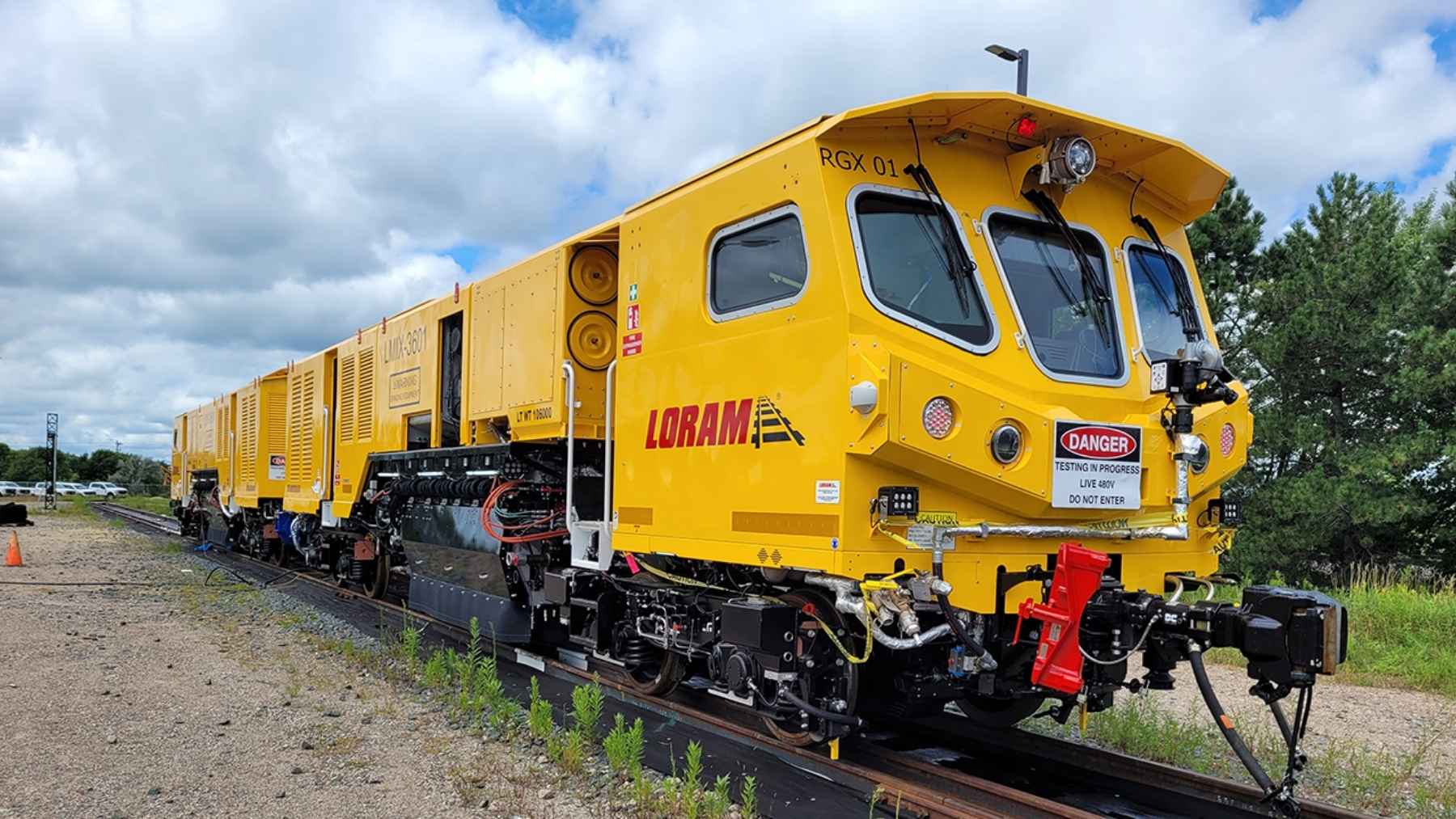
On May 19 the British rail regulator signed off on a machine built to do exactly that. It came out of a factory in Minnesota, it carries 40 grinding stones, and it is the first maintenance machine in Britain that can work a railway with no signals beside the track.
Rail fails from the inside before it wears out on top
The failure mode is called rolling contact fatigue, and it is not wear in the way most people picture wear. Wear is material rubbing away. RCF is the steel near the surface being kneaded past its fatigue limit until fine cracks open up inside it.
Those cracks favor the gauge corner, the inside upper edge of the rail where a wheel bites hardest through a curve. Some grow outward and flake the surface off. Some turn downward into the railhead, and those are the ones that end badly.
Britain learned this the expensive way. On October 17, 2000, a GNER express doing over 115 mph came off the East Coast Main Line at Hatfield, killing four people and injuring more than 70.
The rail did not simply break. Official inquiries found it had fragmented into more than 300 pieces. The Railway Safety and Standards Board traced a 35-metre disintegration back to transverse fatigue defects that had started life as gauge corner cracks on the surface.
Railtrack collapsed inside two years. Network Rail inherited the railway, and a national campaign against RCF along with it.
Grinding is the cheap end of that campaign. A grinding train takes between 0.1 and 1 millimeter off the top of the rail, which is four to forty thousandths of an inch, and removes the cracked layer with it. Leave it too long and the only remaining option is cutting the rail out and welding new steel in.
Forty stones, and every one of them is programmable
The machine cleared in May is the RGC01, a four-vehicle rake registered in Britain as DR79701 to DR79704. Loram Maintenance of Way built it in the United States and shipped it over in May 2025, according to Railway Gazette.
The same report notes its 40 stones can be digitally programmed to cut different railhead profiles depending on track condition and line speed. That is what separates a modern grinder from a rock on a stick. The operator is reshaping the curve of the railhead, putting the wheel back where the engineers want it to sit.
Loram’s published specifications for the RGC series fill in the rest. Each grinding module runs a 30 hp electric motor, so a 40-stone consist carries 1,200 hp of grinding alone. The stones swing from 75 degrees on the gauge side to 25 degrees on the field side to cover the full profile.
Grind speed tops out at 20 mph. Travel speed is 70 mph, which matters more than it sounds, because a maintenance machine that cannot clear the line quickly is a machine that eats somebody’s timetable.
Maximum axle weight is 22 tons. Water capacity across the series runs as high as 29,000 gallons, most of which exists to stop the sparks from setting the lineside on fire.
The regulatory piece is the actual news. The Office of Rail and Road lists the RGC01 Stone Grinder on its public register of interoperability authorisations, filed under Loram UK Limited and dated May 19, 2026, with the application logged on April 23.
That letter is what legally permits the machine to be placed in service on the national network. As far as I can find, nobody in the trade press wrote it up.
A grinder that has to read signals that are not there
Here is where the RGC01 stops being an ordinary piece of yellow plant. Britain is in the middle of tearing the signals out of one of its busiest main lines.
The East Coast Digital Programme is a £1.4 billion government-funded rollout of in-cab digital signalling on the southern East Coast Main Line, roughly 100 miles of 125 mph railway between London King’s Cross and the Stoke tunnels near Grantham.
The pathfinder section, the four-mile Northern City Line into Moorgate, lost its physical lineside signals in May 2025 and has run without them ever since. Network Rail expects around 700 signals to come out in total.
Which creates an awkward gap. If the colored lights are gone, every vehicle on that track needs the signalling in the cab, and that includes the machines that show up at two in the morning to fix the rail.
Loram fitted the RGC01 with a Hitachi Rail ETCS system and ran it through Level 2 testing at Network Rail’s Tuxford and Melton Mowbray test tracks. It came out the other side as the first on-track machine in Britain equipped for in-cab digital signalling.
There is a loop in this story that nobody involved seems to have said out loud. The line getting the digital signalling is the East Coast Main Line. Hatfield is on the East Coast Main Line. The railway that killed four people over a fatigue crack in 2000 is now the railway teaching an anti-fatigue machine to work without signals.
The German machine does it at 50 mph without stopping the trains
Conventional grinding is slow and it takes the track away from traffic. Vossloh went at that problem from a completely different direction with the HSG-2, and the numbers are faintly ridiculous.
According to Vossloh’s product documentation, the machine carries four grinding units, each with a four-position revolver magazine holding 96 stones. That is 384 stones on one train. Twelve of them sit close together on each grinding beam and behave like a ruler dragged along the railhead.
The trick is that they are passive. The stones are not driven by motors, they rotate because the train is moving, and hydraulic contact pressure is monitored continuously so the machine cannot burn the rail or leave periodic marks.
Working speed is up to 80 km/h, just under 50 mph, which is why the HSG-2 can be slotted into a normal timetable instead of shutting the line down.
A worn row of stones swaps for a fresh one in three seconds while the train is still rolling. Vossloh claims a shift of up to 240 km, about 150 miles, with nobody leaving the vehicle, and credits the smoother railhead with cutting rolling noise by as much as 10 decibels.
Different tool, different job. The HSG-2 is preventive medicine that keeps a healthy rail healthy. The Loram machine is for railheads that already have a problem worth 40 stones and 1,200 hp. Mixing the two up is how people end up quoting the wrong number.
What all of this looks like on American track
Loram is not a British company anybody adopted out of sentiment. It is headquartered in Hamel, Minnesota, and it serves every Class I railroad in North America.
By its own published count, the company has 250 machines working in 27 countries and has ground more than 1.5 million pass miles in the last decade.
The American fleet has been moving in the opposite direction from the 40-stone consist, toward smaller and faster. Loram told Progressive Railroading in July that its truckable RGT mounts an eight-stone grinding system on a hi-rail, DOT-certified tractor-trailer that can be working within minutes of arriving.
That one is aimed squarely at switches, crossings and embedded track, where a 300-foot grinding train is useless. If you commute on Metra, ride the Northeast Corridor, or live near a heavy-haul route, some version of this has been happening on your line for years without a single press release.
It is the same pattern that shows up wherever infrastructure quietly outlives its design life, from the rebar corroding inside every parking deck and bridge to the way rail corridors get reused for things nobody planned for.
Switzerland’s removable solar plant bolted between live tracks was designed to lift out precisely so maintenance machines can get at the steel underneath. Britain’s network is also where a scrapped 1959 diesel shunter came back running on a Toyota hydrogen fuel cell.
One caveat worth stating plainly. An ORR authorisation is legal clearance to place a machine in service, not proof that it has started grinding production miles. Network Rail has not published a service-entry date, and the ORR letter itself sits behind a server that blocks automated access, so the entry in the public register is the hard confirmation.
What is on the record is specific enough. An American-built machine with 40 programmable stones is cleared to shave four thousandths of an inch off British rails, on a line where a fatigue crack once killed four people, on a railway busy taking its signals down. Nobody riding over it at 125 mph will notice a thing, which is the entire point.