
If you have ever walked past one of those indoor skydiving places at a mall, the ones where somebody in a padded suit hovers inside a glass tube with a fan howling underneath, you already have a rough mental picture of what NASA just finished building in Hampton, Virginia.
That comparison is not mine. Corey Diebler, the aerospace engineer who manages the new facility, told WHRO reporter Katherine Hafner that the tunnel is “not too different than, say, an indoor skydiving tunnel.”
NASA cut the ribbon on it Friday, July 31. The Flight Dynamics Research Facility, or FDRF, sits at Langley Research Center and is, in the agency’s words, “NASA’s first major new wind tunnel in more than 40 years.” That line came from Administrator Jared Isaacman at the ceremony.
Here is the part the press release states plainly and nobody has led with. The building that opened last week replaces two tunnels at the same center, one that started running in 1939 and one that started in 1941. Both are being retired.
One tunnel opens, two tunnels close. In raw count, Langley comes out of this week with one fewer wind tunnel than it had.
Four carbon fiber fans and 3,000 horsepower pointed straight up
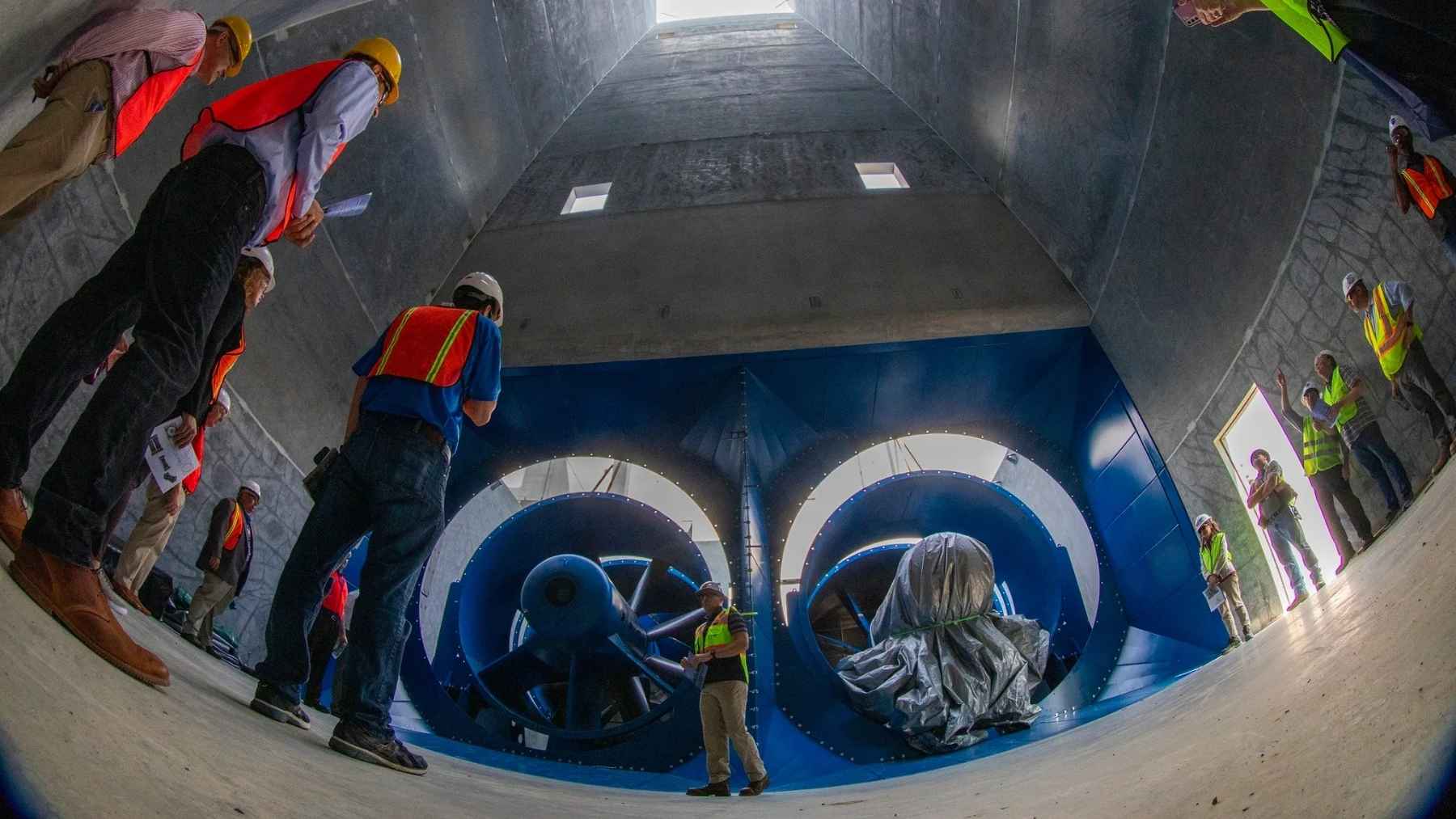
The machine itself is not a consolation prize. NASA’s own FDRF fact sheet puts the test section at 20 feet in diameter and 24 feet tall, inside a 25,000-square-foot building that stands 131 feet high.
Airspeed runs from zero to 172 feet per second, which works out to the 117 mph NASA has been quoting all week. Dynamic pressure tops out at 35 pounds per square foot.
The wind comes from four 750-horsepower motors, each with its own 14-foot fan turning eight carbon fiber blades. That is 3,000 horsepower and 32 blades, all of it aimed at pushing air vertically through the chamber.
Carbon fiber is not there for the marketing. Light blades change speed fast, and NASA says that is exactly the point: during a free-flight test the operator is chasing a model that is falling and climbing inside the airstream, and the wind has to be trimmed constantly to keep the thing in the middle of the shot.
There is also a heat exchanger in the loop, which tells you something about the physics. Dump 3,000 horsepower into a fixed volume of air and that air gets hot. The fact sheet lists the tunnel as actively cooled to 79 degrees Fahrenheit, with honeycomb, flow screens and turning vanes conditioning the stream before it reaches the models.
The tunnel it replaces was already 20 feet across
This is where the numbers get interesting, and where you have to read NASA’s own archive rather than the press release.
The 20-Foot Vertical Spin Tunnel opened in 1941 to study stalls and spins, back when aircraft were falling out of the sky in flat rotations that pilots could not recover from. NASA’s history page for Building 645 describes a 12-sided test section 20 feet across and 25 feet tall, a top speed around 85 feet per second, and a three-bladed fan on a 400-horsepower DC motor.
Twenty feet across. Twenty-five feet tall. The new chamber is 20 feet across and 24 feet tall.
NASA’s release says the FDRF chamber is much larger than those of its predecessors, and against the 12-Foot Low-Speed Tunnel that is true by a wide margin. Against the 1941 spin tunnel, the width is a match and the height is a foot shorter.
The gains are real, they are just somewhere else. Speed roughly doubles. Power multiplies. Turbulence levels are more uniform, which Diebler described to WHRO as producing cleaner data, and clean data is the entire product a wind tunnel sells.
Langley director Trina Dyal put it at the ceremony as almost twice the wind speed and five times the horsepower of its predecessors, plural. That figure covers both old tunnels combined, not the 1941 tunnel on its own.
Nobody has managed to replace the spin test with a simulation
The obvious question in 2026 is why anyone still builds a physical tunnel when computers keep getting better at this.
The answer is that a spin is about the worst case you can hand a solver. The aircraft is past the stall, autorotating, shedding separated flow off surfaces that are all interfering with each other, and the whole thing is unsteady in every axis at once.
That is why the vertical tunnel format survived from 1941 into a building that opened last week. You drop a dynamically scaled model into rising air and watch what it actually does, instead of asking software what it thinks might happen.
NASA is fairly open about the relationship. The fact sheet lists poststall computational fluid dynamics among the FDRF’s jobs, which means part of the tunnel’s output is feeding and checking the simulations rather than competing with them.
Four test techniques are listed: free flight, forced oscillation, a rotary balance system, and flow visualization. Free flight is the one people picture. The others involve holding the model on a rig and measuring what the air does to it.
The first job in the new tunnel is a plane the old tunnel already tested
Diebler told WHRO that the first program through the door is the transonic truss-braced wing, the long, thin, strut-braced wing NASA has been developing with Boeing under the X-66 designation. WTOP reported the same from the ceremony.
Which closes a loop that is genuinely satisfying. NASA has already published photos of an X-66 model, wingspan just under six feet, being tested on October 30, 2024, in the 12-Foot Low-Speed Wind Tunnel at Langley. That is one of the two tunnels the FDRF was built to replace.
Same program, same center, new box. The handoff is literal.
Behind it in the queue is RAVEN, an air taxi and delivery drone concept. NASA aerospace engineer Ben Simmons showed reporters a 28 percent scale model of a full-size vehicle that will weigh 1,300 pounds, and argued that conventional testing methods would need lifetimes to characterize a machine with that many interacting controls.
Then there is DAVINCI, the Venus mission currently estimated for a 2030 launch. Aerodynamics descent lead Giovanny Guecha explained that the Venusian atmosphere is dense enough that the probe has more in common with a submarine than an aircraft, and that the higher wind speeds let his team push testing closer to conditions near the surface.
At the opening itself, Isaacman dropped a parachute-equipped Orion model into the airstream and it hung there, drifting around for a few minutes. Engineers then poured a cup of water in, which broke into droplets that floated in the column like bubbles. Both are demonstrations rather than data, and both are much better television than a rotary balance run.
Nobody has published a single number for what it cost
The one figure NASA itself has put in writing is the construction contract. Its 2022 groundbreaking release says the General Services Administration awarded a $43 million design-build contract to BL Harbert International in September 2021. The fact sheet adds Mason & Hanger on architecture and engineering, with the tunnel itself designed by Calspan ASE, now North Wind.
Reporters at the ribbon-cutting came away with larger numbers and not the same larger number. WHRO and the Washington Examiner both put the facility at $57 million. WTOP put it at $53 million. NASA has not published a consolidated total, so take any single figure you see this week with that in mind.
The schedule is easier to pin down. Ground was broken on August 17, 2022, with construction expected to finish in late 2024. WTOP reported that construction actually wrapped in March 2026, and the ribbon was cut on July 31.
One more wrinkle worth knowing, because it changes what the headline claim means. In 2022 NASA described the FDRF as the center’s first major wind tunnel in more than 40 years. In 2026 the same claim covers the entire agency. Those are two different statements about two different things, and only the second one made it into the coverage.
The old tunnels’ guts went into the new building
Strip the ceremony away and the engineering case is straightforward. Two buildings from the late 1930s and early 1940s were expensive to keep alive, and much of what made them valuable was never the structures anyway.
NASA’s own account of the handover notes that test rigs, instrumentation and data systems were pulled out of the old tunnels and reinstalled in the new one to cut cost and development time. Mike Fremaux, the retired Langley chief engineer who spent 30 years on the concept, describes the result as having “a combination of features found in no other single facility in the world.”
Six wooden fan blades and the metal hub from the 12-Foot tunnel are now mounted in the FDRF control room. Models from decades of spin tests are going in the lobby. It is a nice touch, and it is also what decommissioning looks like when the parts are too historically loaded to scrap.
If you like large American machines that quietly do impossible jobs, we have written about the 6.65-million-pound crawler that hauls NASA’s Moon rocket to the pad, the 1,000-ton magnet America finished by threading in its last 110-ton coil, and the 1970s solar furnace nothing built since has managed to beat.
The FDRF joins that list on merit. It is faster, cleaner and cheaper to run than what it replaces, and the queue behind it is already three programs deep with a Boeing wing, an air taxi and a Venus probe.
Whether one tunnel can absorb the workload that two used to carry is a question with a real answer, and it shows up the first time two of those programs want the same week.