
Every renewable energy source comes with a catch you already know about. Solar quits the moment the sun drops below the horizon. Wind dies when the air goes still. Even hydro leans on whatever the season decides to send down the river. So the quiet holy grail has always been a clean source that just runs, around the clock, without asking the weather for permission. In a coastal corner of southern Japan, a small plant has been doing exactly that for nearly a year now, and it pulls its electricity out of the one place almost nobody was looking: the spot where fresh water meets the sea.
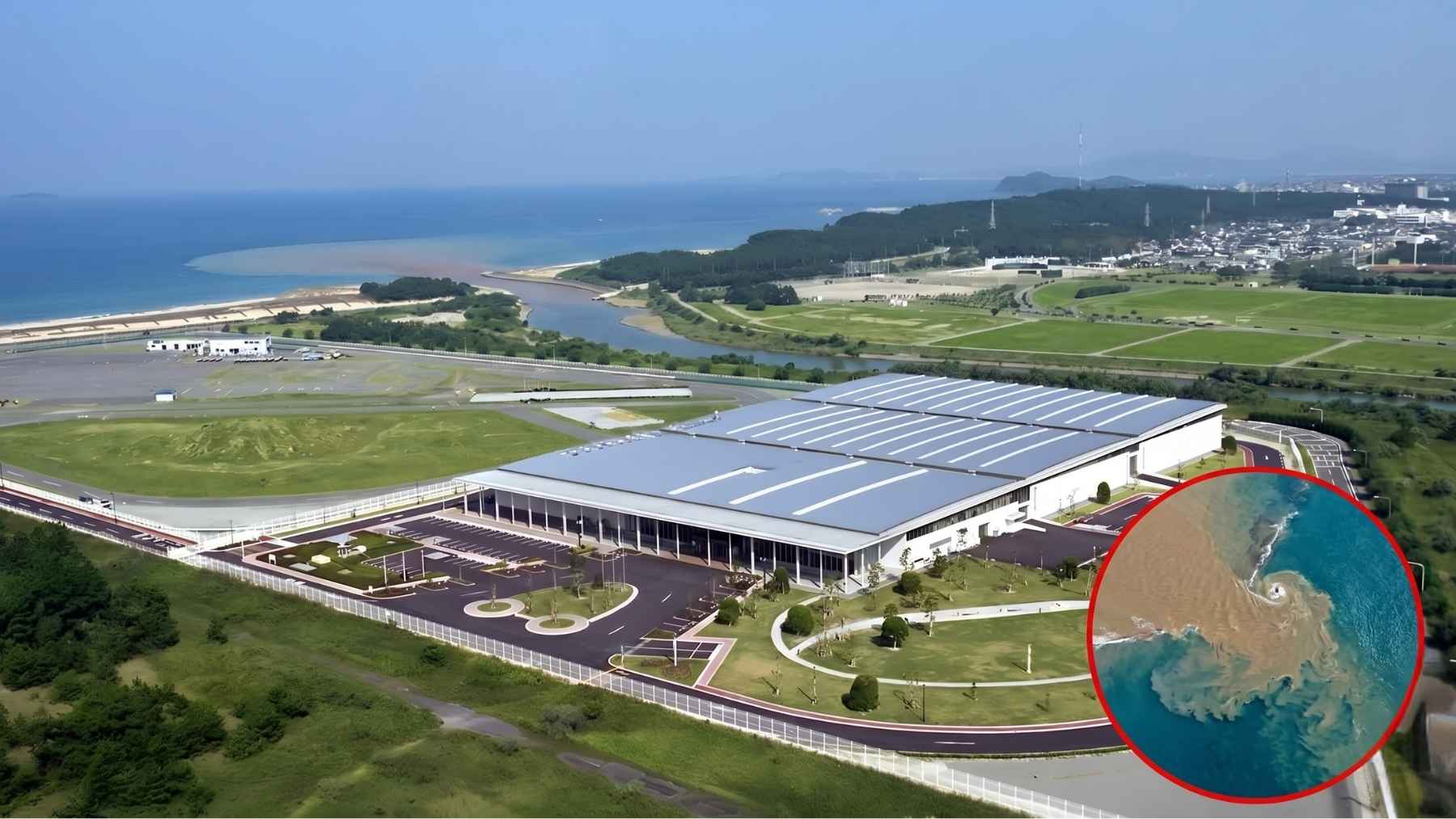
The facility sits inside the Uminonakamichi Nata Seawater Desalination Center in Fukuoka, and it switched on with an opening ceremony on August 5, 2025. It is Japan’s first osmotic power plant, a technology also called salinity gradient power or, if you want the marketing name, blue energy. It is only the second plant of its kind running continuously anywhere on the planet, and the first in Asia. It does not burn anything. It has no moving parts beyond a single turbine. And it does not care whether it is noon or midnight.
It Runs on the Same Pull That Drags Water Into a Tree’s Roots
Osmosis is the same quiet force that lets a tree pull water up out of the soil and keeps the cells in your body from shriveling. Put fresh water on one side of a membrane and salty water on the other, and the fresh water will push its way across to dilute the salt, because nature does not like a concentration gradient sitting there unresolved. Do that inside a sealed chamber and the volume on the salty side climbs, and so does the pressure. That pressure is the entire point. Pipe it through a turbine, spin a generator, and you have electricity made out of nothing but the difference between two kinds of water.
The version running in Fukuoka uses a trick that makes the physics work a little harder. Instead of ordinary seawater, it feeds the salty side with concentrated brine, the leftover sludge a desalination plant normally throws away after it strips the fresh water out. Sandra Kentish, a chemical engineer at the University of Melbourne, told The Guardian that using that brine widens the gap in saltiness and squeezes more available energy out of the process. On the other side goes treated wastewater from a nearby sewage plant. Two waste streams nobody wanted, run past each other across a membrane, and the result is power.
The technical name is pressure-retarded osmosis, PRO for short, and the textbook version wants a pressure difference around 26 bar for a seawater-to-freshwater system, roughly what you would feel at the bottom of a 270-meter column of water. None of this comes free, though. You spend real energy pumping both streams into the building, and you lose more to friction as water grinds its way through the membranes. The electricity that comes out the far end is whatever survives all of that, which is a smaller number than the chemistry promises on paper.
None of that stops Fukuoka from clearing the one bar that matters. The plant’s operational notices put its net output near 110 kilowatts, which squares with the 880,000 kilowatt-hours a year it advertises and, more to the point, stays above what the pumps and controls draw to keep it running. It makes more than it spends on itself. For a full-size power plant that is faint praise. For osmotic power, clearing that line at all is most of the story.
The Output Is Modest, and Pretending Otherwise Would Be Dishonest
The breathless coverage tends to skate past one number. The Fukuoka plant is projected to make about 880,000 kilowatt-hours a year. That is enough to cover a chunk of the power the desalination plant itself eats, plus the rough equivalent of somewhere between 220 and 300 average homes. Dr. Ali Altaee at the University of Technology Sydney put it at roughly 220 Japanese households. The Japanese government’s own writeup is more generous at around 300. The whole thing reportedly cost about ¥700 million to build, roughly $4.7 million, which is pocket change for a power station and real money for a science experiment. Either way, this is not a plant that lights up a city, and the people who built it have never claimed it was.
What it does have going for it is the thing solar and wind cannot buy: it basically never stops. The operators put the utilization rate near 90 percent, meaning it runs close to flat out regardless of cloud cover or calm air. Put another way, that 880,000 kilowatt-hours is about what two soccer fields of solar panels would generate in a year, except this version keeps working through the night and through a storm. Kenji Hirokawa, who directs the Seawater Desalination Center, has framed it as a modest first step rather than a finished answer, which is about the right level of expectation. The power it makes feeds straight back into producing drinking water for Fukuoka and the towns around it, so the plant is effectively making the desalination next door a little cheaper to run.
Norway Already Tried This and Walked Away in 2014
If salt power sounds too good to leave sitting in the ocean, that is because plenty of people have reached for it and come up short. The idea was first floated by a US researcher back in the 1970s, and it took decades before anyone built real hardware around it. The Norwegian utility Statkraft opened the world’s first osmotic power prototype in November 2009, at Tofte on the Oslo Fjord, with a Crown Princess on hand to cut the ribbon. It was designed for 10 kilowatts and in practice managed something closer to 2 to 4. The plant proved the concept was real. It also proved the concept was expensive.
By January 2014, Statkraft had pulled the plug, saying it could not make the technology efficient enough to compete and was leaving the job to others. The sticking point was the membranes. Statkraft’s plant squeezed out somewhere between 1 and 3 watts per square meter of membrane, and the rule of thumb in the field is that you need around 5 watts per square meter before the economics start to make any sense at all. Falling short of that by half is the difference between a science project and a power plant, and for years osmotic energy stayed firmly on the science-project side of the line.
The membranes have not stood still since, though. A nanofluidic design described in Nature Energy in early 2026 hit around 15 watts per square meter in the lab, three times that old threshold, by lining its pores with a slick lipid coating that speeds ions through without losing selectivity. Lab numbers are not field numbers, and the graveyard of energy breakthroughs is mostly paved with promising lab numbers. But the ceiling that killed Statkraft is no longer where it was.
The Math Still Loses to Solar, and the Builders Know It
This is the genre of energy story that usually ends in disappointment, the same genre that gave us solar panels paved into the road surface and then quietly dug back up a few years later. The osmotic economics have not magically flipped since Statkraft quit, either. One detailed analysis in an American Chemical Society journal pegged the realistic cost of osmotic electricity from a seawater source at around $2.37 per kilowatt-hour, a figure that looks faintly absurd next to the roughly 12 to 17 cents Americans pay at the wall. You can drag that cost down with exotic inputs like Dead Sea brine, but most coastlines do not come with a Dead Sea attached.
And yet the idea refuses to die, for a reason that has nothing to do with today’s price tag. The theoretical ceiling is enormous. Estimates of the global salinity-gradient resource run to something like 1,600 terawatt-hours a year, and optimistic researchers have floated the notion that osmotic power could one day cover up to 15 percent of world energy demand, if the membranes ever get cheap and durable enough. It is the kind of long-horizon bet that only pays off years out, in the same bucket as the lab batteries being built to store electricity and hydrogen in a single device for a market that does not quite exist yet. Denmark actually beat Japan to a continuously running commercial plant, opening one in Mariager in 2023 that draws on geothermal brine. Pilots have flickered to life in South Korea, Spain, Qatar, and Norway, and a paused Australian project at the University of Technology Sydney is waiting for someone to switch it back on.
France, meanwhile, has stopped thinking small. Where the Rhône meets the Mediterranean, the Rennes startup Sweetch Energy and utility CNR have switched on OPUS-1, a pilot meant to scale toward 500 megawatts across the river estuary over the next decade, roughly 4,500 times the size of Fukuoka. It skips the turbine entirely. Its bio-based nanotube membranes sort ions rather than push water, so the charged particles crossing the barrier are the current, pulled straight off electrodes. The underlying physics came out of CNRS nanofluidics labs, and Sweetch claims an efficiency gain near 20 times what older osmotic plants managed. Whether any of that holds at full scale is the open question. It is also a very different question than the one Statkraft walked away from.
Akihiko Tanioka, a professor emeritus at the Institute of Science Tokyo who spent decades on this problem, did not hide how he felt at the Fukuoka launch. “I feel overwhelmed that we have been able to put this into practical use,” he told Kyodo News, adding that he hoped it would spread well beyond Japan.
None of this makes Fukuoka’s plant a threat to a solar farm or a gas turbine. It is a demonstrator, and an honest one, sized to help a desalination plant trim its own power bill rather than to feed a national grid. But the grid is exactly where this kind of thing matters. Almost everything we have been plugging in lately, the data centers eating gigawatts, the new battery plants, the growing fleet of cars that charge overnight, wants steady clean power that shows up at 3 a.m. as reliably as it does at noon. Solar and wind cannot promise that on their own. A river running into the sea can, and it has been doing it in Fukuoka, quietly, every hour of every day, for nearly a year. The trick now is making the membranes cheap enough that the next plant does not need a desalination center next door to justify its existence. In the Rhône estuary, somebody is already betting the next one will not.