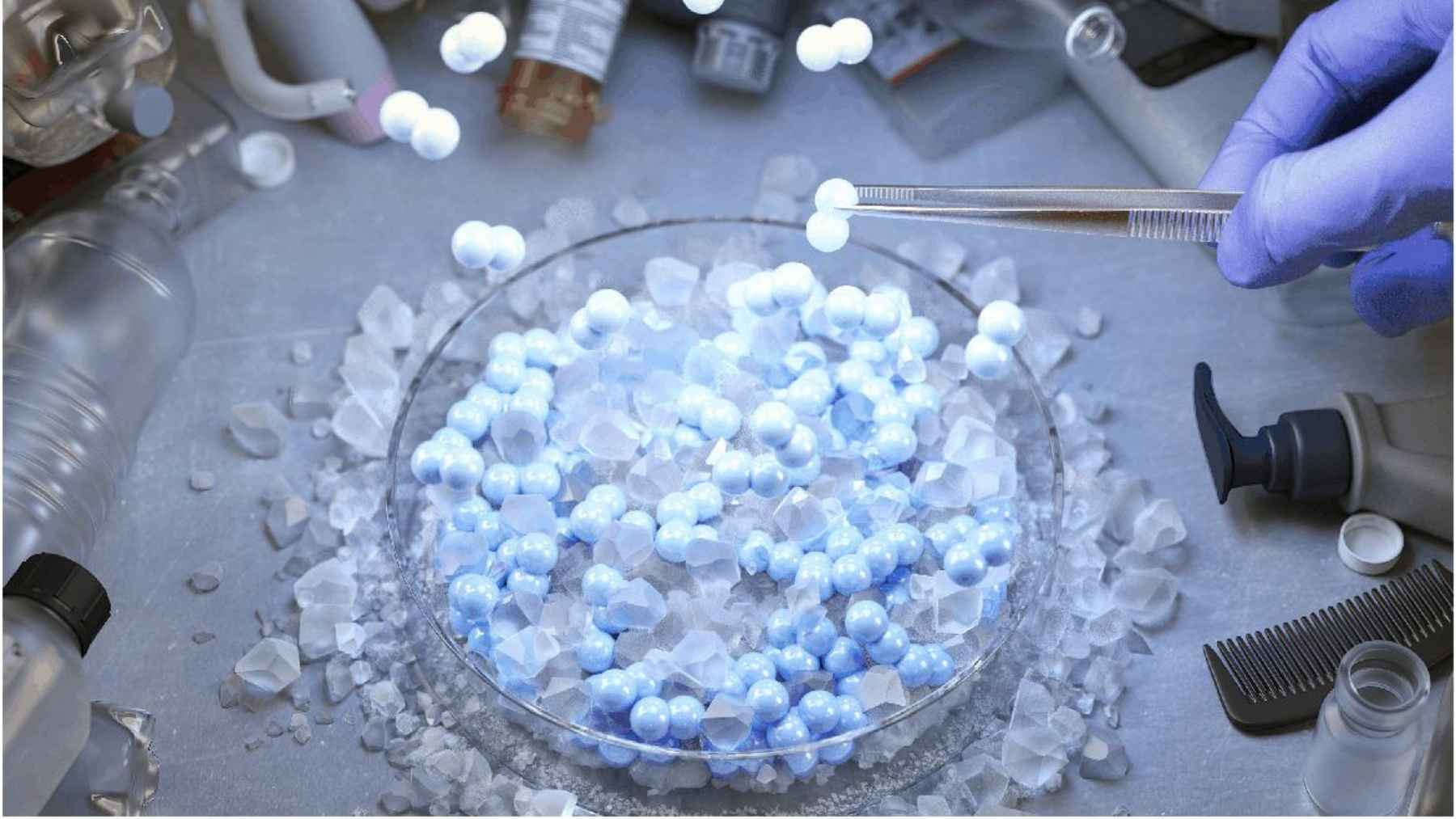

Rinsing out a yogurt tub and checking the little number stamped into the bottom feels like the responsible thing to do. That number is a resin code, and it is there because most recycling processes only work on one kind of plastic at a time.
So somebody has to separate the bottles from the bags from the tubs before any chemistry can happen. That step is slow, manual and expensive, and it is why the numbers on plastic recycling have always been grim. UCLA frames the global picture like this: 9% of discarded plastic gets recycled, 79% goes to landfill, 12% gets burned.
The American figure is no better. The EPA put the national plastics recycling rate at 8.7% in 2018, the most recent year the agency has published, against 35.7 million tons generated and 27 million tons sent to landfill.
A team co-led by the UCLA Samueli School of Engineering and Ewha Womans University in Seoul published a paper on July 6 in the Proceedings of the National Academy of Sciences that deletes the sorting step. They put a mix of the three most common plastics into a single reactor with sodium hydroxide, heated it, and drew off hydrogen gas that came out more than 90% pure. Most of the carbon never reached the air.
The co-corresponding authors are Ah-Hyung “Alissa” Park, the Ronald and Valerie Sugar Dean of UCLA Samueli and a professor of chemical and biomolecular engineering, and Woo-Jae Kim, a professor of chemical engineering and materials science at Ewha. “We are solving two urgent global problems at the same time,” Park said in the university’s July 14 announcement, meaning the plastic pile and the demand for clean hydrogen.
Sodium hydroxide does what steam could not
The process is called alkaline thermal treatment, or ATT, and the ingredient list is short: organic material, sodium hydroxide, heat.
To have something to measure against, the team first ran conventional steam gasification on PET, the plastic in water bottles. Hydrogen showed up mostly around 700 degrees Celsius (1,292 F), at a yield of 26.9 millimoles per gram.
Then they ran ATT on the same plastic, at a one-to-one mass ratio of sodium hydroxide to PET. Hydrogen production started between 300 and 400 degrees Celsius (572 to 752 F), and the average yield came to 43.7 millimoles per gram. That is roughly 62% more hydrogen out of the same gram of bottle, arriving several hundred degrees earlier, at atmospheric pressure. Converted into something you can picture, it works out to about 88 grams of hydrogen per kilogram of PET.
The temperature is the entire argument. The paper notes that conventional gasification typically wants 800 to 1,000 degrees Celsius and pressures measured in megapascals, and that specification decides the steel, the seals, the safety case and most of the capital cost.
One thing the press release does not spell out: sodium hydroxide is a reagent here, not a catalyst. It gets consumed. Where it ends up is the second half of the story.
Bags and tubs needed a shove first
PET cooperated because its backbone already contains oxygen. Polyethylene and polypropylene, the shopping bags and the food containers, are nothing but carbon-hydrogen bonds, and under alkaline conditions they sit there being inert.
The fix was less exotic than the problem. The researchers heated the plastics briefly in ordinary air before the main reaction, a step they call thermal oxidation pretreatment. It grafts oxygen-containing groups onto the polymer chains and gives the sodium hydroxide somewhere to bite. First-principles calculations in the paper show those groups lower the reaction barriers.
After tuning the sodium hydroxide ratio and the oxidation conditions, the reported yields were 43.7 millimoles per gram for PET, 51.9 for polyethylene and 30.2 for polypropylene. The shopping bags turned out to be the most productive feedstock of the three.
That reaches past the kitchen bin. UCLA’s own list of everyday plastic runs water bottles, shopping bags and car dashboards, and the car is not a rounding error: the American Chemistry Council puts plastics and polymer composites at about 10% of a vehicle’s weight and 50% of its volume, with a mid-size EV carrying roughly 45% more plastic than a comparable gasoline model.
Nobody has run shredded car interiors through this reactor. The study tested three clean resins in a lab. But the reason the sorting problem exists at all is that end-of-life streams arrive mixed, which is also why Hawaii has spent the last two years testing whether ocean plastic and fishing nets can be buried in asphalt instead.
The carbon comes out as rock
This is where the consumed sodium hydroxide earns its keep. Carbon released during the reaction is captured by the reagent and turned into solid sodium carbonate rather than escaping as carbon dioxide.
UCLA’s post-reaction accounting is specific. More than 75% of the plastic’s original carbon ends up either as stable carbonate or as liquid organic residues. Less than 13% shows up in gaseous form. Direct atmospheric carbon release during the reaction is described as negligible.
The sodium carbonate can then be converted into calcium carbonate through what the university calls a simple recovery process. Calcium carbonate, per UCLA, is widely used in traditionally carbon-intensive industries. It is a solid somebody will buy, which is a rare thing to be able to say about captured carbon.
Figures from the PNAS paper published July 6, 2026, and the UCLA Samueli announcement of July 14.
Photoreforming and electrochemistry stop at PET
Low-temperature routes from plastic to hydrogen already exist. Solar-driven photoreforming and electrochemical conversion both work, and both, according to UCLA, work only on oxygen-containing plastics like PET. Polyethylene and polypropylene, two of the most abundant plastics in the waste stream, stay out of reach.
High-temperature gasification has the opposite profile. It will swallow unsorted mixed plastic, and it releases substantial carbon dioxide doing so. ATT is the team’s attempt to sit between the two.
It is not the only route to hydrogen from garbage moving right now. A University of Edinburgh group published work in February on feeding waste bread to E. coli and using the hydrogen the bacteria give off to drive industrial hydrogenation. Different chemistry, same instinct: the feedstock is already trash, so stop paying to tidy it up first.
It is a flask, not a plant
The honest part comes from UCLA itself. The researchers say further work is needed to optimize the process and evaluate its economic viability before anything gets deployed at scale.
There is no cost per kilogram in the paper. Sodium hydroxide is consumed, and sodium hydroxide is an energy-intensive industrial product in its own right. The oxidation pretreatment is another energy input. None of that is disqualifying and all of it has to land on a spreadsheet before a single reactor gets welded.
Kim’s case in the announcement is that stripping out the sorting costs and the process complexity removes the two barriers that have kept this class of technology away from commercial use.
It also helps to know where the method came from. Alkaline thermal treatment was not designed for plastic. Kang Zhang, Kim and Park published it in Nature Communications in July 2020 as a way to pull high-purity hydrogen out of wet, salty brown seaweed, back when Park was still at Columbia. Aiming a proven reaction at a new feedstock is why the yields look solid this early, and why the engineering questions are still wide open. The current work was funded by the National Research Foundation of Korea.
Hydrogen’s problem in the United States has rarely been making the stuff. It is moving it, which is why the fuel is priced the way it is at the few dozen public pumps that exist, nearly all of them in California.
A reactor that runs at 400 degrees on unsorted garbage would, in principle, go wherever the garbage already is, and the garbage is everywhere. That is the version of this worth caring about. What exists today is a flask, a clean set of yield numbers, and a line in the university’s own release conceding the economics have not been worked out. The chemistry cleared its bar. The spreadsheet is next.
 @bellscraig ROOKIE2 months ago