
Just about every nuclear reactor running in the United States today is fueled the same way. Long metal rods packed with uranium pellets get bundled into assemblies and lowered into a core flooded with water held under enormous pressure. It works, it has worked for decades, and it is also the reason so much of a conventional plant is heavy, expensive, and built to survive the day the pressure does something it shouldn’t. X-energy, a reactor company based in Maryland, decided to get rid of the rods completely.
Its Xe-100 runs on graphite spheres about the size of billiard balls, and you feed fresh ones in from the top while the reactor is running, like a very slow gumball machine. Amazon is the company’s biggest backer, and the first four of these reactors are headed for a Dow chemical plant on the Texas coast.
That Texas project just cleared a major regulatory step on May 18, when federal nuclear regulators wrapped up its environmental review in under a year and found no significant impact, putting it on track toward a construction permit that could come as soon as late 2026. Nobody has built one yet, and the design has never sent a watt to a paying customer. But it is now closer than any pebble reactor has ever been in this country.
There Are No Fuel Rods, Just Tens of Thousands of Pebbles
The pebble is where the whole design lives or dies. Each one is a sphere of graphite a couple of inches across, and packed inside a single pebble are more than 18,000 tiny fuel particles, every one of them about the size of a poppy seed. According to the Department of Energy, each particle is a kernel of uranium, carbon, and oxygen wrapped in three layers of carbon and silicon-carbide ceramic. Those layers are the safety system. They seal the uranium and its radioactive byproducts inside, and they hold together at temperatures that would wreck an ordinary fuel rod.
That is the part X-energy leans on hardest: the fuel itself is built so it cannot melt down in this kind of reactor. Every particle acts as its own little containment vessel, which is a very different philosophy from a water reactor, where keeping the fuel intact depends on never losing the water. The uranium is enriched to about 15.5 percent, a grade called HALEU. That is richer than the roughly 5 percent fuel in today’s reactors, but nowhere near weapons material, and sealing it in ceramic also makes it a miserable thing to try to extract for any other use.
Refueling is the other oddity. Instead of shutting down every 18 to 24 months to swap fuel assemblies, the Xe-100 drops fresh pebbles in at the top of the core and pulls spent ones out the bottom while it keeps running. A pebble spends a little over three years inside, cycling through the core up to six times before it is finished. There is no big annual outage, just a steady churn of ceramic spheres.
Helium Carries the Heat, and the Fuel Won’t Melt
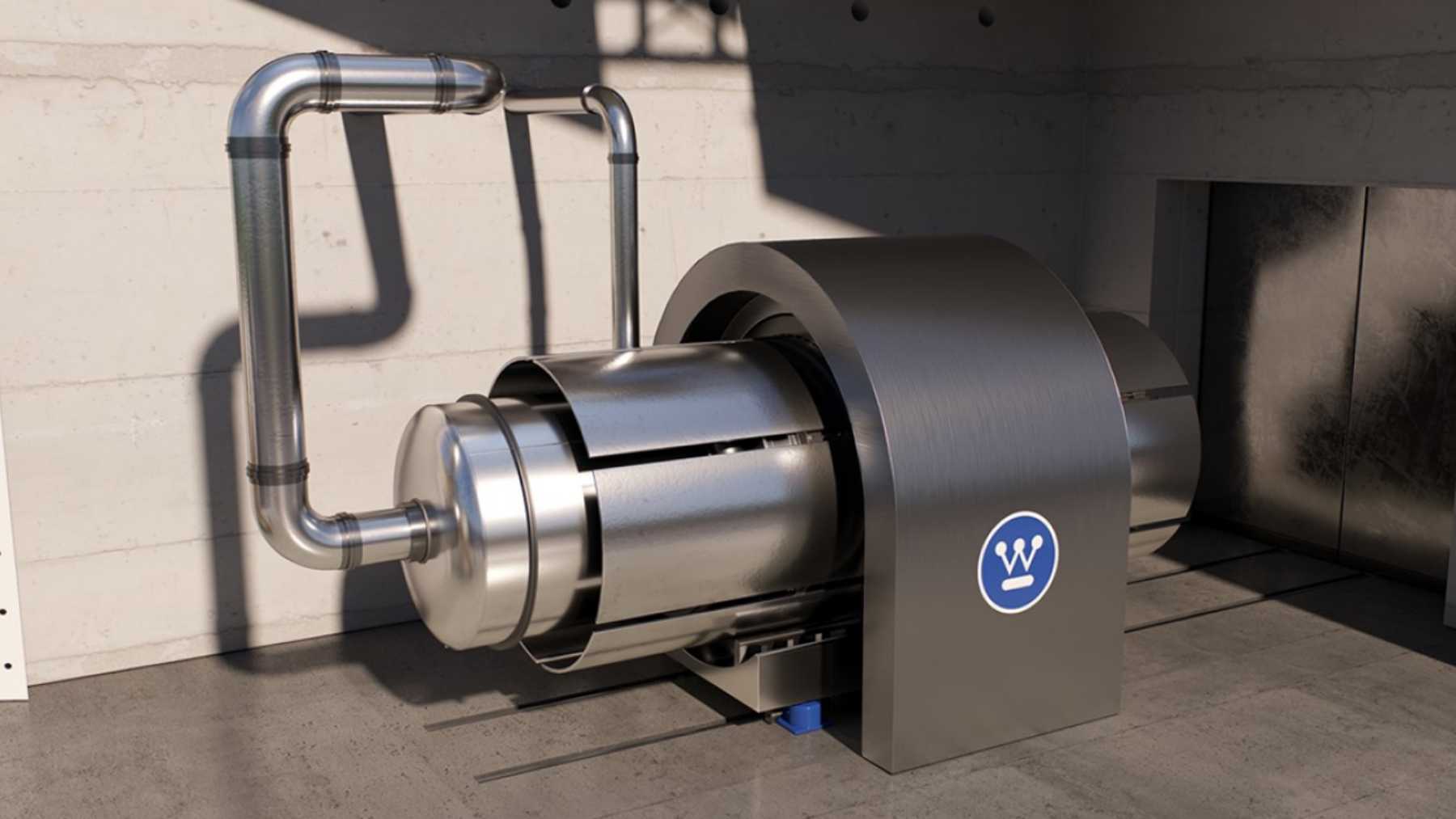
With no water in the core, the Xe-100 needs something else to carry the heat away, and that job goes to helium. The gas runs down through the bed of pebbles, picks up the heat, and comes out the other side at over 750 degrees Celsius, well past what a standard water-cooled plant produces. That heat boils water in a separate loop into high-temperature steam, around 565 degrees, and the steam is what spins a turbine or feeds an industrial process.
Running on gas instead of pressurized water changes the safety math. X-energy says the design needs no large water supply, no active safety systems, and no emergency diesel generators to keep the fuel from being damaged if something fails. The idea is that you could walk away and the core would settle itself, because the ceramic-coated fuel retains more than 99.99 percent of its fission products and the reactor runs out of the heat needed to sustain the reaction. The company says that lets a plant sit much closer to factories or people than the wide exclusion zones around traditional reactors.
It is a different bet than the other big American advanced reactor in the news. Bill Gates-backed TerraPower is building a sodium-cooled reactor wired to a molten-salt battery in Wyoming, the first new commercial non-water reactor the government has cleared for construction in years. Both designs ditched water, and both came out of the same Department of Energy program, but they solved the problem in completely different ways: liquid metal and a heat battery on one side, helium and a pile of billiard balls on the other.
What Amazon Is Actually Paying For
Here is where the headline needs a small correction. Amazon is not building a reactor in Texas. Amazon’s money is in X-energy, the company, and in its own separate fleet of reactors planned for Washington state. In October 2024 Amazon led a $500 million funding round into X-energy, alongside Citadel founder Ken Griffin and the University of Michigan, and it signed a binding agreement to buy up to 5 gigawatts of power from the company’s reactors by 2039. Amazon’s first project, called Cascade, pairs with the public utility Energy Northwest for an initial four-unit, 320-megawatt plant that could later grow to twelve units and 960 megawatts.
The reason a company that sells books and cloud computing is suddenly financing nuclear plants is the same reason Microsoft, Google, and Meta are doing it. AI data centers draw electricity at a scale and a steadiness that wind and solar struggle to match on their own, and the hyperscalers have gone shopping for round-the-clock power wherever they can find it. The Xe-100 is built to play nicely with that demand. Each module puts out 80 megawatts, four of them make the standard 320-megawatt block, and the reactor can ramp from 40 percent to full power in about 12 minutes using a handful of operator-controlled settings, where a conventional plant juggles hundreds.
The market has noticed. On April 24 X-energy went public on the Nasdaq under the ticker XE and raised roughly $1.02 billion, which it billed as the largest nuclear IPO on record, with the stock jumping about 31 percent on its first day. The fuel side has been moving too: in February, the company’s TRISO-X plant in Oak Ridge, Tennessee, became the first commercial advanced nuclear fuel fabrication facility licensed in the country, built specifically to turn out the HALEU pebbles these reactors will eat. X-energy’s ambitions run past the grid as well, since the company is part of a joint venture chasing a nuclear reactor for the surface of the Moon, where two-week nights make solar a non-starter. But the billiard balls headed for Texas are the near-term business.
Texas Is Where This One Gets Built First
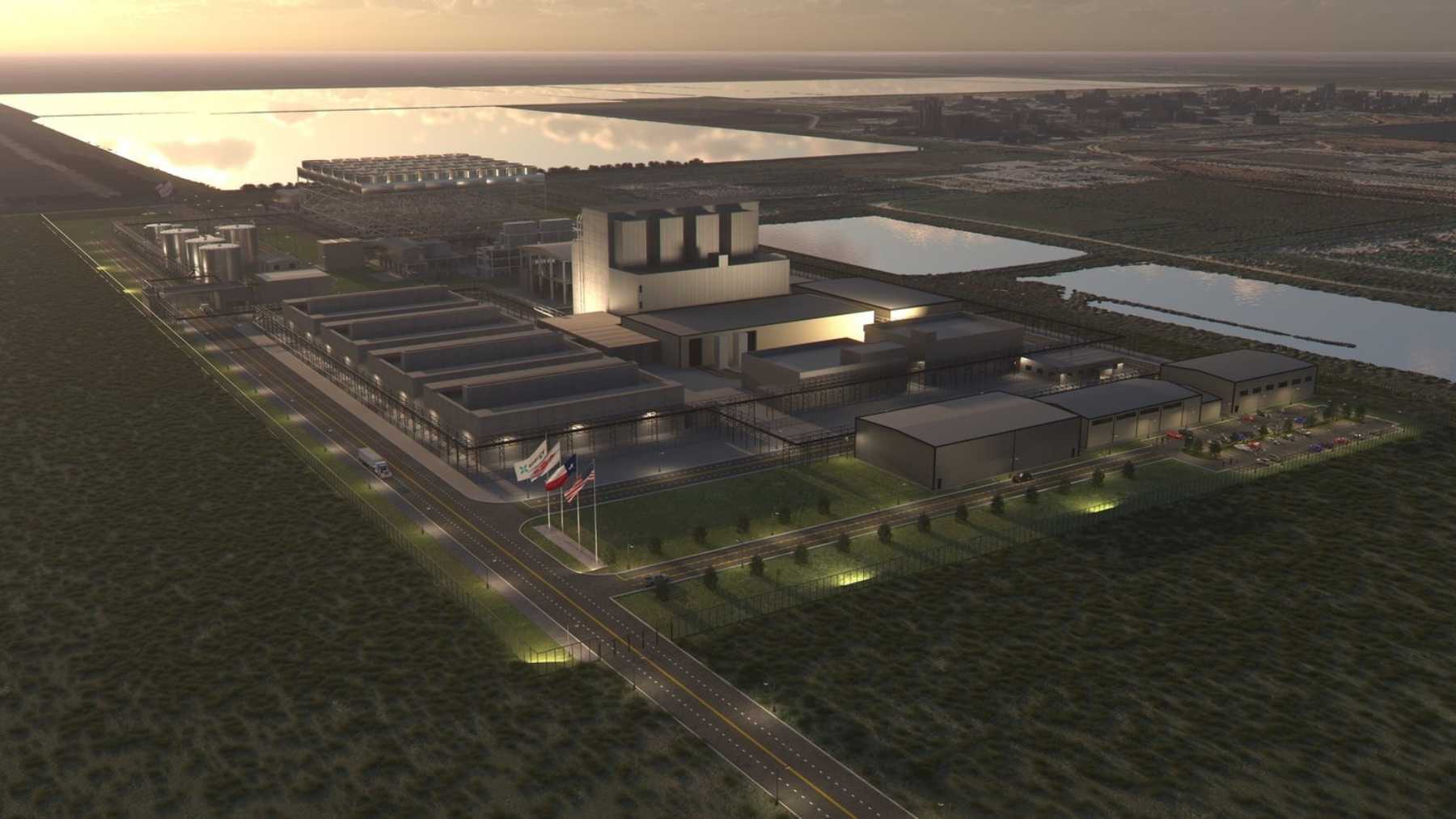
For all of Amazon’s headlines, the reactor that is furthest along belongs to Dow. At its UCC Seadrift Operations site on the Texas Gulf Coast, the chemical maker plans four Xe-100 units in a project called the Long Mott Generating Station, run through a Dow subsidiary, Long Mott Energy. Together the four reactors would deliver 320 megawatts of electricity and 800 megawatts of thermal power, supplying both the power and the high-temperature steam that Dow uses to make more than 4 billion pounds of materials a year. The companies bill it as what would be the first grid-scale advanced reactor in North America built to serve an industrial site.
The May 18 milestone is what pushed it ahead of the pack. The Nuclear Regulatory Commission finished its environmental assessment of the project and issued a finding of no significant impact, and X-energy says it was the first time a U.S. commercial advanced reactor cleared its federal environmental review through the faster assessment path rather than a full impact statement. The review took under a year, roughly half the agency’s historic pace. “There are no shortcuts in nuclear safety,” X-energy operating chief Dragan Popovic said of the result, framing the speed as the payoff for years of preparation rather than a loosened standard.
What comes next is the safety side of the same permit. The NRC is working to finish its final safety evaluation by November 2026, after which it could issue the construction permit itself. Only then can ground actually break on the reactors.
None of This Has Made Electricity Yet
It is worth being blunt about how much of this is still on paper. The Xe-100 has not generated a single watt of commercial power. The Texas construction permit has not been issued. Even once it is, building a reactor is not the same as running one, and X-energy and Dow would still need a separate operating license from the NRC before they could load fuel and start the plant. In its own quarterly filing with the SEC, X-energy says it expects to receive the Texas construction permit in early 2027 and its first commercial delivery in the early 2030s. Dow, for its part, has said it does not expect to make a final investment decision on the project before 2028.
There is history here that argues for patience. NuScale, another small-reactor company, got its design certified and then lost its anchor customer in 2023 when costs climbed, and advanced nuclear projects have a long record of delays and overruns that dwarf the early estimates. The HALEU fuel supply the whole sector leans on is still scaling up from pilot quantities. None of that means the pebble approach is wrong. It means the gap between a cleared environmental review and a working power plant is measured in years, not months.
The billiard-ball pitch is genuinely clever, and after a decade in which the country barely permitted any new reactors at all, regulators are suddenly moving on two advanced designs at once. But the pebbles still have to prove they can do for years inside a commercial core what they have so far only done in test batches, including a campaign of irradiation testing now underway at a national lab in Idaho. Dow’s plant in Texas is where that proof is supposed to start. For now, the most advanced thing about the most advanced reactor on the Gulf Coast is the paperwork.