
I have been writing about cars and energy for the better part of two decades, and I will tell you something that does not get said out loud often enough at auto shows: the biggest problem facing the American electric vehicle is not the car itself. It is the wall socket. Or more precisely, what is behind the wall socket.
Every time I talk to grid engineers in California, Texas or the Northeast, the conversation lands in the same place. We can build EVs. We can build chargers. What we cannot easily build, and what we are running out of time to build, is somewhere to park enormous amounts of clean electricity until the cars need it. That is the bottleneck. And right now, off the coast of Long Beach, a small group of engineers from Germany and two US companies are about to drop a 400-ton concrete sphere on the floor of the Pacific Ocean to see if they can solve it without using a single gram of lithium.
I am not making that up. The project is called StEnSea, Stored Energy in the Sea, and the US Department of Energy’s Water Power Technologies Office has already put $4 million into it. The first sphere is supposed to be in the water by the end of 2026.
The grid problem nobody at the dealership tells you about
Here is the part that does not make it into the EV brochure. When you plug a Mustang Mach-E or a Rivian R1T into a Level 2 charger at home, you pull somewhere between 7 and 11 kilowatts. Multiply that by a few million American households doing the same thing between six and ten at night, and you get a load curve that utilities call the “duck curve” because of its shape. The belly of the duck sags in the afternoon when solar is everywhere and demand is low. The head of the duck shoots up after sunset when solar drops to zero and people get home and plug in.
Right now, that evening spike is mostly absorbed by natural gas peaker plants. Those plants are expensive, dirty, and politically harder to permit every year. The cleaner alternative is grid-scale battery storage, which is why you have probably read about Tesla Megapack installations in places like Moss Landing, California. Lithium-ion grid storage works. It is also, depending on chemistry and use case, good for roughly 10 to 15 years before the cells degrade enough that the whole installation needs replacement. And it depends on the same lithium, cobalt and nickel supply chains that are already under enormous pressure from EV battery demand.
In other words, the technology that is supposed to make the EV grid possible is competing for raw materials with the EVs themselves. That is not a sustainable equation, and grid planners know it.
What StEnSea actually is
What Fraunhofer’s Institute for Energy Economics and Energy System Technology has been developing since 2011 is, at its heart, a very old idea wearing a new outfit. Pumped hydro storage is the most boring, most reliable form of large-scale electricity storage on the planet. You have two reservoirs at different elevations. When you have surplus power, you pump water from the lower one to the upper one. When you need power, you let it flow back down through a turbine. The US already has about 22 gigawatts of pumped hydro online, and most of it dates from the 1970s and 1980s.
The reason we have not built much more of it is geography. You need a mountain. You need a valley. You need water rights. You need to flood land that almost always belongs to somebody who does not want it flooded. The permitting timelines are measured in decades. So pumped hydro, despite being cheaper per kilowatt-hour than lithium-ion over a full lifecycle, has been stuck.
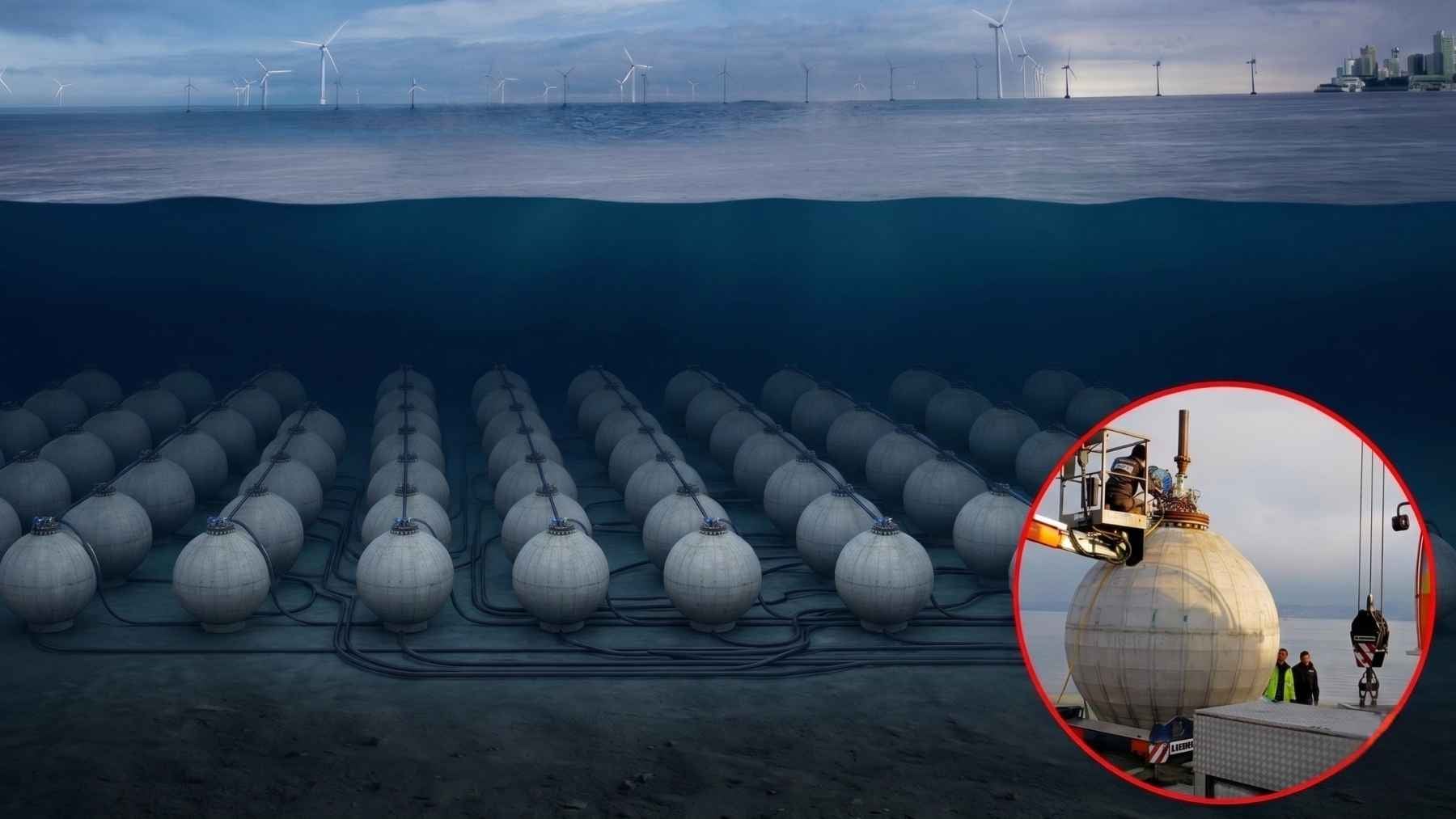
StEnSea’s bet is that you can get the same physics without any of that. Instead of putting water at the top of a hill and letting gravity work, you put a hollow concrete sphere at the bottom of a deep ocean and let pressure work. The sphere is empty when fully charged. When the grid needs electricity, a valve opens, seawater rushes in under hundreds of meters of overhead pressure, and that flowing water drives a turbine inside the sphere. When the grid has surplus power, that same machine reverses and pumps the water back out against the ocean pressure. No mountain. No valley. No flooded farmland.
This is not a fuel cell. It is not a battery in the chemical sense. There is no electrolyte, no electrode, no thermal runaway risk. It is mechanical energy storage using the most abundant resource on Earth as the pressure medium.
The numbers on the Long Beach prototype
The first ocean-going sphere is being assembled right now in Long Beach by a Colorado company called Sperra, which has built a business around 3D-printing large concrete structures for renewable energy. The pump turbine going inside it comes from Pleuger Industries, a deep-water submersible pump specialist headquartered in Miami with manufacturing in Hamburg, Germany, and Orleans, France. Pleuger has been making the kinds of pumps the oil and gas industry uses on subsea wells for decades. That experience matters here. A pump that fails at 500 meters down is not a pump you can casually go fix.
The 2026 prototype is small on purpose. Nine meters across, roughly the size of a two-story house, anchored between 500 and 600 meters down. It is rated at half a megawatt and four-tenths of a megawatt-hour, which is enough to power an average American home for about two weeks. The point of this first installation is not the energy yield. The point is to learn how to build the sphere using 3D-printed concrete, how to transport it to position, how to anchor it on the seabed, how the pump turbine behaves at depth, and how the whole thing holds up over months and years of charge cycles in real seawater with real sediment, real currents and real marine life trying to colonize it.
If those questions get answered the way Fraunhofer thinks they will, the operational version is a 30-meter sphere, weighing 20,000 tons, storing 20 megawatt-hours per unit and producing 5 to 7 megawatts of power. Six of those clustered together would be a 120 MWh / 30 MW installation. That is grid-scale.
Why California, and why it matters for every EV in the country
The site choice off Long Beach is not a coincidence. Southern California has the deepest near-shore continental shelf drop on the US Pacific coast, the most aggressive zero-emission vehicle mandate in the country (the state has banned new gasoline car sales beginning in 2035), and a grid operator, CAISO, that has been publicly warning about reliability margins for several summers running. If you wanted to find a place where the EV transition and the grid storage problem collide most violently, you would draw a circle around Los Angeles and the Inland Empire.
California is also where the lithium fight is happening. The Salton Sea geothermal lithium project is supposed to make the state energy-independent on EV batteries someday, but the timelines keep slipping and the environmental review is brutal. StEnSea, if it scales, would mean that grid storage in California stops being a competitor for that same lithium. The cars get the lithium. The grid gets the concrete and the ocean.
Fraunhofer’s own geographic analysis identified about 10,226 square kilometers of suitable seafloor off the US coast alone, with a theoretical storage potential of 75 terawatt-hours. That is more than the combined annual electricity consumption of New York City. Globally, the institute estimates a potential of roughly 817 terawatt-hours, enough on paper to power the homes of Germany, France and the United Kingdom for a year.
I am quoting those numbers with a pretty serious asterisk, because that is theoretical maximum potential at full buildout. Reality almost always lands somewhere meaningfully south of that. But even a fraction of it would be transformative for the grid that has to support a fully electrified American light vehicle fleet by mid-century.
What I am still not sure about
Let me be honest about what I do not yet trust. The 2026 prototype is going to spend an unspecified amount of time at the bottom of the Pacific. Concrete in saltwater is a known engineering challenge. Sediment intrusion into the pump turbine is a known engineering challenge. Marine biofouling, the slow accumulation of organisms on submerged structures, is a known engineering challenge. The 50-to-60-year design lifespan that Fraunhofer is publishing is based on modeling and on the Lake Constance freshwater pilot from 2016. Until something has been on the Pacific seabed for a decade under operational load cycles, that number is a projection, not a fact.
I also want to see the round-trip efficiency on the real ocean unit. Fraunhofer projects 60% for the prototype scale and 80% for the full-scale 30-meter sphere. Eighty percent would put StEnSea in the same neighborhood as conventional pumped hydro and meaningfully better than most lithium-ion grid installations over a full lifecycle once degradation is factored in. Sixty percent is competitive but not dominant. The difference between those two outcomes is the difference between an interesting engineering experiment and a piece of infrastructure that actually changes how the US powers its EVs.
None of that means I am skeptical of the project. I am not. I have been watching grid storage proposals come and go since the mid-1990s, and this is one of the few where the physics is unambiguous, the engineering partners have track records you can verify, and the federal money is real and earmarked, not hypothetical. The sphere will be built. It will be sunk. It will run. What happens after that is the question.
If you drive an electric car in this country, or you are thinking about it, the Long Beach sphere is not something that will affect your next charge. But the conversation about whether American EVs become a permanent part of how we move, or whether we hit a grid wall in the late 2030s and have to slow down, is going to be settled by exactly this kind of project. I will be watching the December headlines closely.
 @coneshot ROOKIE5 months ago