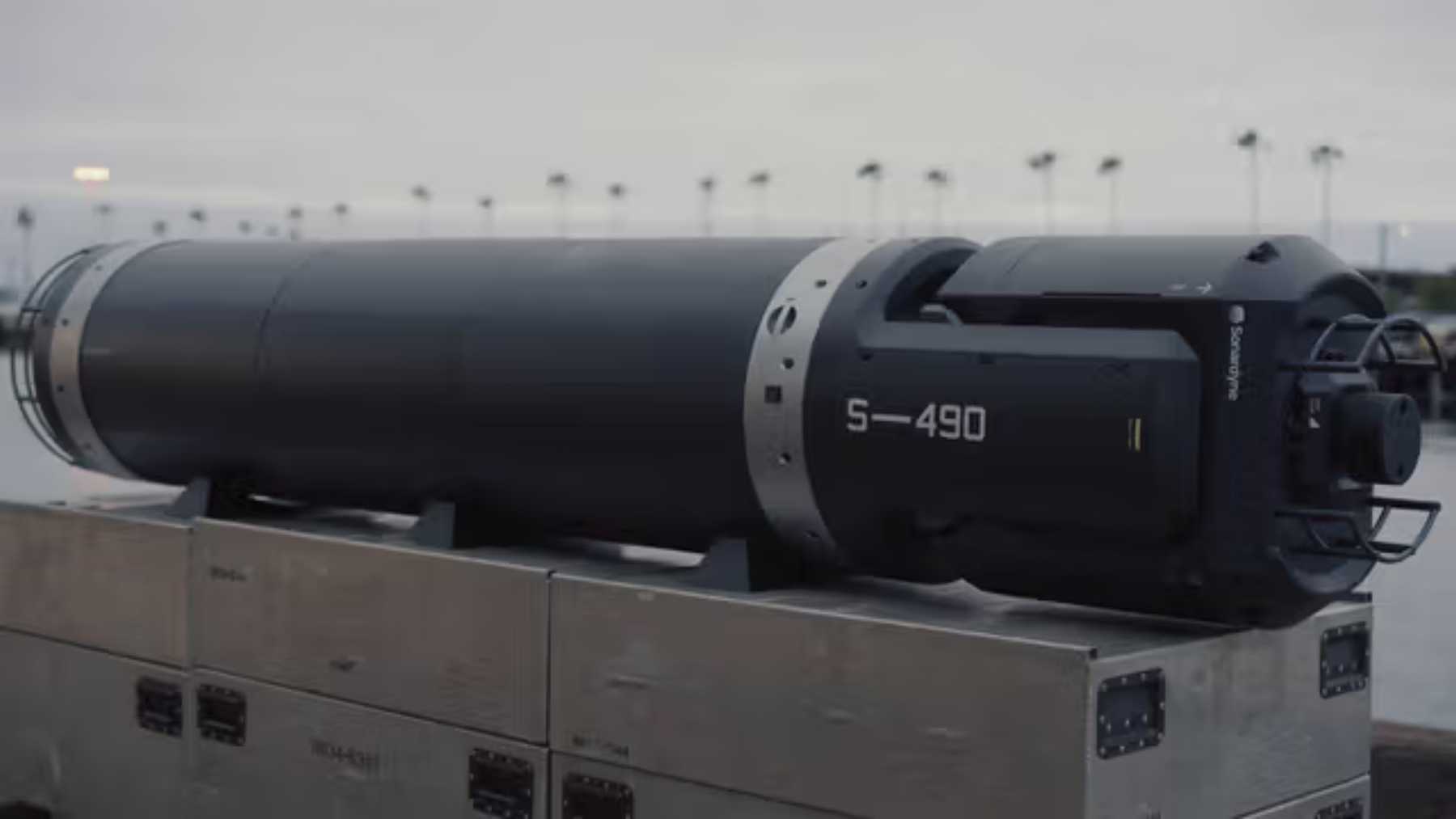

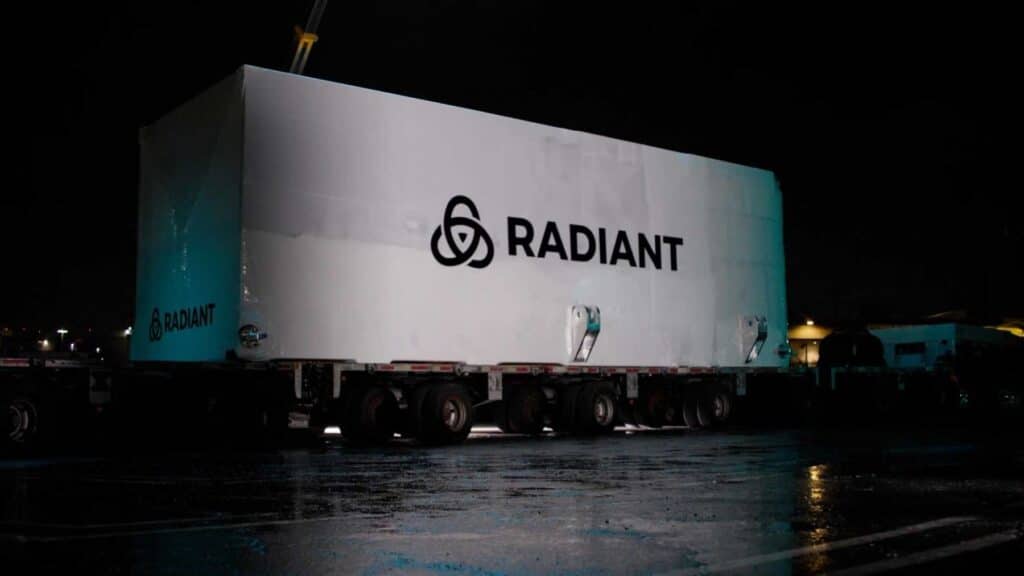
Nuclear plants get built where the concrete gets poured, and then they stay there for forty years. You need a river or a coastline, a cooling system, a decade of paperwork, and once the thing is up it is welded to that one patch of ground until somebody decommissions it. That has been the deal since the 1950s. But a 1-megawatt reactor rolled out of a Los Angeles suburb on the back of a flatbed truck this month and started driving north.
Radiant announced the departure on August 13. The machine is Kaleidos, a helium-cooled microreactor built in El Segundo, California, and its destination is the DOME test bed at Idaho National Laboratory, more than 1,000 miles away. World Nuclear News dated the send-off video to August 12, a day before the company put out the release.
Once it gets there, the reactor has to earn the whole thing back. Engineers will load it with fuel, take it critical, walk it up to full power and full temperature, and then leave it running for 150 consecutive hours without an operator intervening. Radiant wants all five phases done inside the third quarter of 2026. That quarter ends September 30.
The 1,000-mile flatbed run is part of the product spec
Radiant has spent six years telling anyone who would listen that its reactor moves. Not “modular” in the sense that you assemble it on site out of trucked-in pieces. Moves, as in you put it on a vehicle and take it somewhere else.
So the road trip is the demonstration. “Kaleidos is traveling more than 1,000 miles on a trailer bed,” the company said in its announcement. A reactor that survives 1,000 miles of interstate has survived a vibration and shock environment that no conventional plant component ever sees.
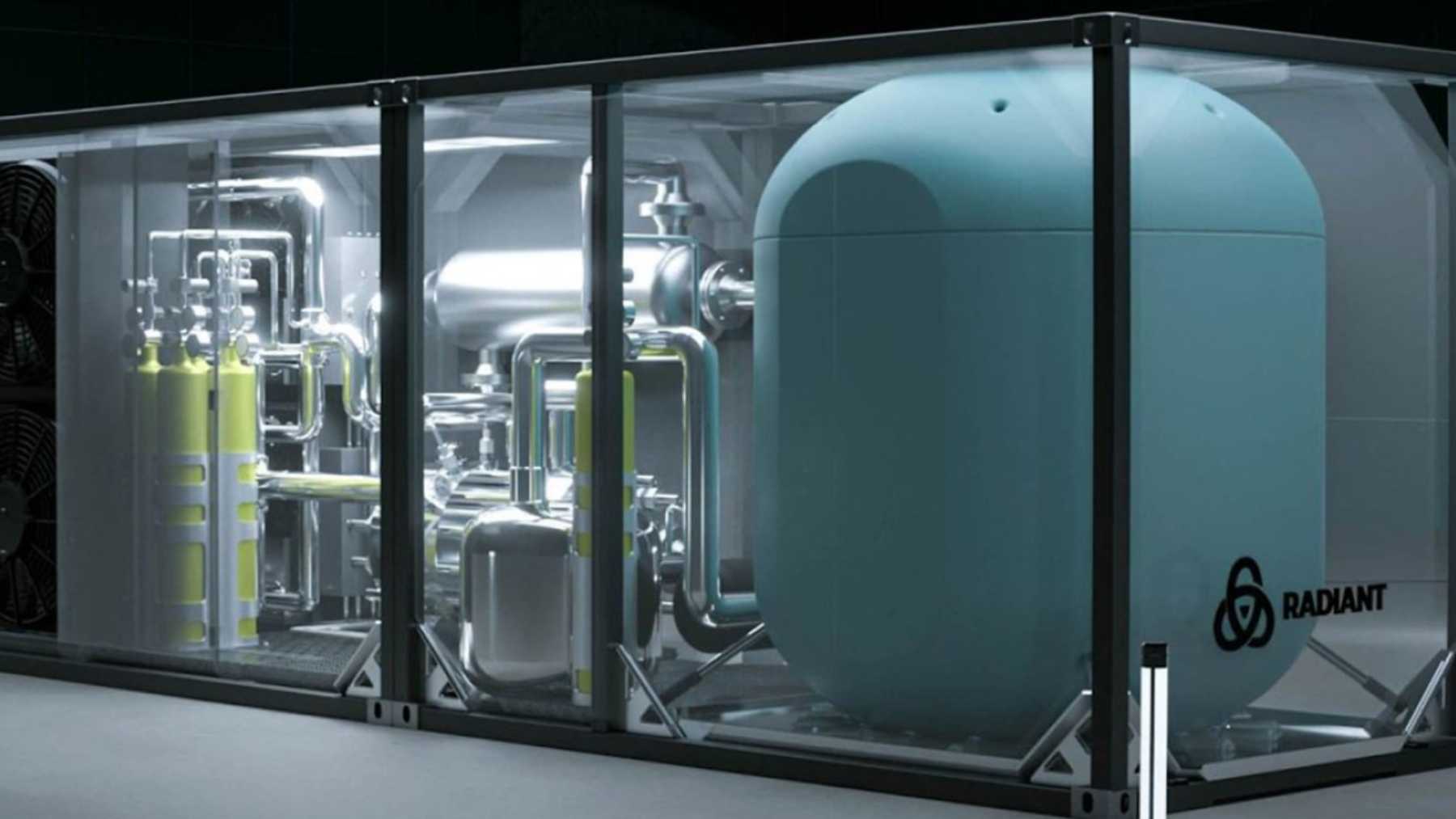
Kaleidos puts out up to 1 MW of electricity and 1.9 MW of heat. Helium carries the heat out of the core, TRISO fuel holds the fission products in ceramic layers, and fans and an air jacket handle cooling, which means the reactor needs no site water at all. Radiant designs it to fit a shipping-container footprint, to run up to five years between refuelings, and to last 20 years.
Radiant has not published the convoy route, and neither has the Department of Energy.
The unit on the truck is not a scaled-down stand-in. Radiant says it carries the same design, the same scale and the same commercial fuel load as the reactors it intends to build at its R-50 factory in Oak Ridge, Tennessee, which is where the whole business model lives or dies.
The DOME is a 1960s breeder reactor building with a second career
DOME stands for Demonstration of Microreactor Experiments, and it is not new construction. The Department of Energy’s National Reactor Innovation Center gutted the containment structure of Experimental Breeder Reactor-II, a reactor that ran at Idaho from the 1960s into the 1990s, and turned it into a rental test bay for private companies.
The building is 80 feet across and 100 feet tall, sits at Idaho National Laboratory’s Materials and Fuels Complex, and can host experiments up to 20 megawatts thermal. INL opened it on April 8, 2026, and says the build was accelerated by nearly a year.
Companies apply for slots through an annual competition, and they pay for their own test campaigns. Radiant says the Department of Energy awarded it exclusive access to DOME for a full year. Westinghouse was picked alongside Radiant for the facility’s first microreactor test campaigns with its eVinci heat-pipe design.
The fuel is already on site. Standard Nuclear fabricated the TRISO to Radiant’s specifications and delivered the first tranche to DOME on July 1. Loading happens inside the dome, under Department of Energy and INL oversight.
Zero-power criticality and 150 hours at full power are different exams
Four other American startups beat Radiant to a fission milestone this summer, and the distinction between what they did and what Radiant is attempting matters.
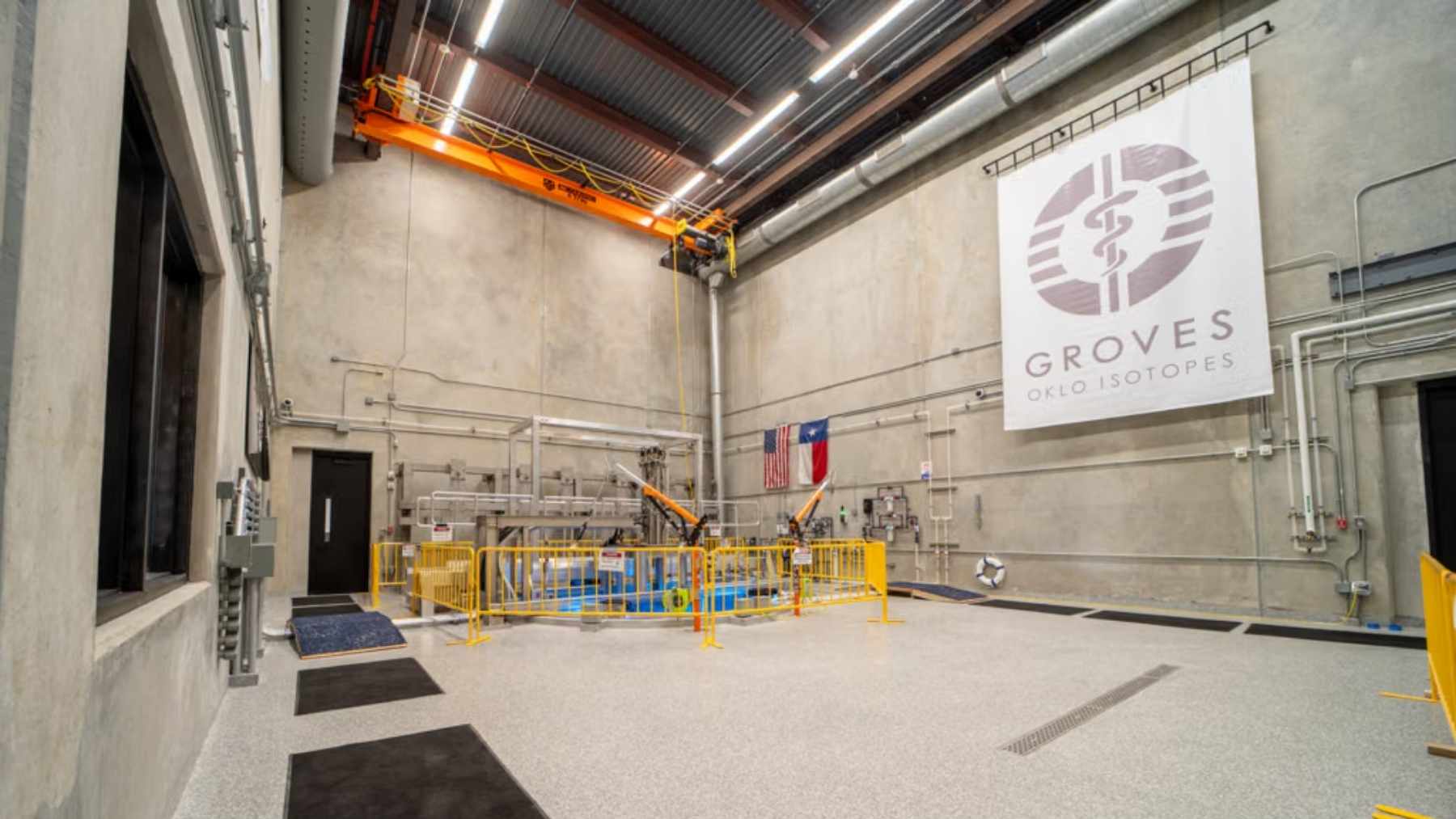
Antares Nuclear took its Mark-0 critical at Idaho on June 4. Valar Atomics followed on June 18 at the San Rafael Energy Lab in Emery County, Utah. Aalo Atomics reached criticality at 12:20 a.m. MT on July 4 at Idaho, clearing the deadline in Executive Order 14301, which had asked for three advanced reactors critical by Independence Day. Oklo’s Groves isotope test reactor got there afterward.
Every one of those was a zero-power fueled criticality demonstration. The chain reaction sustains itself, instruments confirm it, and the reactor produces essentially no usable heat or electricity. Radiant’s test plan treats that stage as phase two of five.
Radiant has climbed none of those rungs yet. Its sequence runs install and fuel, zero-power criticality, sustained 1 MW thermal operation, full temperature at full power, and then the 150-hour continuous run. Every phase feeds data into the company’s NRC license application. Our earlier piece on the summer criticality sweep covers how quickly that field moved.
The Army signed for 15 of them while this one was still on the road
Thirteen days after the truck pulled out of El Segundo, the Department of the Army named five vendors and five bases under its Janus Program, awarding up to a combined $2.2 billion to own, build and operate microreactors on military installations.
Antares Nuclear drew Fort Bragg in North Carolina. BWXT Advanced Technologies got Fort Campbell, Kentucky. General Atomics Electromagnetic Systems took Fort Hood, Texas. Westinghouse Government Services landed Fort Drum, New York. Radiant was paired with Fort Benning, Georgia.
Radiant then disclosed its own number: a binding agreement worth up to $750 million to develop and deploy 15 Kaleidos reactors by 2030. The company calls it the largest award inside Janus. Radiant’s announcement also flags that the base shown in its own rendering is illustrative and that the reactor’s planned location is still to be determined.
Vendors get paid on milestones, not on signature. The Army spreads roughly $2.2 billion across fiscal 2027 through 2031, expects private capital alongside it, and anticipates more than 20 microreactors across Department of War installations. The prototype reactors stay contractor-owned and contractor-operated.
“We are seeking not just reactors capable of turning on for a brief demonstration,” said Dr. Jeff Waksman, principal deputy assistant secretary of the Army for installations, energy and environment, in the Army’s announcement. He described the program as taking the baton from Project Pele and the Department of Energy’s Reactor Pilot Program.
Radiant already had a separate military commitment before Janus. The Department of the Air Force and the Defense Innovation Unit picked the company on April 22 to develop and operate a reactor proposed for Buckley Space Force Base in Aurora, Colorado, under the Advanced Nuclear Power for Installations initiative, with delivery targeted for 2028.
December 18 is the other date on Radiant’s calendar
Radiant’s mass-production model runs through Oak Ridge, and that factory needs a federal license before it can touch fuel. The Nuclear Regulatory Commission accepted Radiant’s 10 CFR Part 70 license application for the R-50 production facility and put it on an expedited review, targeting completion by December 18, 2026. The agency’s own documents describe that schedule as roughly 55% faster than the 18 months a Part 70 review normally takes.
So Radiant is running two clocks at once. One ends September 30, when the company’s own target for finishing the DOME campaign expires. The other ends December 18, when federal reviewers say whether a Tennessee factory can load nuclear fuel into commercial reactors.
Plenty can still go wrong between those two dates. A reactor that has never gone critical is not a validated product, an accepted license application is not an approved one, and a milestone-based contract pays nothing until the milestones land.
Radiant has not announced that Kaleidos arrived. The company’s last public statement on the reactor, dated August 13, 2026, puts it on a trailer bed heading for a dome that has never held a fueled experiment.
 @jack ROOKIE1 month ago