
Every EV owner has at one point looked at their parked car and thought about all the kilowatt-hours just sitting there doing nothing. A modern EV battery holds enough juice to run an average American home for two or three days, and most of the time it is plugged into a garage wall doing absolutely nothing useful. But turning that idle pack into a grid asset has been one of those ideas that sounds great at a conference and falls apart the second a utility engineer starts asking real questions about safety, metering, and who pays whom for what.
Massachusetts is now the closest thing the US has to an actual answer. The Massachusetts Clean Energy Center (MassCEC) is mid-way through a statewide demonstration that hands out free bidirectional chargers to homes, school districts, and fleets, then watches what happens when those vehicles start pushing electrons backward into the grid. The first wave of installations is live, the first round of headaches has surfaced, and the findings are already rewriting assumptions utilities had been comfortably making for years.
What MassCEC actually built
The program is called the Vehicle-to-Everything (V2X) Demonstration, and it is exactly what it sounds like. MassCEC is deploying 100 bidirectional EV chargers at no cost to residential, commercial, municipal and school customers as part of a two-year demonstration, with an estimated 1.5 MW of distributed energy storage capacity added across Massachusetts by September 2026. The program is funded at $6.3 million, and unlike most pilots, participants get the hardware and the install paid for plus a path to actual revenue.
That second part matters a lot. Unlike many V2X tests done by other US utilities, this one offers two financial incentives at once: bidirectional chargers at no cost to participants, and real money to those who commit to letting utilities tap into their EV battery power. The revenue side runs through ConnectedSolutions, the long-standing demand-response program operated by Eversource and National Grid in New England. Compensation runs about $200/kW for participating commercial entities and $275/kW for residents, paid on average performance across 30 to 60 dispatch events between June and September.
The split is deliberate. MassCEC expects to install 50 to 60 chargers at single-family residential locations, with a focus on homes in low-income and disadvantaged communities; 30 to 40 chargers at three to five commercial sites; and 10 to 20 chargers at three school bus storage sites. Spreading the hardware across that many use cases is the entire point. A bidirectional charger that works fine in a Newton driveway is not necessarily the same beast as one bolted to a school bus depot in Acton, and Massachusetts wants real data on both.
The first vehicles to plug in are school buses
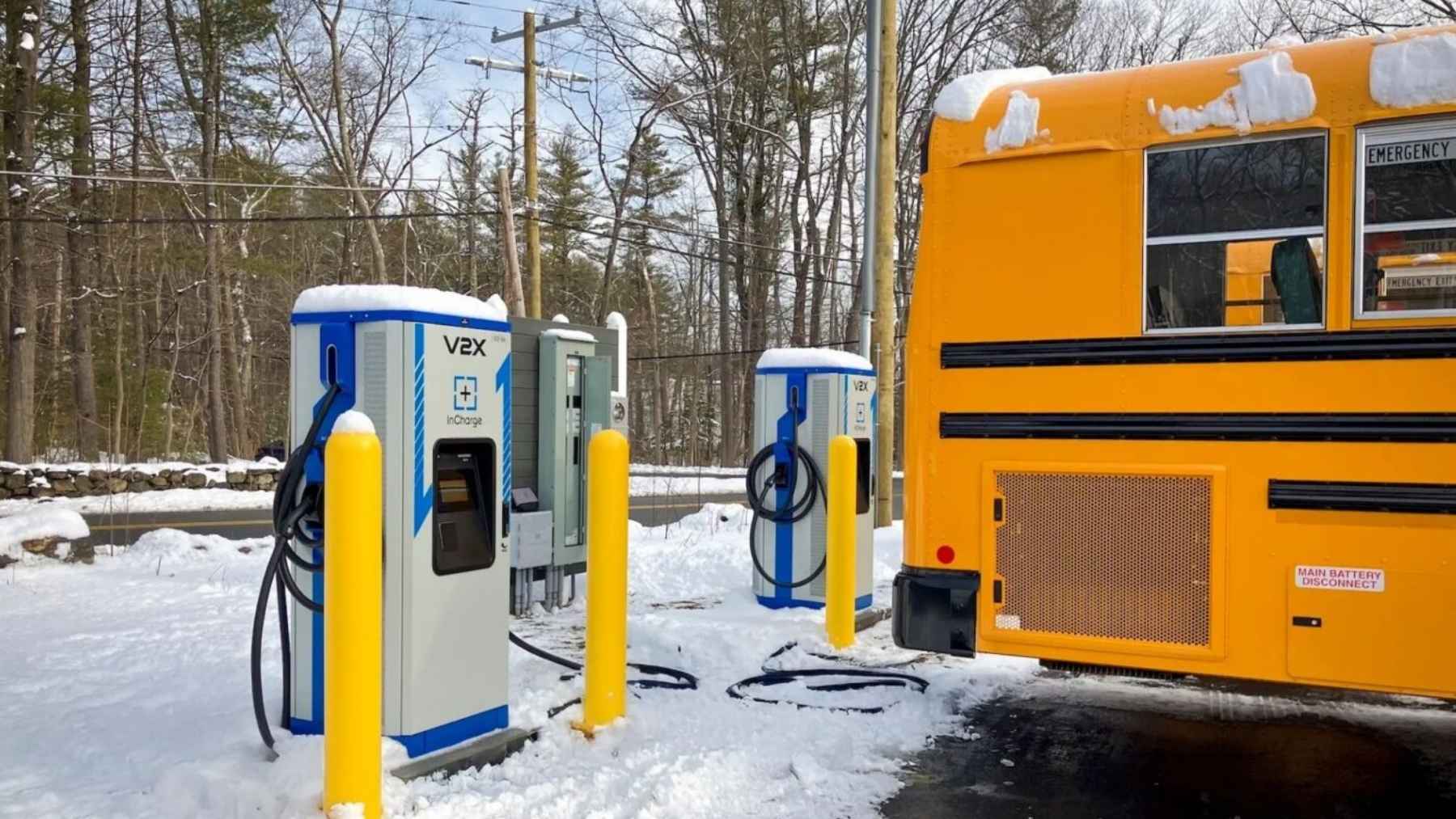
The opening act is already underway. Acton-Boxborough’s electric school buses are the first vehicles to plug in, using bidirectional chargers that can power up a vehicle as well as send the energy stored in its battery back to a building or the grid. The three buses charge their roughly 200-kilowatt-hour batteries overnight, when power is cleanest and cheapest, then push energy back from 4 p.m. to 7 p.m. on days when the grid is strained. Between 10 and 15 chargers are installed and awaiting authorization to begin bidirectional charging, with the rest expected online by September.
School buses are arguably the perfect test case. They sit unused all summer when the grid is screaming for capacity during heat waves, and their batteries are enormous. Participants were announced in February 2026: five school districts, four municipalities, and 30 residents, in projects across rural, urban, and suburban areas served by 10 different utilities, with six different types of chargers plugging into eight different vehicles. If you wanted to design a test specifically to find every interoperability problem hiding inside V2X, this is roughly how you would do it.
The solar conflict nobody saw coming at this scale
Here is where the early data gets interesting, because the biggest finding so far is not about the hardware at all. It is about the regulatory plumbing.
Existing technology cannot tell the difference between electrons sent from solar panels and those coming from batteries. For a home with both solar panels and a bidirectional charger, it is impossible to separate the solar power that should receive net-metering incentives from the EV battery power that would receive payment from ConnectedSolutions. Which is a problem nobody really stress-tested before applications opened, because it turns out a huge chunk of EV-curious homeowners in Massachusetts also have rooftop solar.
How huge? MassCEC had to immediately disqualify roughly 75% of the nearly 300 residential applicants for the V2X program because their homes had solar, according to the center’s senior program manager, and the scale took planners by surprise, delaying participant selection and therefore charger deployment. Three-quarters of interested households could not even play. That is not a rounding error; that is a structural finding about how V2X actually intersects with existing rooftop solar policy.
MassCEC has been transparent about the trade-off baked into current rules. Solar customers can install a grid-isolated V2H system, one that only provides backup power when the grid is down, and keep their net-metering compensation. But they cannot install a grid-parallel V2X system, the kind this program is built around, without their net-metering eligibility being affected. As of January 2026, in investor-owned utility territories like Eversource, National Grid and Unitil, there is no way to be paid for both. The lesson for utilities watching from other states: if you want bidirectional EVs to scale alongside rooftop solar, you need a virtual power plant compensation model, not two incentive programs fighting each other for the same electrons.
The hardware costs still don’t pencil out
The other early finding is brutally straightforward. The chargers are expensive. The most pressing challenges have to do with finding a financial model that works, and the systems are pricey: $15,000 to $40,000 for a residential setup, MassCEC estimates. Pilot programs can defray costs for small numbers of users for a limited time, but a long-term, reliable compensation plan is needed to get any meaningful number of EV owners to make the leap.
Without the MassCEC funding covering the install, almost nobody would do this on their own. ConnectedSolutions payouts of a few hundred dollars per kW per year are nice, but they do not amortize a $30,000 charger over any reasonable timeframe. Which is precisely the data point utilities need: at current hardware prices, V2X needs either a virtual power plant rate structure with much higher payouts, a serious drop in charger costs, or both. The pilot is generating the receipts to prove which.
The certification side is at least getting cleaner. The program’s pre-qualification process required eligible bidirectional chargers to meet UL 1741-SB, a key safety standard for grid-interactive inverters, and demonstrate grid-parallel discharge capability. That is the same standard utility-scale solar inverters live by, and it is how you stop a V2X charger from frying a lineman during an outage. The fact that there are now multiple chargers on the market that hit UL 1741-SB is itself a quiet sign the equipment side is maturing.
And here is the genuine surprise, the one that cuts against the script. Utility interconnection, the process of formally agreeing with a utility to hook an energy resource up to the grid, was supposed to be the big barrier. It was not. The program’s senior program manager said interconnection “hasn’t slowed us down,” with the utilities far easier to work with than anyone had braced for. The headaches showed up in the incentive design and the hardware bill, not the place everyone expected.
Other states are already taking notes
The state’s ambitions sit at the heart of why this pilot matters beyond New England. Massachusetts aims to have 900,000 EVs on its roads by 2030, up from roughly 90,000 today. If even a fraction of those future EVs participate in V2X, the distributed storage opportunity stops being a rounding error and starts being legitimate grid infrastructure, the same role grid-scale projects like a record-setting sand battery are being built to play. Massachusetts is not alone: other states have moved recently to enable bidirectional charging. Maryland enacted the DRIVE Act, requiring utilities to submit plans for vehicle-to-grid charging and virtual power plants, and California is moving to let homeowners enroll EVs and home batteries in the same virtual-power-plant programs.
The endgame is a document, which sounds underwhelming until you remember how utilities actually adopt new technology. All bidirectional charging stations are expected to be installed and operational in the summer of 2026, with data collection continuing through the year. MassCEC will publish a comprehensive V2X Guidebook in late 2026, with practical findings on cost, system design, charging management, and the technical and regulatory barriers. That guidebook becomes the thing regulators in other states can point at when their own utilities tell them V2X “isn’t ready.” If you have followed the slow march of EV charging policy, you know how badly that kind of reference document has been missing.
The Massachusetts pilot is one of the largest state-led V2X initiatives in the US, and it is designed to tackle exactly these deployment problems. A year in, the challenges have names: solar incentive conflicts and $30,000 hardware. The good news is the pilot is finding them on someone else’s dime before the rest of the country has to.
What this means for EV owners outside the pilot
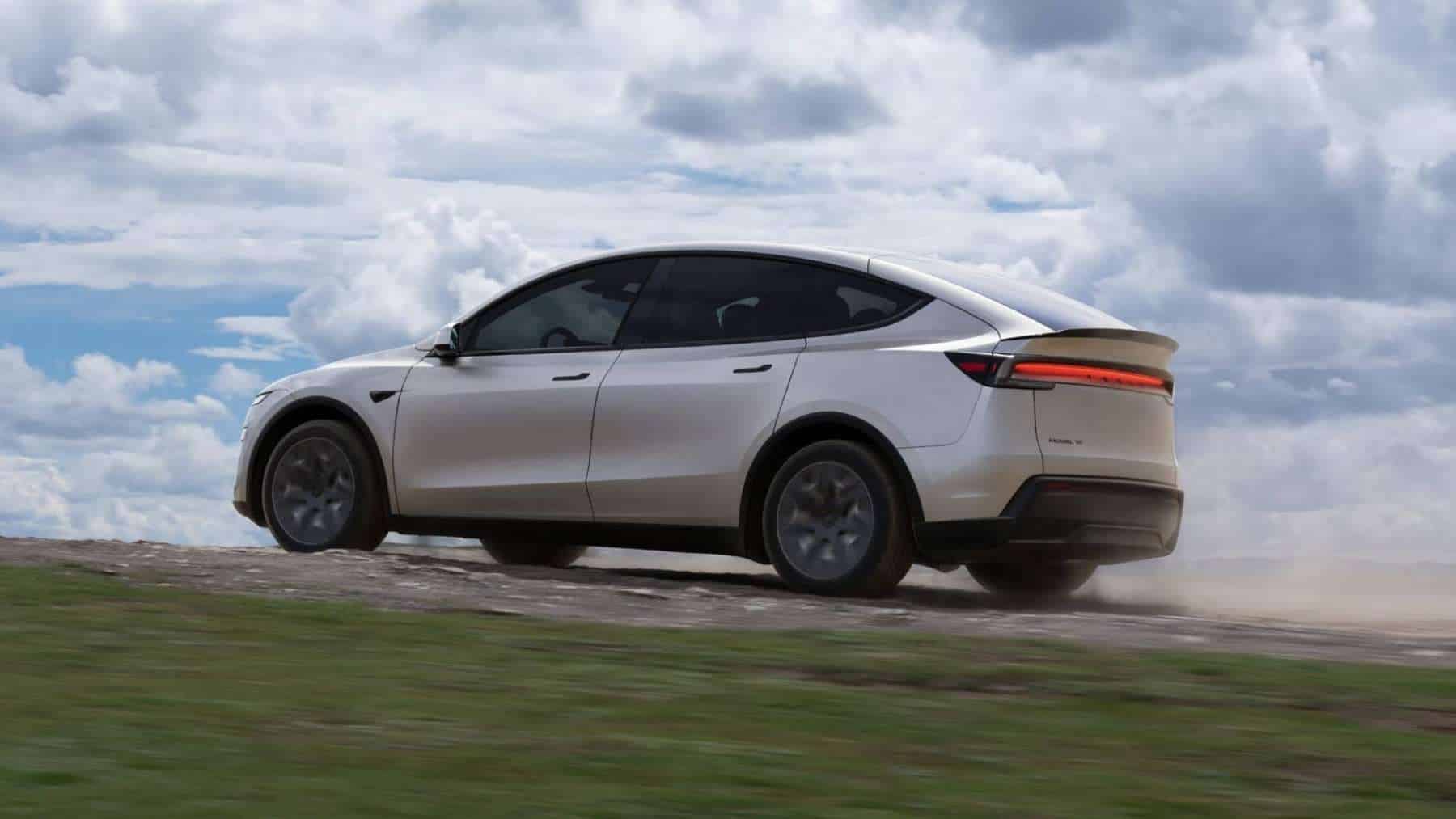
If you live anywhere in the US with a bidirectional-capable EV (the Ford F-150 Lightning, the Nissan Leaf, certain Kia and Hyundai models, and now some Teslas), the practical takeaway is that V2X is still mostly a pilot-program game. The chargers are real, the standards are real, and ConnectedSolutions-style payouts exist in pockets of New England. But the economics for an average homeowner buying the hardware retail at $15,000 to $40,000 are still rough, and net-metering rules in most states have not caught up to the idea that a car battery and a solar panel might want to feed the grid from the same address.
The Massachusetts data, when the final guidebook lands at the end of 2026, will tell you whether the math improves. The early signs say the technology works fine. It is the policy that needs the rewrite.
 @everettpeacock ROOKIE5 months ago