
When someone says “the world’s largest battery,” you probably picture a field of white lithium cabinets baking in the Texas or California sun, wired into the grid and ready to fire electricity back out the second demand spikes. That’s the image the US has spent five years and tens of gigawatts building toward, and the math backs it up. But the actual record holder for the largest battery of one specific kind isn’t in Texas, doesn’t hold a single electron, and looks like a grain silo. It sits in Pornainen, a Finnish town of about 5,000 people, and it just spent the harshest winter in years proving it works.
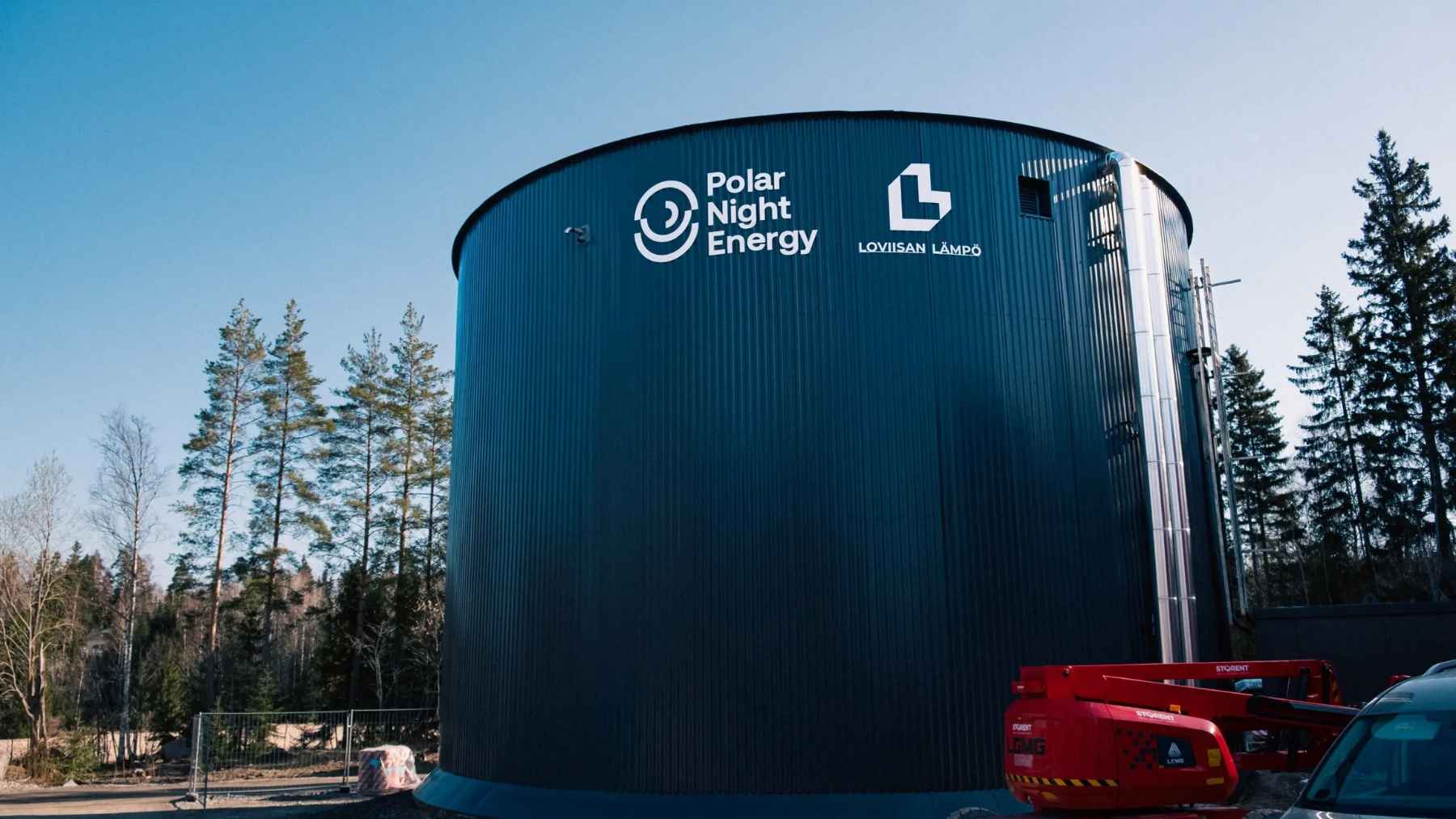
The machine is a sand battery built by Finnish firm Polar Night Energy: roughly 2,000 metric tons of crushed rock packed into an insulated steel silo and heated to between 500 and 600 °C with electricity bought when it’s cheap. It went live for the district heating utility Loviisan Lämpö in June 2025, and on paper it was an elegant idea. The winter of 2025–2026 was where the idea had to survive contact with a genuinely hostile Nordic grid.
It Stores Heat, Not Electrons
This is the part that trips people up, so it’s worth nailing down before anything else. The Pornainen battery does not store electricity and hand it back to the grid. It takes cheap power, converts it into heat, sits on that heat for days or weeks, and then pushes it into the pipes that warm the town. That’s the whole job. Calling a silo of hot sand a “battery” annoys a certain kind of engineer, but the logic is identical to a chemical cell: store energy when it’s abundant, release it when it’s needed.
The storage medium isn’t even construction sand. It’s about 2,000 metric tons of crushed soapstone, a byproduct from Tulikivi’s heat-retaining fireplaces, which means a Finnish town is now heating itself with the leftover scraps from making the things that used to heat homes one room at a time. The silo stands about 13 meters tall and 15 wide, delivers 1 MW of thermal power, and holds 100 MWh of heat at a round-trip efficiency of 80 to 90 percent. Sand works for this because it doesn’t boil or break down. Water taps out near 100 °C; sand will happily sit at 600 °C without complaint, which lets you pack a lot more energy into the same volume.
There’s one spec that rarely makes the headlines but does most of the work. The Pornainen system charges over roughly 100 hours, where most storage wants its cheap power delivered in a tidy handful of hours. Cheap Nordic electricity does not keep tidy hours, so a battery that can soak up four days of low prices captures far more of them than one that can only grab an afternoon.
Finland’s Coldest Winter in Years Was the Actual Exam
The entire commercial case for this thing depends on buying electricity cheap and storing it. So the worst-case scenario is a winter where electricity is both scarce and expensive at exactly the moment you need the most heat. That’s the winter Finland got. Polar Night Energy’s own data, reported after an on-site visit by Interesting Engineering’s Deena Theresa, shows Finnish spot prices swinging from 3 euros to 373 euros per megawatt-hour inside a single week. “We had a very challenging winter,” CEO and co-founder Tommi Eronen told the publication.
The system handled it by knowing when to step back. During the coldest, most expensive stretch, the site’s wood chip boiler took over as the primary heat source and the sand battery played backup. The rest of the time, those roles flipped. The combined result is the number that actually matters to a municipal budget: Pornainen hit all of its local climate targets with a single installation. Oil use dropped to zero, wood chip burning fell by about 60 percent, and the network’s emissions came down by roughly 70 percent, around 160 metric tons of CO₂ a year. The old oil boiler that used to back up the town hasn’t fired once. A new sports arena opening in September 2026 will run on the same heat.
Texas Is Building 12.9 Gigawatts of Lithium This Year. None of It Stores Heat
Here’s where the US comparison earns its place, because the two countries are solving different problems with the word “battery.” According to the US Energy Information Administration, developers plan to add 24 GW of utility-scale battery storage to the American grid in 2026, after a record 15 GW in 2025 and more than 40 GW over the past five years. About 80 percent of this year’s additions land in three states: 12.9 GW in Texas, 3.4 GW in California, 3.2 GW in Arizona. Almost all of it is lithium-ion, and almost all of it stores electricity, not heat.
That’s a real capability sand can’t match. A sand battery can’t power your data center or your EV that depends on lithium dug out of rock and refined mostly in China. But lithium carries a failure mode that a pile of pre-roasted rock simply doesn’t have. On January 16, 2025, Vistra’s 300-MW battery facility at Moss Landing, California caught fire. The site held about 100,000 lithium-ion modules, roughly 55 percent of them were damaged, and the EPA later called the resulting cleanup the largest lithium-ion battery removal in agency history. The cause remains under investigation. Sand can’t do that. It’s already been baked to 600 °C, it has no cobalt, and thermal runaway is not in its vocabulary, which is part of why labs keep hunting for chemistries that drop the fire risk entirely.
A Bigger One Is Already Going Up
Pornainen is the largest sand battery running anywhere today, but it won’t hold that title for long. Polar Night Energy and utility Lahti Energia have agreed to build a 2 MW, 250 MWh system in Vääksy, in the municipality of Asikkala, which will be the largest sand-based thermal store in the world once it’s finished in 2027. It’s a useful tell about how confident the people writing the checks are, given Pornainen has barely had time to cool down between charges.
The Vääksy unit is a slightly different animal. It’ll stand about 14 meters tall, use roughly 2,400 metric tons of locally sourced natural sand rather than soapstone, and is built to cut the Vääksy network’s fossil emissions by around 60 percent, mostly by displacing natural gas. Same principle, bigger box, different feedstock. Construction is already underway.
The Real Market Isn’t Towns Like Pornainen
Ask anyone at the company where this technology actually goes, and they’ll tell you district heating is the niche, not the destination. Cold towns with district heating networks are a Nordic specialty. The global prize is industrial process heat: food and beverage plants, chemicals, pharmaceuticals, and general manufacturing that currently burn enormous amounts of gas and oil to make steam, with very few clean options at the temperatures they need. The sand battery can push out heat ranging from district-heating warmth up to saturated steam around 200 °C, and you can’t exactly park a gigawatt-hour pressurized steam tank next to a factory without someone in a hi-vis vest objecting.
One thing worth keeping separate from all of this: Polar Night Energy is also piloting a way to turn the stored heat back into electricity, a project running in Valkeakoski that targets 30 to 35 percent electrical efficiency and wraps up in 2027. That’s a different experiment. The Pornainen battery you’ve been reading about does not make electricity. It makes heat, and that distinction is the whole point.
So the honest read on Pornainen is narrower and more interesting than “lithium killer.” It doesn’t compete with a Megapack and it never will. It does a job a Megapack can’t, which is sit on a week of a town’s heat through a brutal February without catching fire, without cobalt, and without a single mined gram of lithium. The fact that it’s running on the crushed remains of old fireplaces is the kind of detail that sounds made up until you climb the silo and feel it radiating. Finland built the proof. Whether anyone outside the land of district heating buys the argument is the part still being written, one 250-megawatt-hour silo at a time.