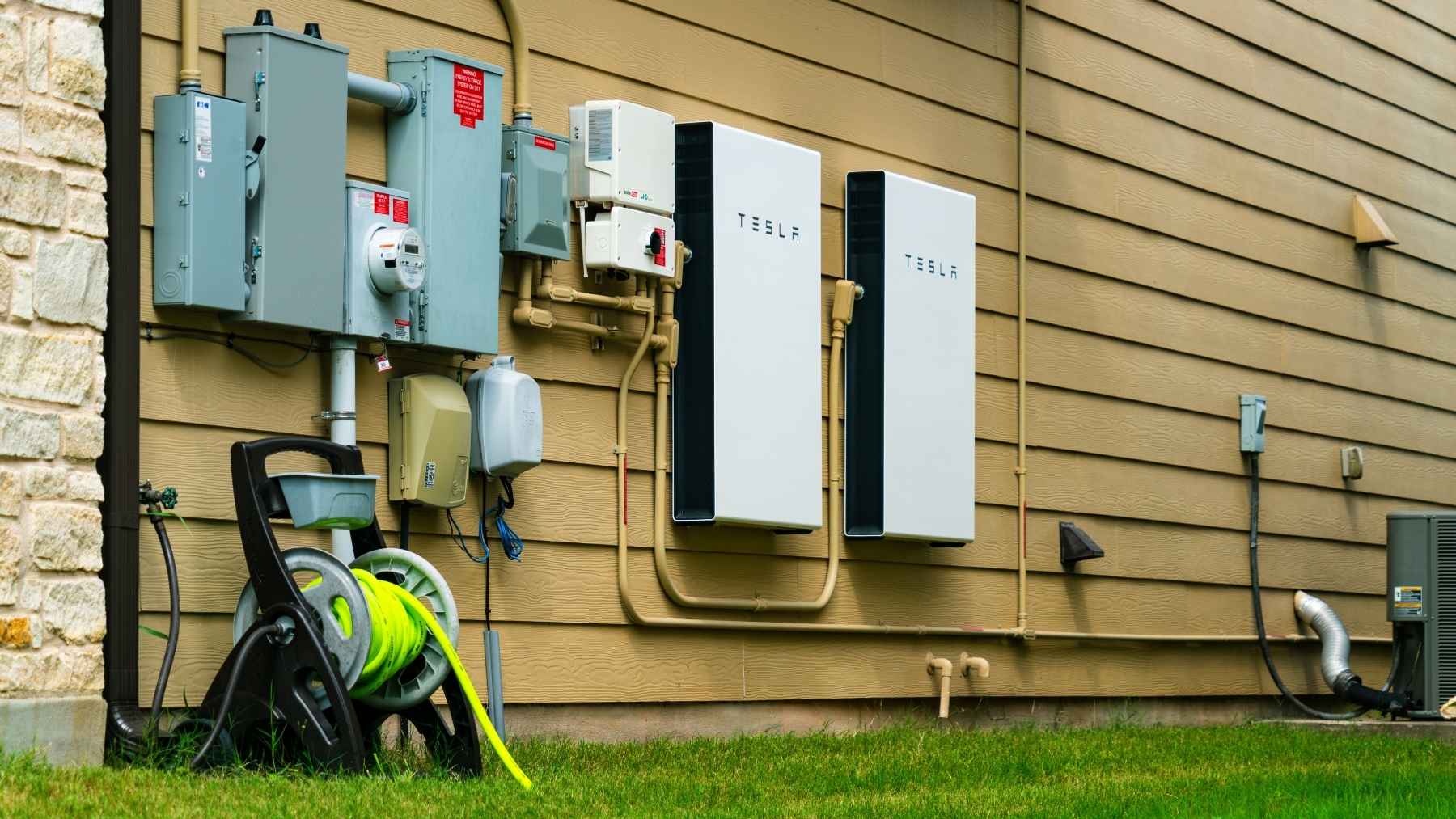

California adds roughly 8,000 new home backup batteries to its grid every single month. According to data from the California Public Utilities Commission, cited by State Senator Josh Becker (D) when he introduced Senate Bill 913 on March 24, that adds up to around 100 megawatts of new storage capacity walking onto the grid every single month, paid for entirely by homeowners. None of that capacity is currently allowed to compete with gas peaker plants when California’s grid operator goes shopping for power on a hot August afternoon. Becker’s bill, which passed the Senate Energy Committee on April 7 and is now sitting in Senate Appropriations, would change that.
In plain English: if SB 913 becomes law, the Tesla Powerwall sitting in your garage in Sacramento becomes something the utility can rent. Aggregators package up thousands of those batteries into what’s called a virtual power plant — basically a software-coordinated swarm of household batteries that behaves like one big plant when it gets a dispatch signal — and bid that capacity into California’s resource adequacy market, the same place utilities go to buy electricity for peak demand. A portion of what the utility pays comes back to the homeowner. That’s the moneymaker part of the Electrek headline. Whether you actually see a check depends on which battery you have, which utility you’re served by, and whether this bill clears the rest of the way through Sacramento.
What SB 913 actually says
The full text of the bill matters less than the regulatory move it makes. Becker’s framing is that California’s grid keeps having to buy expensive new gas-peaker capacity to handle the worst few hours of the worst few days of the year. The DER fleet — that’s distributed energy resources, the trade jargon for rooftop solar, residential batteries, EV chargers, and smart thermostats — could theoretically cover the same job, much cheaper. The catch is the regulatory plumbing doesn’t currently let them play. The capacity exists. The market door is locked.
“California has a choice,” Becker said when he introduced the bill. “We can continue to build our way out of the problem at great cost, or we can use the capacity we already have more efficiently.” Brandon García, who runs the California office of trade group Advanced Energy United, made the same point with sharper language. California has “spent years incentivizing and encouraging consumers to invest in distributed energy resources,” he said, but “our policies still undervalue how these resources can be part of the solution to the energy affordability crisis.”
SB 913 also pulls EVs into the same bucket. If your car supports bidirectional charging — what the industry calls V2G, or vehicle-to-grid — the bill would let aggregators count your vehicle the same way they count a Powerwall. That detail matters for one specific reason: California is the largest EV market in the United States, and the state already has a separate framework. SB 59, championed by State Senator Nancy Skinner and signed into law in 2024, authorizes the California Energy Commission to require new EVs sold in California to be bidirectional-capable. SB 59 was the legislative successor to Skinner’s earlier SB 233, which was repurposed in committee. The two pieces of legislation fit together. One forces the hardware. The other opens the wallet.
PG&E and Tesla already cut the deal SB 913 would normalize
Here’s the part most of the coverage of SB 913 glossed over. Five days before Electrek wrote up Becker’s bill, California’s largest utility had already finalized a much smaller, much louder version of the same idea with the most-talked-about pickup truck on the road. On April 20, 2026, Pacific Gas and Electric and Tesla announced an agreement under which Cybertruck owners can sell power back to the California grid through PG&E’s residential Vehicle-to-Everything pilot program. Customers get up to $4,500 in incentives toward the equipment and installation costs. It’s the first time AC vehicle-to-grid has been approved on a Tesla in California, following Tesla’s own Powershare Grid Support launch in select Texas markets back in February.
That last sentence is worth dwelling on, because the Tesla Model Y is the best-selling vehicle in California by a wide margin, and a lot of people reading a headline about home batteries and grid revenue will assume their Model Y qualifies. As of right now, it does not. Tesla has not enabled bidirectional charging on the Model 3, Model Y, Model S, or Model X. Only the Cybertruck. The Powerwall, separately, has been able to enroll in Tesla’s own Virtual Power Plant program in PG&E and SCE territory since 2022 — but a Powerwall is a stationary battery, not your car.
The Cybertruck Powershare deal sits exactly where SB 913 wants the whole market to sit. PG&E pays a customer to send power back. The customer gets installation help up front. The utility, in turn, dispatches that customer’s battery during peak demand. Three trucks here, a few hundred there, scaled up across thousands of homes — that’s the virtual power plant the bill would make easier to build. The fact that the country’s loudest car company and the country’s loudest utility signed off on it five days before the Energy Committee vote was probably not an accident.
One short note on the East Coast
The same architecture has been operating quietly in Maryland since September 2025, when Sunrun and Baltimore Gas and Electric activated what they called the nation’s first residential V2G distributed power plant — three customer-owned Ford F-150 Lightning trucks dispatching power back to the grid during peak demand under a regulator-approved agreement. Three trucks isn’t a power plant in any serious sense. But it is the regulatory proof California needs to point at when somebody on Appropriations asks whether the model works at residential scale. It does. The paperwork exists in another state.
Where this leaves people who actually own one of these things
If you own a Tesla Powerwall in PG&E or Southern California Edison territory, you’re already eligible to enroll in Tesla’s existing virtual power plant. The compensation isn’t dramatic — most participants report somewhere between $200 and $1,000 a year — but you also don’t have to do anything. The Powerwall handles its own dispatch. If SB 913 becomes law, the size of those payments goes up because aggregators get a wider, more lucrative market to bid into. So the bill is a paycheck-multiplier for people already enrolled, not a new opportunity.
If you own a Cybertruck in PG&E territory, you get the $4,500 installation incentive and the pilot enrollment, and you’re currently in a club of essentially zero owners — Cybertruck volume in California has been modest, and the AC bidirectional feature shipped recently enough that the first wave of pilot installations is still ramping. If you bought the cheaper Cybertruck Long Range RWD trim, it’s worth noting Tesla pulled production after about 173 units, so the pool of vehicles that could actually enroll in this program is even smaller than the headline suggests.
If you own a Model Y or Model 3 or any of the rest of the Tesla passenger lineup, you are not in the program. Tesla has so far chosen to keep V2G on the Cybertruck only. There’s no public roadmap for opening it to the rest of the fleet, though the hardware in the newer Model Y and Model 3 is reportedly capable. Whether Tesla flips the switch depends on Tesla.
If you own a GMC Hummer EV or a Ford Mustang Mach-E, both are on the published roadmap for bidirectional capability but the at-home grid integration hasn’t shipped at scale yet in California. And if you don’t own any of this and you’re just paying for electricity in the state, the math is the part that should pull you in. The Public Advocates Office at the California Public Utilities Commission has spent the last several years documenting how California’s electricity rates are growing faster than any other state’s. Resource adequacy contracts paid to new gas peakers are part of that bill. Senator Becker’s pitch on SB 913 is, in effect, that letting distributed batteries compete should slow that growth down. Whether it actually does that — and how much — is what the Appropriations Committee is currently chewing on.
The honest math on getting paid
Anyone selling you the dream that your battery is about to become a meaningful income stream is overselling. Even with SB 913, the realistic upside for an average household enrolled in a virtual power plant in California is probably going to settle somewhere between $200 and $1,500 a year, depending on battery size, dispatch frequency, and how the aggregator splits its take. That’s not nothing. A Powerwall 3 costs around $12,000 installed; a few hundred bucks of annual VPP revenue plus a few hundred more in retail-rate arbitrage starts to make the payback period look serious. But it isn’t going to retire anyone, and it wasn’t pitched that way.
What the bill actually changes, if it passes, is whether California gets value out of the storage capacity its homeowners have already paid for. Right now, that capacity sits idle most of the time. Sit on 100 megawatts of new storage every month for ten years and that’s twelve gigawatts of capacity gathering dust by 2035. Twelve gigawatts is roughly equivalent to ten large gas-fired power stations, if the comparison helps. The thing that’s interesting about SB 913 isn’t really the moneymaker headline. It’s that the state has, for the first time in a serious way, started talking out loud about whether the grid actually needs new gas plants when it’s been buying the batteries to replace them all along. The Cybertruck deal just made that argument harder to ignore.