
Ask what the biggest ship on the planet does for a living and most people picture cargo. A floating wall of containers stacked ten high, or a supertanker full of crude grinding across an ocean at roughly the speed of a bicycle.
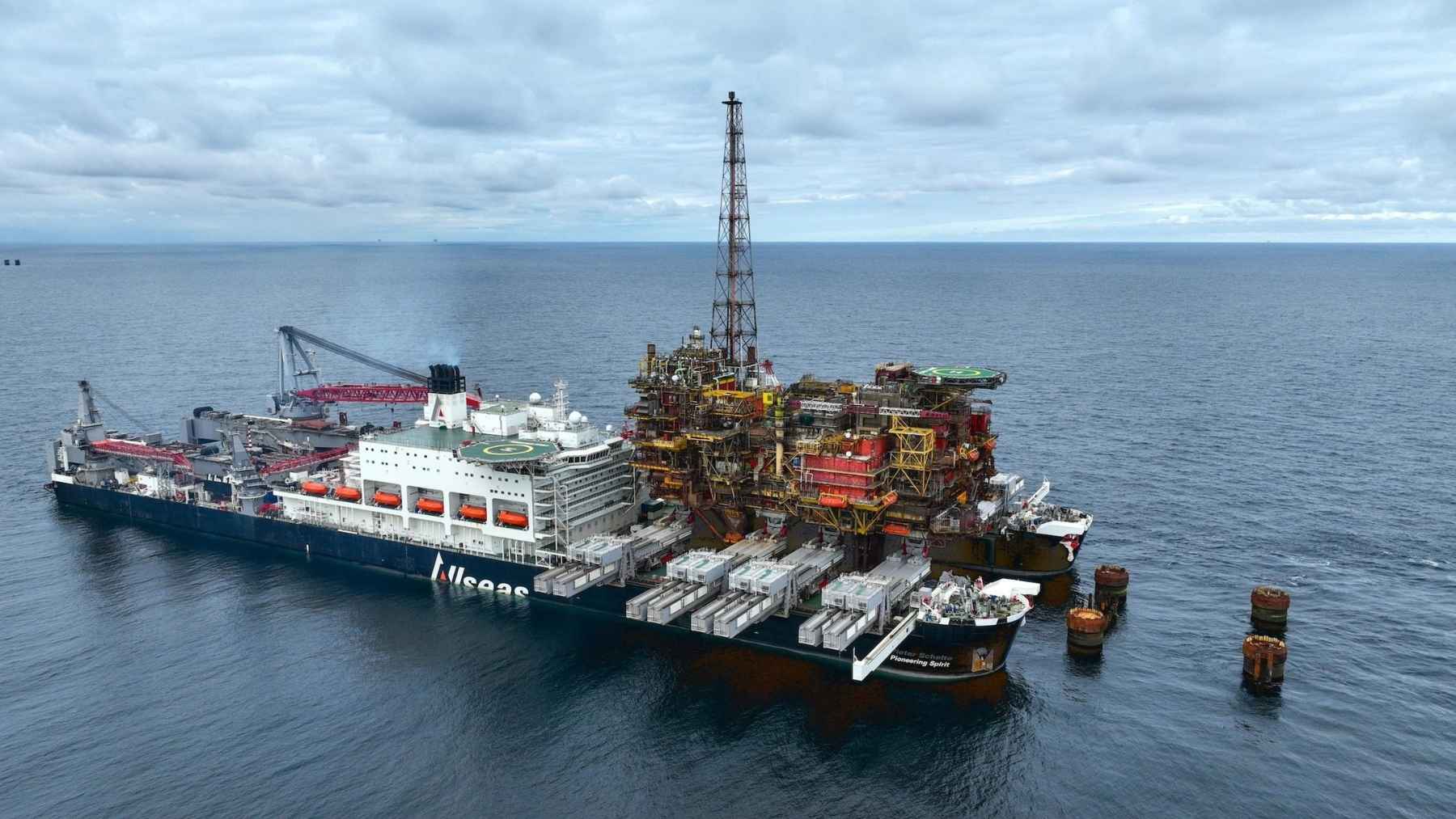
The vessel that actually holds the record does none of that. It spends its working life creeping up to oil platforms in the North Sea, sliding a set of steel arms under the part that sticks out of the water, and lifting the entire structure off its legs in one piece.
It is called Pioneering Spirit, it belongs to the Swiss offshore contractor Allseas, and by displacement it is the heaviest object ever set afloat.
The heaviest thing it has lifted so far weighed 31,000 tonnes and came off its foundations in a matter of seconds. And right now, this summer, it is in the middle of an upgrade meant to let it pick up even bigger ones.
It isn’t the longest ship ever built. It’s the heaviest.
Size at this scale gets confusing fast, so it’s worth being precise about which record this thing actually holds. It is not the longest ship ever built.
That title still belongs to the Seawise Giant, the 458-metre supertanker scrapped back in 2010, and after that to the 488-metre Prelude floating gas plant. Pioneering Spirit is “only” 382 metres from bow to stern, which is still roughly four soccer fields laid end to end.
Where it stands alone is mass and bulk. At 403,342 gross tons it is the largest vessel ever built by gross tonnage, and at 124 metres across it is wider than most aircraft carriers.
The number that earns it the “heaviest” label is displacement, the actual weight of water a hull shoves aside when it floats. NOV, the company that built the ship’s ballast system, puts it at a world-record million tonnes of seawater at the vessel’s deepest draft, which makes it the heaviest object ever set afloat.
It was built in South Korea by Daewoo Shipbuilding & Marine Engineering, christened Pieter Schelte after the late father of Allseas founder Edward Heerema, and quietly renamed Pioneering Spirit in 2015 after the original name drew complaints.
NOV pegs the bill at around $2.9 billion. It entered service in 2016, and from above it looks like someone welded two supertankers together and left a giant notch in the bow.
The lift takes seconds. The planning takes years.
That notch in the bow is the whole trick. It is a U-shaped slot 122 metres long and 59 metres wide, and the ship reverses around a platform until the structure sits inside it.
Eight horizontal steel beams then slide across the gap and take position directly under the topsides, which is the part of a platform that holds the drilling gear, the processing modules and the crew quarters.
The strange part is what happens next, because the ship doesn’t crane the platform up. It ballasts down, taking on seawater until the beams are sitting just under the load, and then de-ballasts in a hurry, pumping that water back out so the whole hull rises and lifts the topsides off its legs as it goes.
Engineers cut the structure free from its supports at the right moment, and thousands of tonnes transfer from steel legs rooted in the seabed to the ship in one motion. When Allseas pulled the 15,300-tonne Heather Alpha topsides off its jacket in the UK North Sea in 2025, it clocked the actual lift at around 14 seconds, the payoff of roughly three years of planning.
A motion-compensation system soaks up the wave movement the whole time, because doing this in the open North Sea means wind and swell are constantly trying to slam a million-tonne ship into something it cannot afford to touch.
The biggest one it has pulled off so far was Shell’s Brent Charlie. In July 2024 Pioneering Spirit removed its 31,000-tonne topsides from the UK North Sea in a single lift, which Allseas and the trade press logged as the heaviest offshore lift ever performed.
For a sense of scale, the largest land-based crane on Earth, the one Britain used to lower a reactor into the Hinkley Point C nuclear plant, is rated to about 5,000 tonnes. Pioneering Spirit moved roughly six times that, floating, in one go.
The North Sea is full of platforms that have to come out.
None of this would matter much if there were nothing to lift. There is plenty.
The first generation of North Sea oil and gas platforms is reaching the end of its working life, and somebody has to take the structures out, which has turned decommissioning into one of the busiest corners of the offshore business.
The old way of doing it was to break a platform apart at sea, piece by piece, and barge the bits ashore over years of expensive, dangerous offshore work. Pioneering Spirit’s pitch is to skip most of that.
Take the whole topsides off in one lift, carry it to shore on the same hull, and let the cutting and recycling happen on dry land where it’s safer and cheaper. On Shell’s Brent field alone, the four platforms the ship cleared between 2017 and 2024 added up to close to 100,000 tonnes of topsides, and almost all of that steel ends up recycled.
The work hasn’t slowed down since. Allseas is partway through a multi-year contract with the operator TAQA to clear more than 120,000 tonnes of infrastructure from the UK North Sea as the company winds down seven aging platforms by 2027, starting with the Eider Alpha topsides that came off in October 2025.
The same capability turns out to be just as useful for offshore wind. The converter platforms that gather electricity from a wind farm and push it to shore are built like a soccer pitch and can weigh 30,000 tonnes, which lands squarely in this ship’s wheelhouse.
Belgium is sinking 22,000-tonne concrete boxes to build an entire artificial island for exactly this kind of power-collecting job, and the heavy steel substations that sit on top of zones like that are the sort of thing Pioneering Spirit gets hired to install in one campaign instead of several.
Now it’s being rebuilt to lift even more.
The record might not stand for long, because Allseas is in the middle of pushing the ceiling higher. The plan, first floated in 2019, is to take the ship’s rated single-lift capacity from 48,000 tonnes up to 60,000 by reinforcing the lifting beams.
According to Offshore Magazine, six of the sixteen beams had been upgraded and load-tested across 2024 and 2025, with the rest due to be finished this summer and full certification targeted for late 2026 into early 2027. Allseas’ own current spec sheet already lists the ship at 60,000 tonnes.
There are specific platforms behind all of it. Equinor has hired Allseas to remove the Statfjord A topsides, a 50,000-tonne structure in the Norwegian North Sea that was simply too heavy for the ship as originally built, with that job slated for the end of the decade.
And the Brent Charlie record already has a challenger on the books: Allseas has been contracted to take off the 33,150-tonne Brae Alpha topsides in the central UK North Sea, heavier than anything the ship has lifted in one piece so far, sometime between 2028 and 2032.
The ship isn’t waiting around for any of that, though. In July 2025 it pulled off its first lift outside northern Europe entirely, mating a topsides onto a 210,000-tonne concrete base on the Grand Banks off Newfoundland after a transatlantic crossing.
Its next big assignment is on the other side of the planet, where ExxonMobil has lined it up for the Gippsland Basin off southeast Australia, the largest offshore decommissioning project in the country’s history, removing up to 12 topsides and 11 jackets in one intensive campaign starting in late 2027.
Allseas has also ordered a new partner vessel, the Grand Tour, built to slot into Pioneering Spirit’s bow and hand off cargo, due in 2028.
For a machine built around brute force, the surprising part is how little of the job is brute force. The lift itself is over in seconds.
Everything else is months of modelling one specific platform and one specific patch of sea, so that when a million-tonne ship reverses up to a structure people worked on for thirty years, nothing goes wrong in the few seconds that actually matter.
The North Sea has a long line of platforms waiting their turn, several of them bigger than anything yet attempted, and for now there is exactly one ship that can take them off whole.