
Most people have a leak they keep meaning to deal with. A faucet that drips, a gutter that spills over in heavy rain, something that went on the list and stayed there. New York City has one too, except its version sits roughly 600 feet under the Hudson River and has been running since 1990.
The Delaware Aqueduct carries about half of New York City’s drinking water 85 miles from the Catskills down to a reservoir in Yonkers, using nothing but gravity. The city’s Department of Environmental Protection calls it the longest tunnel in the world. Somewhere beneath the Orange County town of Newburgh, it cracked.
The repair exists. It has existed for years. A 2.5-mile bypass tunnel was bored under the river, lined with steel and concrete, and finished. It has never been connected to anything.
On Thursday evening, two DEP officials sat down in a small office in Narrowsburg, New York, and by Zoom, to give the Upper Delaware Council an update on where that stands. The council had to ask for the meeting.
The leak turned up at a power plant, not in the tunnel
Nobody found this thing by inspecting the aqueduct. In late 1990, water started showing up at the Roseton generating station near Newburgh, and it turned out to be coming from underneath. A second leak was identified in 1992 in the Ulster County town of Wawarsing.
Both trace back to the same problem: the tunnel was driven through faulted limestone in the 1930s and 1940s, and the rock did not cooperate. Water has been pushing out through the cracks ever since.
The headline figure DEP uses is 35 million gallons a day. That number appears in essentially every city press release on the subject, and it is the top of a range rather than a typical Tuesday. A 2022 DEP technical briefing to a Delaware River Basin Commission committee put everyday leakage closer to 20 million gallons, with roughly 95 percent of it escaping on the Newburgh side. Parsons, the firm running construction management on the repair, describes it on its own project page as a 15 to 30 million gallon per day leak.
Pick whichever end you like. At 20 million gallons a day you are losing about 7.3 billion gallons a year into upstate bedrock. At 35 you are closer to 12.8 billion. Neither is a rounding error on a system that delivers roughly a billion gallons a day.
The bypass was finished five years ago
New York announced the fix in 2010 and started building in 2013. The approach was to go around the bad section entirely rather than try to patch a pressurized tunnel that has not been drained since 1957.
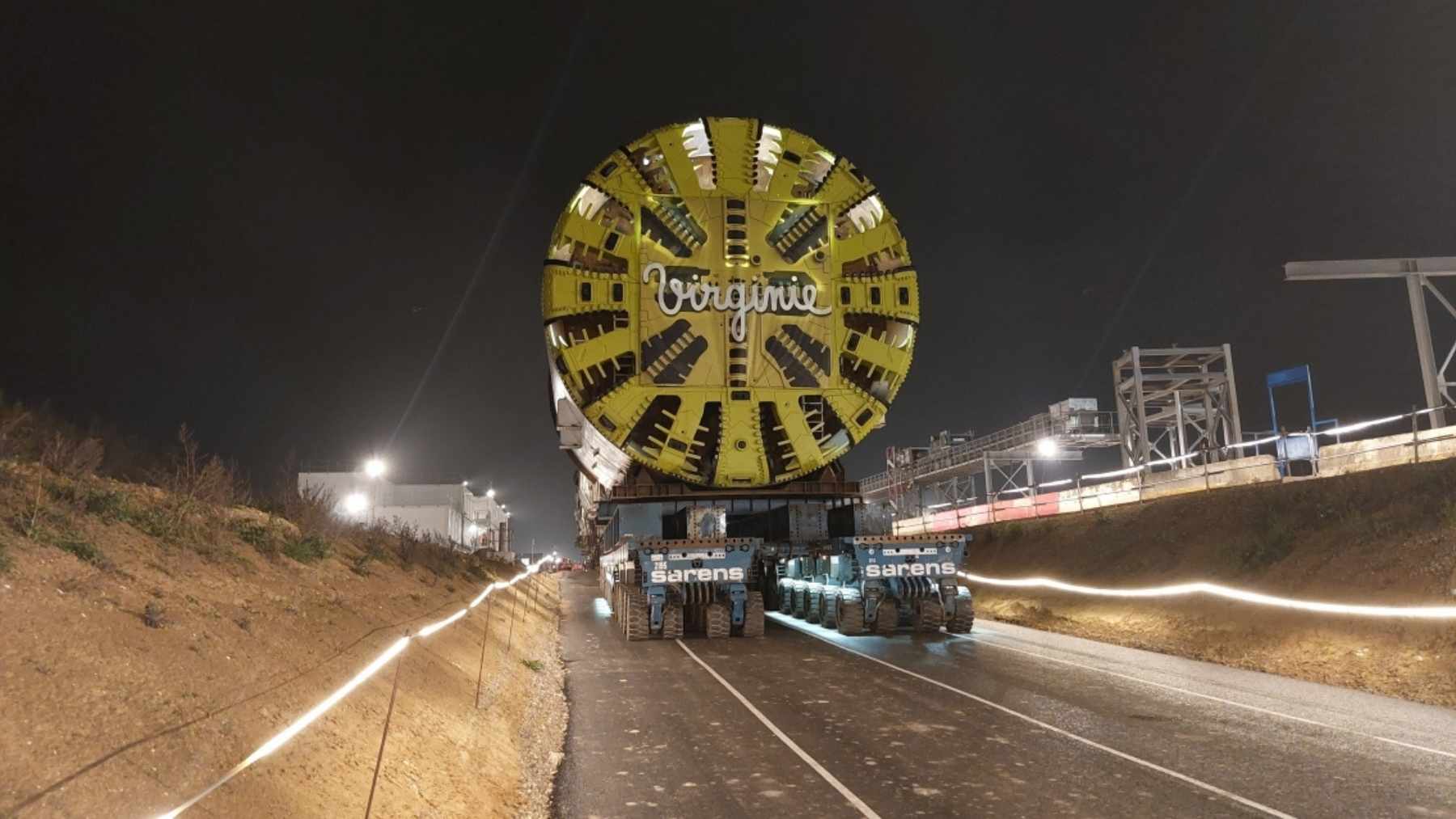
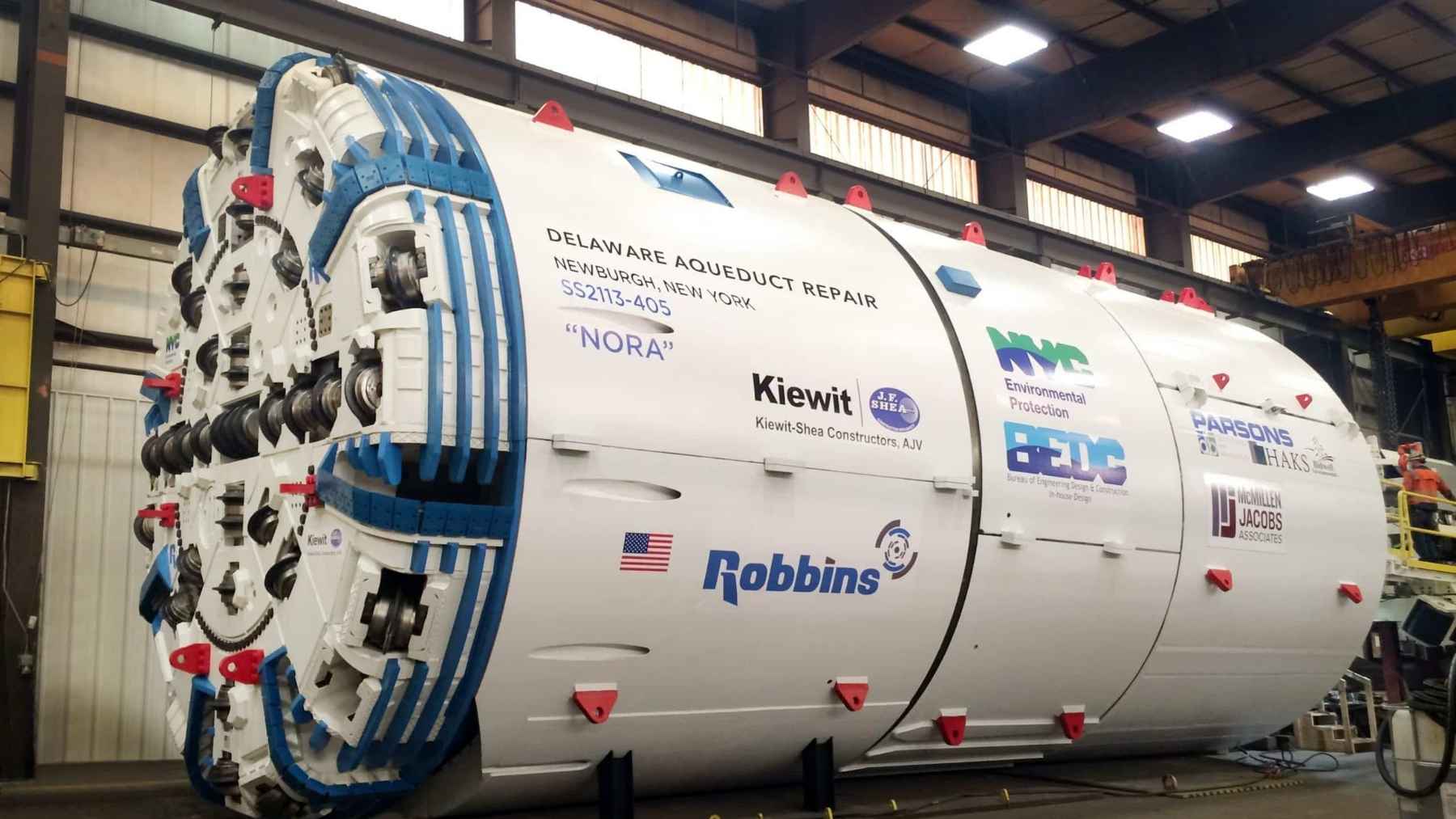
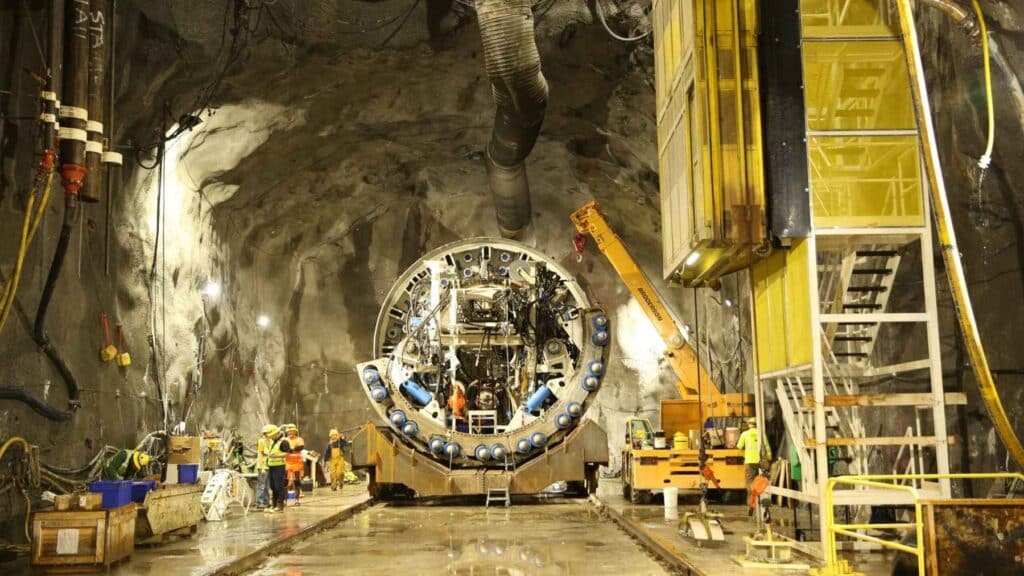
Crews sank two shafts into rock, one 900 feet deep and the other 760. A hard-rock boring machine named Nora, built by Robbins and rated to hold back 30 bars of water pressure, launched in January 2018 and mined 12,448 feet in 582 days, coming out under the town of Wappinger in August 2019. Her best single day was 89.8 feet.
Then came the lining, which is the part that explains the price. Inside the concrete rings the machine laid as it went, the crews installed a one-inch-thick steel pipe 16 feet across, then sandwiched it between two more layers of reinforced concrete. That ten-step process finished in November 2021.
Access chambers and a siphon system at the Rondout Reservoir were done by December 2022. Since then the bypass has been complete, dry, and attached to nothing. It is the first tunnel built under the Hudson since the south tube of the Lincoln Tunnel in 1957, and it has never carried a drop of water.
If you want the modern version of what that kind of work costs and how long it takes, the four boring machines assigned to New York’s $16 billion Hudson rail tunnel are grinding through the same river, and their crews are freezing the ground to get through the Manhattan side.
Draining the tunnel is the part nobody can schedule
Connecting the bypass means taking the aqueduct out of service, emptying it, cutting into it from both sides of the river, and plugging the leaking stretch for good. That requires an eight-month shutdown, and it has to start in October, because winter is when the city drinks the least.
For eight months, half of New York’s supply comes from somewhere else. Which is why the city spent years rehabilitating the Catskill Aqueduct and building the pumping and drainage capacity to keep a work zone dry 700 feet down.
That last part turned out to be harder than expected. A dewatering exercise in spring 2023 measured groundwater pushing into the tunnel faster than the models predicted, which forced DEP to add two more vertical turbine pumps rated at 15 million gallons a day each and swap four drainage pipes for wider ones.
The shutdown finally started on October 1, 2024. It lasted six weeks. In November, with the watershed in a historic drought, then-Mayor Eric Adams raised the city to a drought warning and DEP put the water back in the tunnel.
Reopening it killed the contract. The construction agreement covering the connection ended with the pause, and the work now has to be rebid from scratch.
The drought is over. The date still isn’t.
On May 5, 2025, DEP announced a new procurement and said the connection would not be finished until after 2027. That statement is now 15 months old and it is still the department’s most recent public word on the schedule. The Delaware River Basin Commission’s project tracking page was last updated the same day.
The drought argument, meanwhile, has expired. On March 26, 2026, New York State’s Department of Environmental Conservation returned every upstate drought region to normal status and reported city reservoirs above 95 percent of capacity. The only part of New York currently under a drought warning is Long Island, which does not touch this system.
There is also new management. Mayor Zohran Mamdani appointed Lisa Garcia as DEP commissioner in January 2026, replacing Rohit T. Aggarwala, who signed the May 2025 delay.
When Garcia went before the City Council’s environmental committee on March 19 to walk through DEP’s roughly $34 billion ten-year capital plan, she itemized the watershed spending: $1.1 billion for a new tunnel to give the Kensico Reservoir redundancy, $1 billion for Ashokan, $351 million for Hillview, $25 million for the Gilboa Dam. The Delaware Aqueduct connection did not come up in her written testimony.
That is not the same as the project being shelved. It is the same as it not having a date.
Everyone else is planning around the crack
The rest of the basin has stopped waiting. Thursday’s presentation in Narrowsburg covered two items, and the second one was the Delaware River Basin Commission’s study of where to put more water.
Phase one screened roughly 2,500 possible sites and cut them to 14 for closer study: twelve quarries and two reservoirs. One of the two is Cannonsville, the newest and largest reservoir in the Delaware system, which the commission is looking at expanding by raising its spillway. That idea was first floated in the 1980s and has been dusted off with Mott MacDonald hired to run the feasibility work.
So while the region studies how to store an extra few billion gallons, several billion a year keep going into the ground under Newburgh through a crack everyone has known about since Nirvana released Nevermind.
The engineering is not the holdup here. The hole is dug, the steel is in, the pumps are sized, and a contractor already worked out how to cut the outage from sixteen months to six. What is missing is a signed contract and an October that everyone agrees is safe. Both of those have been missing for two years now, and the tunnel does not care either way. It just keeps leaking, the way it has since the Reagan administration was packing up.