
Nuclear power plants are designed around a long, grim list of things that could go wrong. Earthquakes, floods, aircraft, fires, the grid itself failing. Entire careers are spent gaming out scenarios most of us would rather not think about.
Jellyfish made the list too, as it turns out. They just beat it anyway.
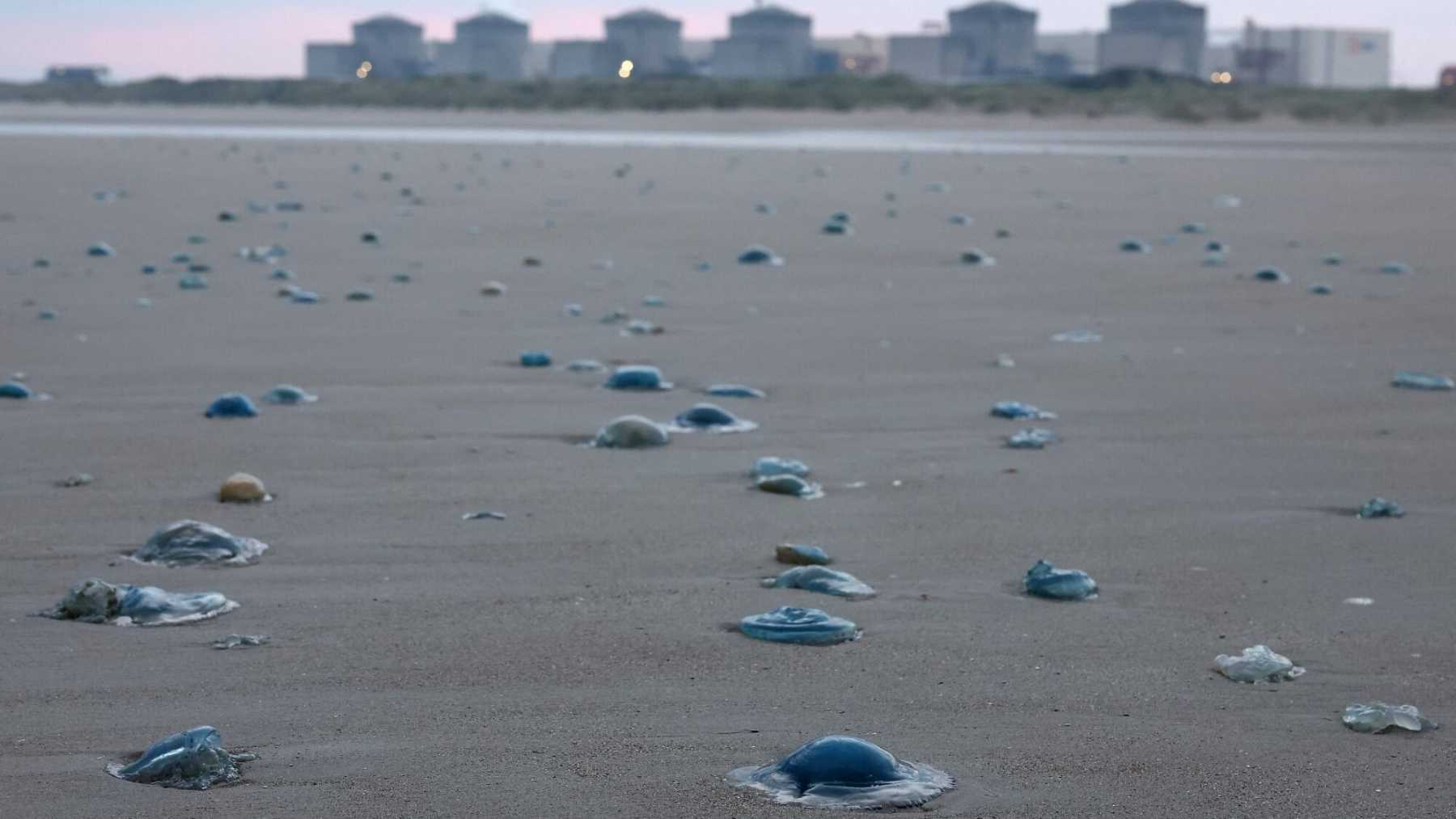
On the night of August 10, a swarm that French utility EDF later described as “several dozen tons” of jellyfish poured toward the seawater intakes at Gravelines, the largest nuclear plant in Western Europe, and clogged the filter drums that keep debris out of the cooling water. Three of the site’s six 900-megawatt reactors shut themselves down in the space of about two and a half hours. A fourth dropped to roughly half power so the pumps could keep breathing.
If this sounds familiar, it should. The same plant lost reactors to a jellyfish swarm on the same August night last year. EDF spent the months in between building a defense system for precisely this, with cameras, thermal imaging and fishing boats on constant patrol.
The jellyfish went through all of it anyway.
Three reactors down in about two and a half hours
Here’s how fast it went, according to grid transparency data tracked by Argus Media. Units 3 and 4 tripped offline just before 8pm local time on Monday, August 10. Unit 1 began winding down to 430 megawatts, about half its output, from 9pm. Unit 2 followed at 10:30pm with a full shutdown.
By Tuesday afternoon, EDF had also throttled unit 6, briefly the only reactor still running flat out, down to 500 megawatts. Unit 5 never entered the fight; it’s partway through its scheduled 10-year inspection and isn’t due back until December. At the low point, the clog had sidelined roughly two-thirds of a 5,400-megawatt site. Bloomberg put the knocked-out capacity at 3.2 gigawatts.
The shutdowns themselves were automatic, which is the system working as designed. When the rotating filter drums that screen incoming seawater get overwhelmed, the reactors trip rather than gamble on their cooling supply. EDF said the episode had “no impact on the safety of the facilities, the safety of personnel, or the environment,” and nobody has suggested otherwise.
The pumps in question sit in stations drawing from a canal fed by the North Sea, and that water carries away the plant’s waste heat. It’s an arrangement shared by coastal reactors all over the world. It works beautifully right up until the ocean sends something the filters can’t handle.
EDF literally pays fishermen to prevent this exact scenario
That’s the genuinely painful part of the story. After the 2025 swarm, EDF didn’t shrug. The company spent hundreds of thousands of euros on cameras and monitoring, per Politico, and put three fishing vessels on round-the-clock patrol off the plant’s coastline to intercept jellyfish before they reach the intakes.
Then in late June, about six weeks before the anniversary, EDF formalized the whole operation: a three-year, 1.5 million euro (about $1.6 million) jellyfish-surveillance partnership with a sustainable fishing association, plus support from France’s volunteer sea rescue service, according to trade outlet energynews.
The boats actually worked for a while. EDF says the patrols held off a major influx over the preceding weekend. Then the swarm simply outgrew them. Meduseo, a crowd-sourced jellyfish tracking service that is a real thing that exists, showed density at the beach next to the plant jumping from 0 to 75 on Monday.
Once the drums clogged, local fishermen hauled more than 26 tonnes of jellyfish out of the intake channels, per Nuclear Engineering International. The species doing most of the damage is Rhizostoma octopus, the barrel jellyfish, a blob between 4 and 16 inches across. Individually, it’s harmless. By the ton, it outperforms a billion-dollar contingency plan.
Same plant, same night, one year apart
The 2025 version of this story was worse. On the night of August 10 last year, jellyfish jammed the same filter drums and four reactors shut down automatically. The other two were already offline for summer maintenance, so the swarm took Western Europe’s largest nuclear plant to zero output. Getting every unit reconnected took about 10 days.
Politico ran this year’s coverage with the detail that stings: same plant, same date, two years in a row. If you operate Gravelines, August 10 is now a date you circle on the calendar the way coastal Floridians circle hurricane season.
And Gravelines isn’t even alone. A swarm shut Sweden’s Oskarshamn plant for three days in 2013, and a 1999 incident in Japan caused a major drop in output. France’s own Paluel plant, on the Channel coast in Normandy, lost 2,400 megawatts of capacity to jellyfish in September 2025. Wherever a reactor drinks seawater, the ocean occasionally sends the bill.
This is a different problem from the hot rivers
France has already spent this summer switching reactors off for environmental reasons. Back in July, EDF idled 3.65 gigawatts because the rivers next to three inland plants were legally too warm to absorb their cooling discharge. The machines were fine then, too.
But that was a thermodynamics problem wrapped in a regulation. This is not that. The filter drums at Gravelines don’t care what temperature the water clogging them is. What jammed the plant was biomass, in bulk, pressed against a screen.
Where the two stories reconnect is upstream of the pumps. The global sea surface averaged 20.96 degrees Celsius this past July, the warmest July reading on record, per Copernicus data cited by Argus. Warmer water widens the jellyfish breeding window, and the scientists quoted across this week’s coverage also point at overfishing, which removes predators and competitors, plus invasive species hitching rides into the North Sea.
So no, the heat didn’t clog the pumps. It just grew the thing that did.
Two of the three reactors are still waiting
The comeback has been slower than the collapse. Units 1 and 6 were back at full power by Wednesday morning, and unit 2 reconnected to the grid on Thursday, August 13. Unit 1 then tripped again for two days over a feedwater valve issue on one of its steam generators, which had nothing to do with jellyfish and everything to do with this not being Gravelines’ month.
Units 3 and 4, the first two to go down, were still offline as this was written. Unit 3’s posted return date of August 16 came and went. Unit 4 is currently slated for August 19, and EDF is keeping reinforced monitoring on the filter drums and the intake canal in the meantime.
Zoom out and the week looks rough for the entire French fleet. EDF’s environmental unavailability rate hit 20.4%, a record, with eight reactors fully stopped at once, the Gravelines trio among them and most of the rest sidelined by heat and drought limits, per energynews. A fifth heatwave of the summer was building at the same time. The grid held, France stayed a net exporter of electricity, and nobody’s lights went out.
Still, the scoreboard is clarifying. EDF can engineer around earthquakes, and it can work around river temperature rules when the state signs off. Against several dozen tons of drifting protein, the best available defense is currently three fishing boats and a jellyfish weather app. To be fair, not every encounter between a nuclear plant and the local wildlife ends this way; the crocodiles thriving in Turkey Point’s cooling canals can attest to that. At Gravelines, though, the wildlife is winning on points, two years running.
Image credit: AFP