
Floating wind has mostly solved balance with bulk. If a turbine cannot stand on the seabed, the standard fix is to hang it on a hull so massive the ocean cannot shove it over, which is how you get machines like the 15,000-tonne concrete twin-header China keeps moored off Guangdong.
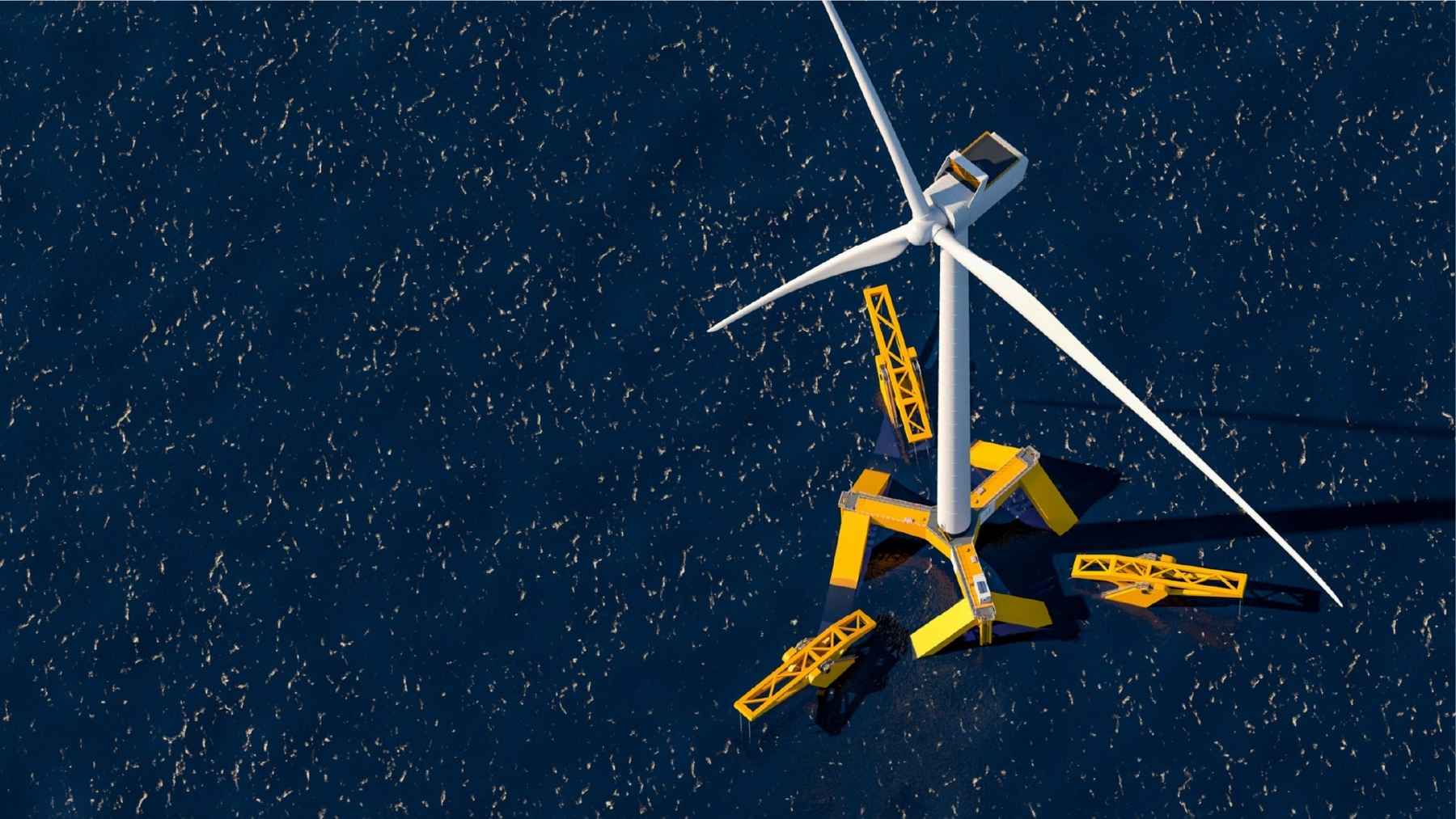
A startup run out of the Portuguese port city of Viana do Castelo is betting that most of that mass is wasted. Gazelle Wind Power keeps its platform level with a central counterweight slung between three anchored arms, working roughly the way a tightrope walker’s pole does. The structure gets lighter, the mooring gets shorter, and the finished platform can leave a shallow port without a heavy-lift crane in sight. At least, that is the company’s math.
That math now has consequences attached. Gazelle holds a 10-year permit for a patch of Atlantic off Aguçadoura, about €18.8 million in declared project funding, and a signed steel fabricator. The demonstrator is called Nau Azul, it carries a 2-megawatt turbine, and the schedule announced when the company opened its Portuguese headquarters points at water by spring 2027.
A counterweight does the work of the ballast
Most floating wind platforms stay upright through some mix of submerged weight, pumped water ballast and long runs of catenary mooring chain. Gazelle’s design goes the other way. The hull is allowed to shift sideways and ride up and down as waves pass, while the counterweight hung between its three seabed-anchored arms moves to cancel the tilt.
The numbers the company publishes for this are specific. Platform pitch stays under 5 degrees, where most offshore turbines are engineered to tolerate up to 10. Mooring loads come in at half those of a typical tension-leg platform. The design needs 80 percent less mooring line than a catenary-moored semisubmersible, and at around 100 meters (330 feet) of water depth, its seabed footprint is less than a fifth of a catenary system’s.
Those figures come from Gazelle’s own technology documentation, which attributes them to a Statement of Feasibility granted by DNV, the Norwegian classification society that certifies offshore energy hardware. DNV business development director Claudio Bittencourt Ferreira called the mooring “a completely new concept” in his assessment. Every floating wind startup claims to combine the best of tension-leg platforms and semisubs. This one at least has a classification society’s paperwork stapled to the claim.
Less steel is the whole business plan
Cutting motion is not really the end goal here. Cutting steel is. A platform that balances itself does not need the mass of one that absorbs everything the Atlantic throws at it, so the components shrink to sizes ordinary ports and shipyards can handle. Jon Salazar, Gazelle’s founder and CEO, has said “the Gazelle platform possesses a naturally low draft,” which is the property that lets it be assembled and towed out from harbors that deeper-hulled floaters cannot use.
The fabrication side is no longer theoretical. In July 2025, Portuguese conglomerate dstgroup put €1.5 million into Gazelle through its venture arm, and its steel subsidiary bysteel, based in Braga, signed on to fabricate and build the platform’s modular structures. The same announcement noted the design has been structurally sized for Portugal’s rough offshore conditions and engineered to scale to turbines of 15 megawatts and larger, in an industry it expects to grow from 8 gigawatts of installed offshore capacity in 2024 to 50 gigawatts by 2033.
Steel logistics are quietly shaping wind economics everywhere, and everyone is attacking the problem from a different angle. It is the same constraint that has a Swedish company building turbine towers out of laminated spruce. Gazelle’s version of the answer is not a new material. It is needing less of the old one.
The permit, the survey and the €18.8 million
The legal piece landed on April 10, 2025, when Portugal’s Directorate-General for Natural Resources, Safety and Maritime Services granted Gazelle a 10-year TUPEM authorization, giving the company exclusive rights to install, operate and test the platform in a designated slice of national maritime space. A geophysical survey of the site followed in May 2025.
The money arrived in stages. An €11.4 million round in November 2024 was led by Lisbon-based Indico Capital Partners, with dstgroup, August One, Hong Kong shipowner Wah Kwong and Spain’s E2IN2 also aboard. Banco Português de Fomento, the state development bank, added €2 million in May 2025, which the company says takes total funding raised for the project to €18.8 million.
Local government is counting on more than the demonstrator. When Gazelle opened its national headquarters in the port of Viana do Castelo, the city council put the company’s overall planned investment in Portugal at around €40 million and its local hiring at 30 or more people, according to Jornal de Negócios.
Aguçadoura keeps collecting strange machines
The site is not an accident. This stretch of coast off Póvoa de Varzim hosted WindFloat 1, among Europe’s first floating wind pilots, a concept that later grew into the 25-megawatt WindFloat Atlantic, the first project of its kind in Portugal. The Swedish wave-power buoy that rode out 61-foot storm seas while feeding the Portuguese grid works these same waters.
Its maker, CorPower Ocean, even appears on Nau Azul’s official partner list, alongside Vestas, DNV and mooring specialist Lankhorst. If you want to test a weird ocean machine in Europe, apparently this is the beach.
Spring 2027 is the deadline the company set for itself
The published timeline has been consistent since the Viana do Castelo announcement: project work starting in 2025, platform construction in 2026, and the machine in the water by spring 2027. That last date now sits less than a year out.
The scale-up bet is already being placed. In mid-October 2025, Gazelle signed a memorandum of understanding with Titan Wind Energy, a Chinese wind-component manufacturer with offices in Denmark and Germany, during a visit to Titan’s Nantong plant in Jiangsu, as reported by offshoreWIND.biz. The agreement covers adapting the platform to Titan’s manufacturing standards, and Salazar called it “a strong endorsement of Gazelle’s technology.”
What nobody has published yet is a photo of steel being cut. Gazelle’s own news feed has been quiet since the bysteel deal, and the Titan agreement surfaced through the trade press rather than a company release. So the honest status is this: permit granted, site surveyed, money raised, fabricator signed, nothing visibly in the water.
A 2-megawatt demonstrator was never going to move an electricity market, and it is not supposed to. It exists to convince the people who finance 15-megawatt machines that balance is cheaper than bulk. The permit runs ten years. The schedule gives the counterweight until next spring to get wet.
 @johnnicholas ROOKIE2 months ago